
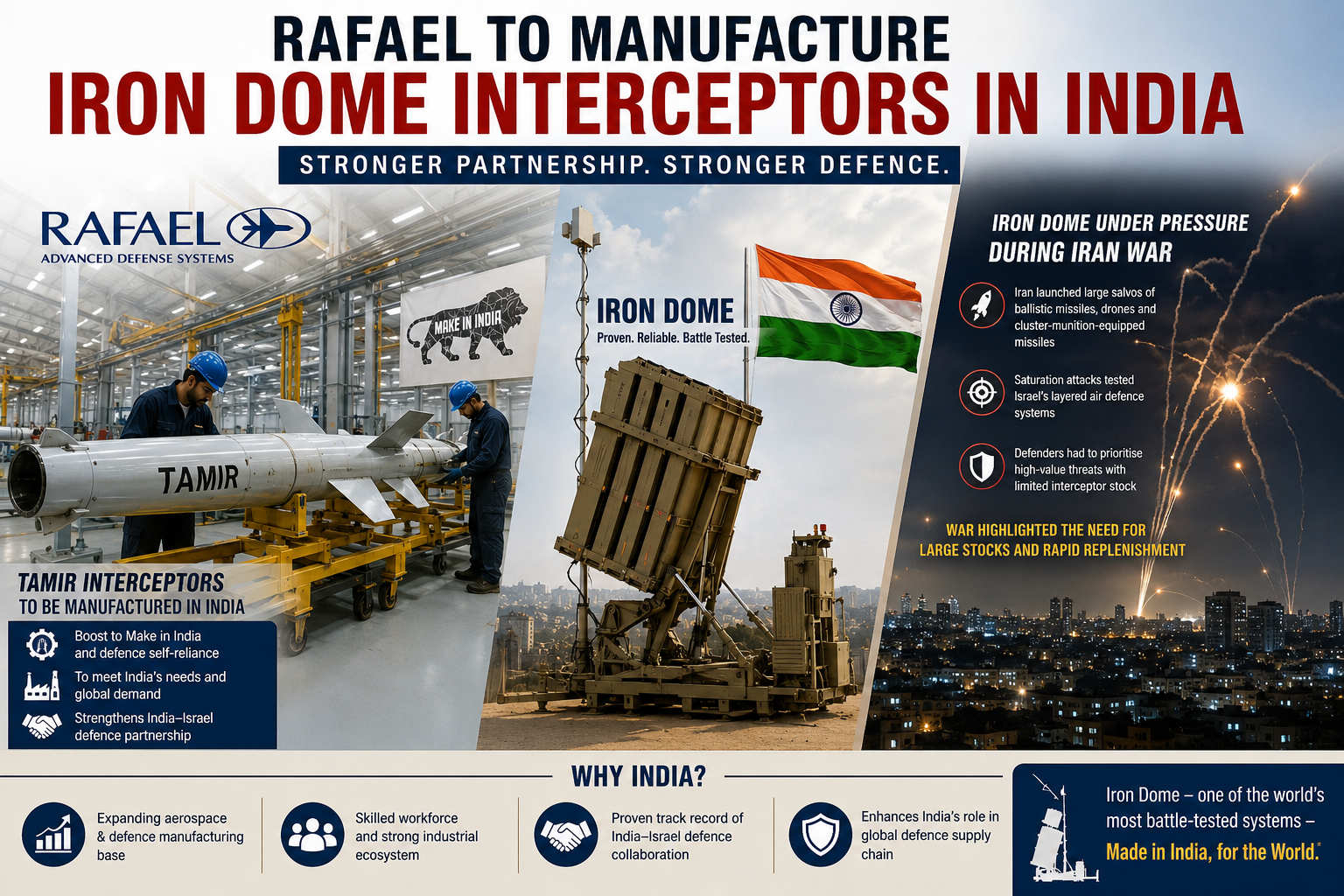
Israeli defence major Rafael Advanced Defense Systems is reportedly in discussions with Indian defence companies to establish production of Iron Dome’s interceptor missiles in India. The move would mark another significant milestone in the growing India-Israel defence partnership while reinforcing New Delhi’s ambitions to become a global defence manufacturing hub under the “Make in India” initiative.
The proposed production line is expected to cater not only to India’s future requirements but also to international demand for air defence interceptors. As geopolitical tensions continue to fuel a surge in demand for missile defence systems, manufacturing in India could provide Rafael with a cost-effective and scalable production base while strengthening India’s indigenous defence ecosystem.
The development comes after the recent Iran-Israel conflict demonstrated both the strengths and the limitations of modern air defence systems. While Iron Dome has earned a global reputation for intercepting thousands of short-range rockets with a high success rate, the conflict highlighted that no missile shield is impenetrable when faced with sustained, complex attacks involving ballistic missiles, drones and saturation tactics.
During the conflict, Iran launched large salvos of ballistic missiles, drones and, in some cases, cluster-munition-equipped missiles that complicated Israel’s interception efforts. Military analysts noted that Israel’s layered air defence architecture—which includes Iron Dome, David’s Sling and the Arrow system—came under significant operational pressure as defenders had to carefully prioritise high-value threats while managing finite interceptor inventories.
The war reinforced a critical lesson for militaries worldwide: air defence effectiveness depends not only on advanced technology but also on maintaining large stocks of interceptors and the industrial capacity to replenish them rapidly. This has prompted Rafael to explore expanding manufacturing beyond Israel, with India emerging as an attractive partner because of its expanding aerospace manufacturing base, skilled workforce and established defence collaboration with Israel.
For India, hosting production of Iron Dome interceptors would complement ongoing efforts to strengthen domestic missile manufacturing capabilities while providing valuable experience in sophisticated interceptor technologies. Although India is simultaneously pursuing indigenous programmes such as Project Kusha and Mission Sudarshan Chakra, collaboration with Rafael could accelerate technology absorption and enhance the country’s role in the global defence supply chain. As demand for air defence systems continues to rise across Europe, the Middle East and Asia, India could emerge as a key manufacturing centre for one of the world’s most battle-tested interceptor systems.

