
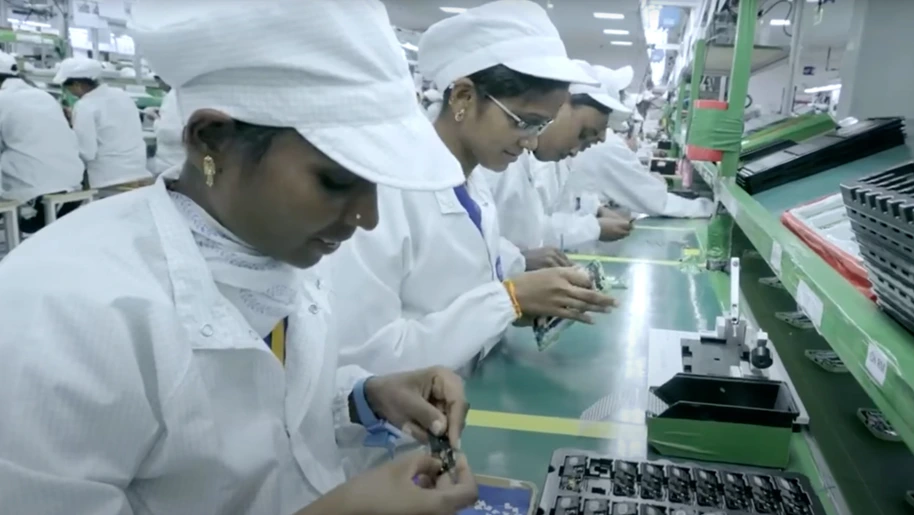
Apple’s iPhone business in this country is becoming a strong example of how assembly can gradually turn into a big export story. The basic idea is simple: many parts still come from outside, so there is an import bill, but once those parts are assembled here and the finished phones are shipped abroad, the export value begins to outweigh the import cost.
Recent data shows that iPhone exports from India have grown sharply, and one report says Apple’s Indian vendors exported iPhones worth about $21.5 billion in FY26, while the import bill for components and other inputs was around $22.3 billion, with total iPhone production valued at about $26 billion. That means the gap is narrowing fast, and the business is moving close to becoming forex-positive.
This matters because many people think manufacturing only counts when every part is made locally, but that is not how global supply chains work today. In smartphone production, assembly itself is part of manufacturing because value is added when imported parts are brought together, tested, packaged, and sent to customers.
In the iPhone case, the finished product carries much more value than the individual parts alone, especially once export demand rises. Official and industry-linked reports show that iPhone exports from India have expanded strongly in recent years, with Apple’s shipments from India reaching about $17.5 billion in FY25 and around $23 billion in calendar year 2025.
The forex-positive idea is important for the economy because it means more foreign currency is coming in than going out for that product line. When imported components are used only for the domestic market, foreign exchange is spent but not fully recovered through exports.
But when the same product is exported in large volumes, the foreign currency earned from sales can cover the import cost and still leave a surplus. This is why the iPhone story is being watched so closely by policymakers and business analysts. It shows how a country can move from simple assembly to a more valuable export-linked manufacturing model.
There is also a wider effect beyond one company. Smartphone exports from this country crossed about $30.1 billion in 2025, and iPhones were responsible for a very large share of that growth.
Another report tells that mobile phone exports crossed Rs 2 lakh crore in FY25, with iPhone shipments contributing about Rs 1.5 lakh crore. This means the Apple-led export push is not just helping one brand; it is helping lift an entire electronics export category, which is a strong sign for industrial growth.
Still, it is important to keep the picture balanced. This is not yet full self-reliance in the strict sense, because many critical parts are still imported and the supply chain remains global. The real gain is that local assembly has reached a scale where exports are large enough to reduce the net foreign exchange burden.
That is why the phrase forex-positive is becoming more relevant now. If local value addition keeps rising, the gap between import cost and export earnings can keep improving, and the country can capture even more of the value chain.
For viewers and readers, the simplest way to understand this is to imagine a phone built like a packet of imported ingredients turned into a finished meal here. The ingredients may come from elsewhere, but the final product gets a higher market value once it is assembled, packed, and sold globally.
That is exactly what is happening with iPhones made in India. The story is no longer only about assembling phones; it is about how assembly, exports, and foreign exchange are coming together to create a stronger trade position.

