
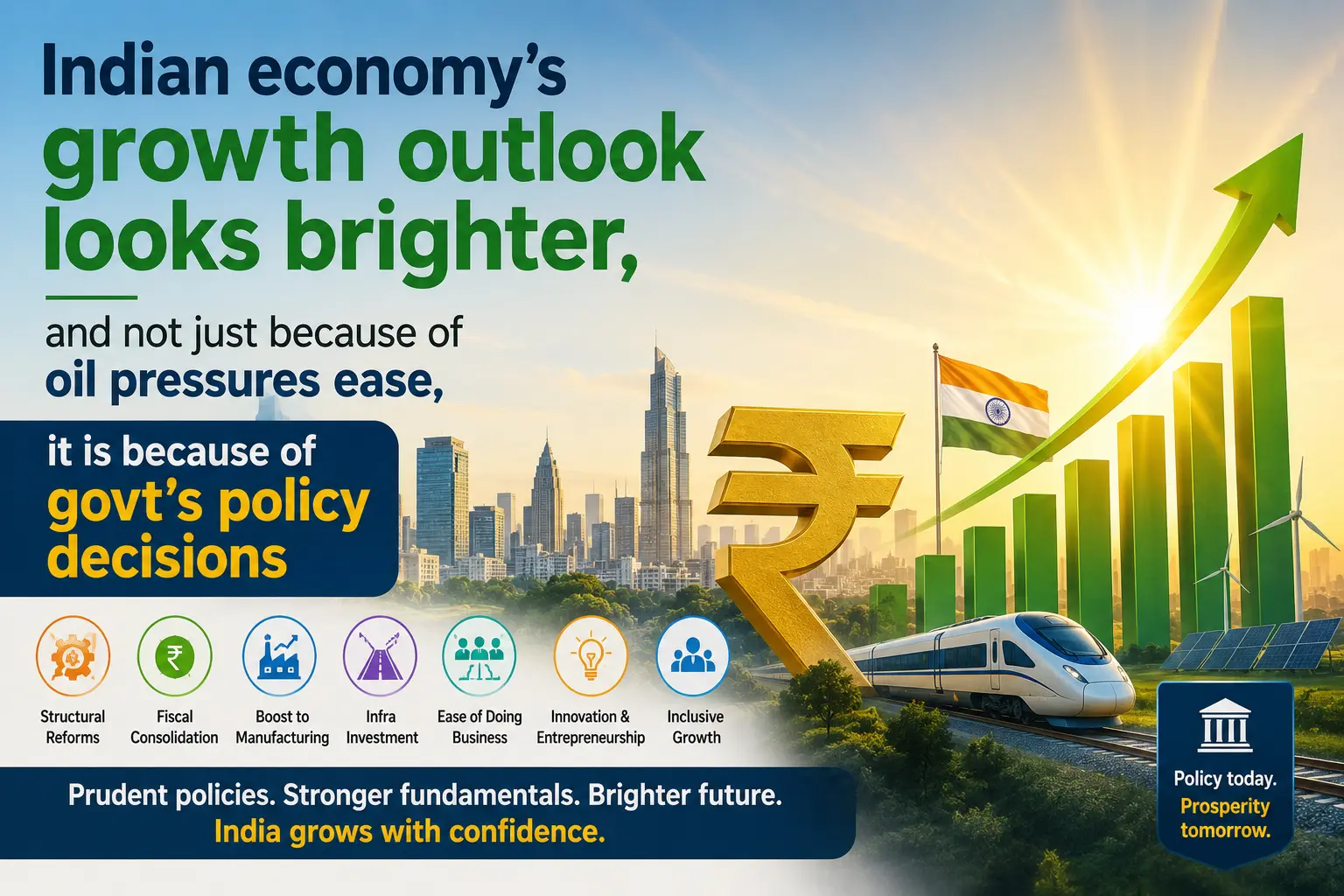
Goldman Sachs and Ernst & Young (EY) have revised their forecasts about Indian Economy upward, saying how lower crude prices and steady policy support are helping the economy stay resilient.
The latest revision in India’s growth forecasts by Goldman Sachs is not a sudden surprise, but a sign that the economy has been holding up better than many expected. Goldman Sachs has raised its calendar year 2026 GDP growth estimate to 6.8%, while also cutting its inflation forecast to 4.4% and its current account deficit estimate to 1.1% of GDP.
EY has also turned more positive, saying growth should remain strong unless global energy shocks become severe again.
The simplest way to understand this is through the price of oil. When crude becomes cheaper, many things become easier to manage at once, because fuel costs affect transport, manufacturing, farming, and even the price of daily essentials.
Goldman Sachs linked its revision to the sharp fall in oil prices after the US-Iran peace deal, noting that lower crude should reduce inflation pressure and improve the external balance. In plain terms, cheaper oil works like a relief valve for the whole economy.
This also explains why the rise in forecasts is being read as the result of policy choices, not just luck. Even when West Asia was tense, economic decisions were taken with the expectation that the disruption could last for months, so the response stayed cautious and practical.
That mattered because a stronger policy framework helps prevent a temporary global shock from turning into a larger domestic problem. Goldman Sachs said improving domestic conditions were part of the reason for its upgrade, and EY also pointed to the positive effect of easing geopolitical pressure.
The important point is that the economy did not wait passively for the situation outside to improve. Business confidence, domestic demand, and policy support seem to have kept activity moving even during a difficult phase.
This is why the new forecasts should be seen as confirmation of resilience rather than a fresh miracle. EY’s assessment also shows a wider view: If tensions stay low and crude remains controlled, growth can stay in a healthy range.
A good example can make this clearer. Suppose a family budget depends heavily on cooking gas, travel, and food prices; if fuel prices fall, the monthly bill becomes easier to handle, and some money remains for savings or spending elsewhere. The same logic works for a national economy. Lower oil prices can reduce import costs, ease inflation, and give households and firms more room to spend or invest.
There is also a larger strategic lesson here. Economies that prepare early for uncertainty usually suffer less when trouble arrives. That is why the current outlook reflects not only the easing of West Asia tensions, but also the effect of earlier decisions designed to keep growth steady and inflation under control. Goldman Sachs specifically lowered its inflation and current account deficit estimates along with the growth upgrade, showing that the improvement is broad, not narrow.
The overall message is simple: The economy has shown strength under pressure, and the latest forecasts are acknowledging that strength. Better oil prices, calmer external conditions, and policy steadiness have together created a more comfortable outlook. The revision by Goldman Sachs, along with the positive view from EY, suggests that the economic story is moving from caution to confidence, even if the outside world remains uncertain.

