
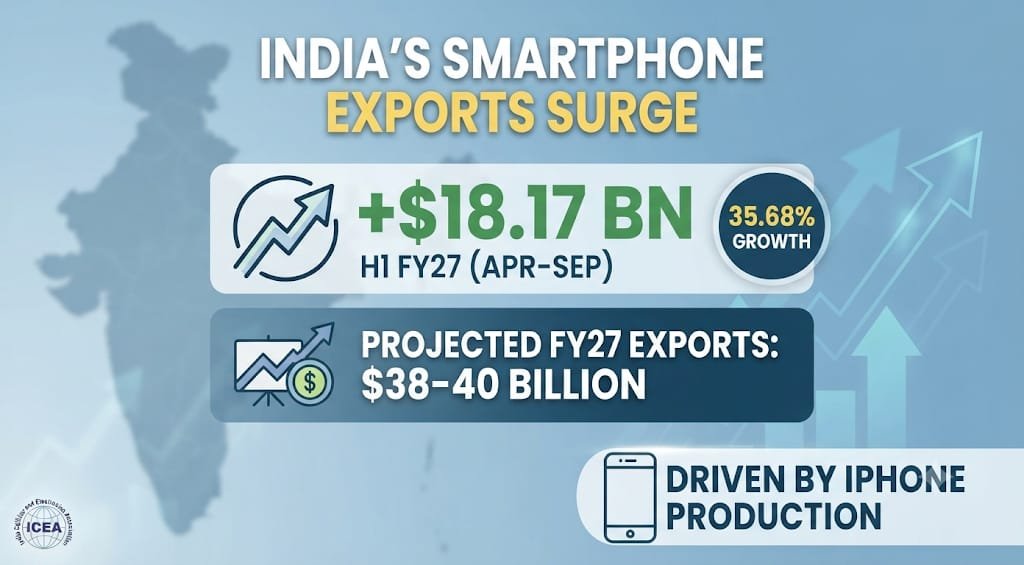
India’s smartphone exports have shown remarkable strength in the first six months of the current financial year, reaching $18.17 billion between April and September of FY27. This is a growth of 35.68 percent compared with the same period last year.
The performance is important because it has come at a time when smartphone prices are rising and global demand is facing pressure due to higher memory-chip costs. Despite these challenges, India’s mobile-phone factories have continued to supply large volumes of devices to overseas markets.
The India Cellular and Electronics Association, known as ICEA, expects smartphone exports to reach a record $38 billion to $40 billion by the end of FY27. This would mean an increase of up to 33 percent in export value compared with FY26, when India exported smartphones worth $30 billion. In simple terms, the country is not only making phones for its own people but is also becoming a major global supplier.
This growth strengthens India’s position in the worldwide electronics supply chain and supports the larger goal of building a strong domestic manufacturing base.
September alone recorded smartphone exports of about $2.20 billion, according to initial industry estimates. This was 30.90 percent higher than the $1.68 billion recorded in September last year. The strong monthly performance reflects the growing capacity of Indian factories, improved production systems, and the rising role of global companies that have shifted part of their manufacturing to India. The export growth also shows that Indian-made smartphones are gaining acceptance in international markets.
Apple’s iPhones are expected to play the biggest role in this export success. ICEA estimates that iPhones may account for 70 percent to 75 percent of India’s total smartphone exports in FY27. In value terms, this could be between $26.6 billion and $30 billion, compared with $19.5 billion in FY26.
The main reason is the increased production of premium iPhone models in India, including the iPhone 18 Pro and Pro Max. Apple built up inventory before the September launch of these models, which helped push exports sharply higher during the second quarter.
Smartphone exports grew by 53.5 percent to $8.31 billion in the second quarter of FY27. This strong quarterly rise was closely linked to Apple’s production plans and the demand for its latest premium phones. Premium smartphones usually carry higher prices, so even a limited increase in the number of units exported can create a large increase in export value. This is why iPhones have become such an important part of India’s smartphone-export story.
Smartphones are now the backbone of India’s electronics exports. ICEA believes that mobile phones will make up 57 percent to 58 percent of India’s total electronics exports by value in FY27. The association also expects overall electronics exports to reach $65 billion to $70 billion during the year. These numbers show that mobile-phone manufacturing is no longer a small part of India’s industrial growth; it has become one of the leading drivers of export earnings and employment.
ICEA chairman Pankaj Mohindroo said that the journey toward $500 billion in electronics manufacturing and $180 billion in electronics exports by 2030 is on track. Mobile-phone exports growing at more than 35 percent in the first half of the financial year support this confidence. The industry believes that India can continue expanding its manufacturing capacity, attract more investment, create jobs, and increase the value added within the country.
However, the domestic smartphone market presents a different picture. Rising handset prices have affected sales within India, while the global market has also slowed because of higher memory-chip costs. Data shows that domestic smartphone shipment volumes fell 26 percent year on year in the second quarter of FY27.
Retailers also reported that Diwali sales declined by more than 20 percent. This means that although exports are rising strongly, local buyers are becoming more careful about spending because phones have become costlier.
The contrast is clear: India is exporting more smartphones even as domestic sales face pressure. This happens because export production is often linked to global supply chains, overseas demand, and the manufacturing plans of large brands.
At the same time, higher component costs and rising phone prices can reduce demand among Indian consumers. The industry will therefore need to balance export growth with affordable options for the home market.
Overall, the first-half performance of $18.17 billion is a major achievement for India’s smartphone industry. If the projected $38 billion to $40 billion is achieved by the end of FY27, it will mark a new record and further establish India as an important global hub for smartphone manufacturing.
The continued rise of iPhone production, expanding factory capacity, and growing electronics exports indicate that India’s mobile-phone sector is moving firmly toward its long-term goals.

