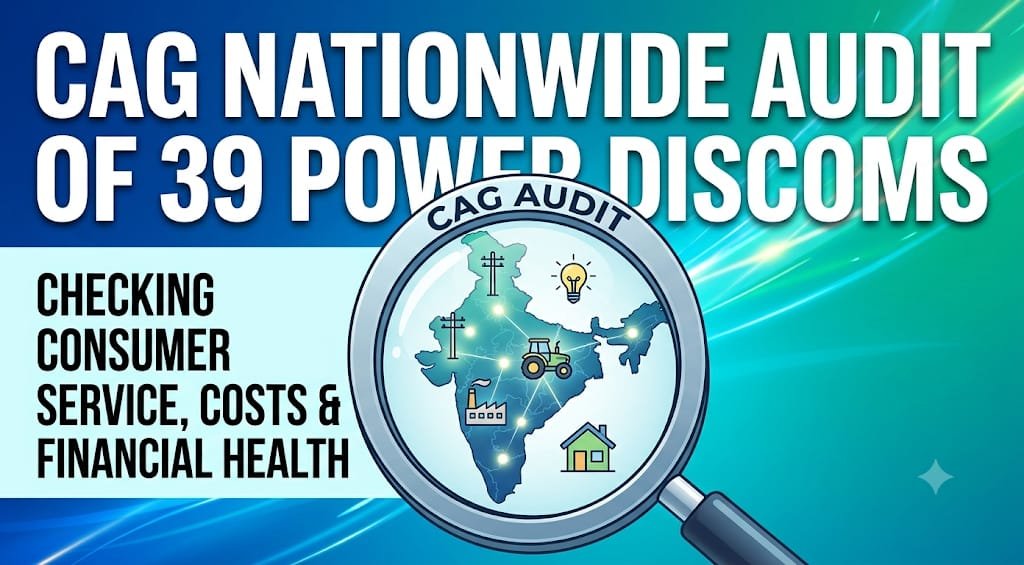
The Comptroller and Auditor General of India, or CAG, has started a major nationwide audit of 39 state-owned electricity distribution companies, commonly known as discoms. The audit is important because discoms are the companies that supply electricity to homes, shops, farms, factories and offices. Any problem in their working directly affects the quality of power supply, electricity bills, outages and the financial condition of state governments.
Unlike earlier audits, which generally examined one discom in one state during a particular year, this time the CAG has brought 39 state-owned discoms under one common audit. The exercise also covers five departmental undertakings where electricity distribution is still handled directly by government departments instead of separate companies. The audit began in some states in July and is expected to be completed by the middle of the next financial year.
The main purpose of the audit is to understand whether discoms are providing reliable, affordable and satisfactory electricity services to consumers. The CAG will look at consumer satisfaction across different groups, including domestic households, commercial users, industries and agricultural consumers. For this purpose, a consumer satisfaction survey may be conducted through the Ministry of Statistics and Programme Implementation or another survey agency. The survey is expected to cover around 10,000 consumers across the country.
The audit will also examine the usual performance indicators of power distribution companies. These include Aggregate Technical and Commercial losses, billing efficiency, collection efficiency and power supply performance. In simple words, the CAG will check how much electricity is lost during distribution, how accurately bills are raised, how much money is actually collected from consumers, and whether electricity reaches people without frequent interruptions
A major focus will be on the financial health of discoms. State-owned power distribution companies have been facing serious financial pressure for years. Their accumulated losses have reached Rs 6.77 lakh crore, while their borrowings stand at Rs 7.11 lakh crore. These figures show that many discoms are struggling with old losses, rising debt and heavy interest payments.
The CAG is also expected to examine how government support is being used. Officials have pointed out that revenue grants have increased more than four times compared with the rise in capital grants. This suggests that a growing part of government money may be going towards covering losses, debt and interest payments rather than towards new investment in power infrastructure. Such a situation can affect the ability of discoms to improve networks, reduce outages and provide better service.
Another important area of the audit is short-term power procurement. Discoms often buy electricity for immediate needs through power exchanges and other short-term arrangements. The share of such short-term purchases in the power purchase basket of states has increased from around 7 to 8 percent four or five years ago to around 14 percent. Power exchanges account for more than 56 percent of these short-term purchases.
The CAG wants to check whether discoms have a strong system to forecast electricity demand and whether they buy power at the right time and at a reasonable price. If a discom buys electricity in a hurry or at a high price, the extra cost can eventually reach consumers through higher tariffs or put more pressure on the company’s finances. Therefore, the audit will closely examine power trading practices and the timing of market purchases.
This audit is part of a larger plan by the CAG to conduct an integrated audit of India’s power sector. The power sector is expected to attract investments of about Rs 50 lakh crore by 2032 and Rs 200 lakh crore by 2047. Over the next four years, the integrated audit is expected to cover generation, transmission, distribution and renewable energy. Distribution has been taken up first because discoms are the direct link between the power sector and ordinary consumers.
The CAG’s State Commercial Audit division, which was set up last year to focus on state-owned public sector enterprises, is conducting the audit. The integrated approach brings together different audit wings and government departments to examine an entire sector rather than studying each department separately. This method can give a clearer picture of how different parts of the power system work together and may help identify problems that separate audits could miss.
For ordinary consumers, the audit could eventually lead to better answers on why power cuts happen, why bills are sometimes disputed, and why electricity costs rise. For states, it may highlight whether public money is being used effectively and whether discoms are moving towards financial stability. The final findings will be important because they can help policymakers improve power supply, reduce losses and make electricity distribution more transparent and consumer-friendly.

