
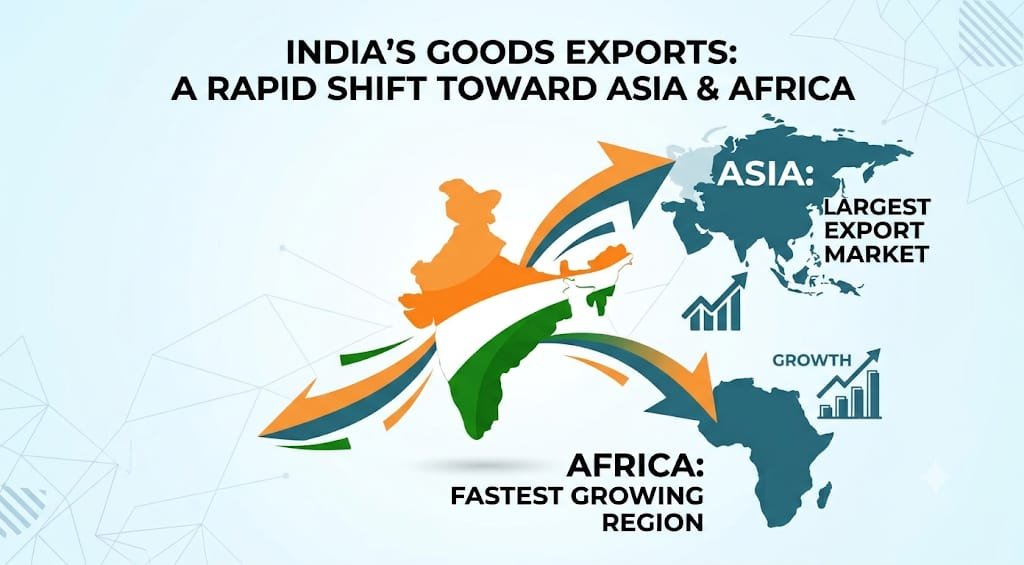
India’s goods exports are undergoing an important change. For many years, Europe and the Americas were seen as the main destinations for Indian products. That picture is now changing. Asia has become India’s largest export market, while Africa has emerged as the fastest-growing region.
This shift is not only about selling more goods abroad; it also reflects a wider change in the kind of products India is exporting and the countries it is reaching. According to Commerce Ministry data, India’s exports to Asia crossed $100 billion in the first half of 2026-27, while exports to Africa grew by 44 percent year on year.
The numbers show a broad-based expansion. Exports to Asia rose 21 percent to $103.84 billion during April-September of the current financial year. Exports to Africa reached $31.42 billion, growing 44 percent.
At the same time, exports to the Americas increased 13 percent to $66.82 billion, and shipments to Europe grew 8 percent to $51.04 billion. This means that India’s trade is not becoming dependent on one region alone. Instead, Indian goods are finding buyers across different parts of the world, which makes the export base stronger and more balanced.
What makes this shift more significant is the change in the product mix. Engineering goods, electronics, petroleum products, pharmaceuticals, chemicals, and other manufactured items are becoming major drivers of exports.
These are not only traditional low-value products; many of them are higher-value goods that can support jobs, investment, and industrial growth within India. The rise of electronics and engineering goods, in particular, suggests that Indian manufacturing is gradually moving into more advanced and globally competitive areas.
Asia offers the clearest example of this change. It is already India’s biggest export destination, and it is also becoming an important market for newer and higher-value products. Electronic goods exports to Asia nearly doubled, rising 91 percent to $10.54 billion.
Engineering goods exports to the region increased 22 percent to $27.47 billion, while petroleum exports rose 28 percent to $17.05 billion. These figures show that Asian markets are buying more Indian products across several categories, rather than depending only on a few traditional items.
The growth is also visible in individual Asian markets. Exports to China increased 36 percent to $11.39 billion. Shipments to Singapore more than doubled to $11.07 billion. Malaysia recorded 83 percent growth to $5.58 billion, while exports to Hong Kong rose 37 percent to $5.12 billion.
Such growth indicates that Indian exporters are finding opportunities beyond the usual large markets. It also shows that trade ties within Asia are becoming deeper, which can be useful for India at a time when global trade is becoming more uncertain and competitive.
Africa is another major part of this changing export story. The continent has become central to India’s geographical diversification strategy. Exports to Africa rose 44 percent, led mainly by petroleum products, which more than doubled to $11.85 billion.
Engineering goods exports increased 29 percent to $7.48 billion, while pharmaceuticals contributed $2.58 billion. Africa’s growing demand for Indian fuel, machinery, medicines, and industrial products can create long-term business opportunities for Indian companies.
The expansion in Africa is especially strong in markets that were not traditionally among India’s biggest trading partners. Exports to Tanzania surged 121 percent to $4.77 billion, while shipments to Kenya more than doubled to $3.63 billion. Egypt recorded 73 percent growth to $3.25 billion.
South Africa remained the largest African destination for Indian goods, with exports rising 52 percent to $5.69 billion. These numbers suggest that Africa is not just a future opportunity; it is already becoming an active and growing market for Indian exporters.
The government has been trying to support this diversification through export promotion schemes, market-access initiatives, and trade agreements. During April-September of FY27, the Commerce Ministry identified 1,985 new product-market combinations.
These generated exports worth $622.1 million across 229 countries and territories. The new opportunities include ships and boats, railway equipment, motor vehicles, and silver. This indicates that India is looking beyond its conventional export basket and trying to enter areas where global demand may rise in the coming years.
Trade agreements are also playing an important role. India has secured preferential market access through free trade agreements with the UAE, Australia, the UK, and the European Free Trade Association. More agreements with countries in North and South America, Africa, and Eurasia are moving towards completion.
Once these agreements are finalised, India would have trade pacts with almost all major economies except China. Such agreements can reduce tariffs, make Indian products more competitive, and help exporters enter new markets more easily.
Overall, India’s export story is becoming more diverse, more industrial, and more globally connected. Asia is providing scale, Africa is offering fast growth, and new product categories are adding value to the country’s export basket.
If this momentum continues, India’s goods exports could become less dependent on traditional Western markets and more resilient in a changing world economy. The challenge now is to maintain quality, improve logistics, support small exporters, and turn these early gains into long-term export strength.

