
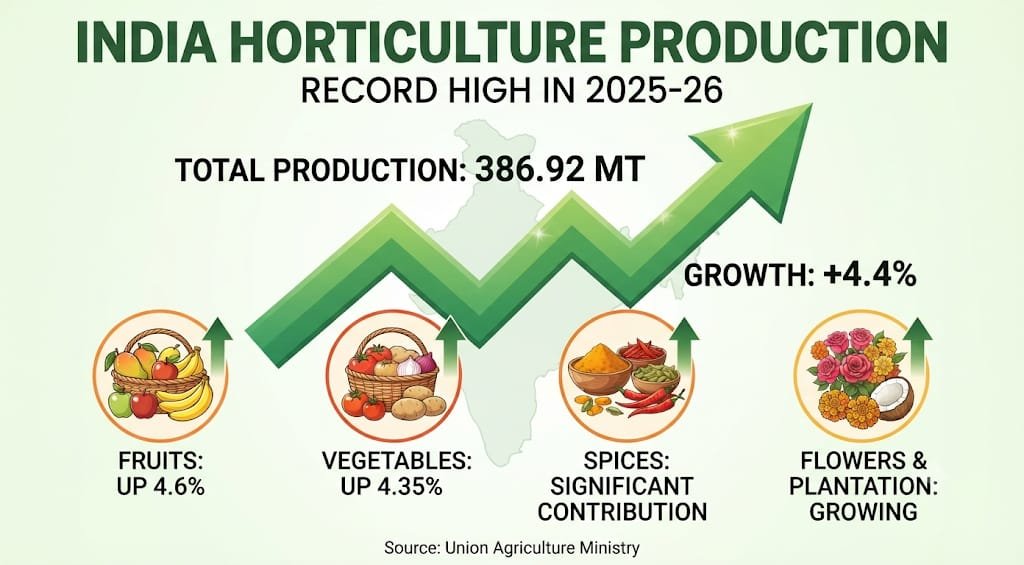
India’s horticulture sector has reached a major milestone in the 2025-26 crop year, with total production estimated at a record 386.92 million tonnes. This is 4.4% higher than the 370.74 million tonnes produced in 2024-25, according to the third advance estimate released by the Union Agriculture Ministry.
The estimate covers fruits, vegetables, flowers, spices, plantation crops, honey, and aromatic and medicinal plants. What makes the achievement especially important is that production has increased even though the total area under horticulture crops has fallen slightly, which means farmers have been able to get more output from the land through better yields.
The latest estimate is also higher than the government’s earlier projection. In June, the Ministry had estimated horticulture production for 2025-26 at 377.78 million tonnes, but the revised figure now stands at 386.92 million tonnes. The area under all horticulture crops has been revised downward to 29.72 million hectares from 30.15 million hectares in the second estimate.
In 2024-25, the area was 30.14 million hectares. Despite this reduction in cultivated area, output has risen across fruits, vegetables, flowers, plantation crops, and aromatic and medicinal plants, showing that productivity has improved in many crops.
Fruits have played an important role in this growth. Their production is expected to rise by 4.6%, from 117.65 million tonnes in 2024-25 to 123.07 million tonnes in 2025-26. The increase has been supported by better output of bananas, mangoes, papayas, apples, pomegranates and jackfruits.
These crops are not only important for domestic consumption but also create income opportunities for farmers, traders, transporters and processors. A higher fruit supply can also help improve access to nutritious food across the country.
Vegetables remain the largest part of India’s horticulture economy. Their production is estimated to increase by 4.35%, from 217.8 million tonnes in 2024-25 to 227.27 million tonnes in 2025-26. The growth has come from higher production of potatoes, tomatoes, peas, cauliflower, bottle gourds and okra, also known as lady’s finger.
The area under vegetables has also increased from 11.79 million hectares to 11.93 million hectares. Potato production is estimated at 65.57 million tonnes, compared with 58.57 million tonnes in the previous year, while tomato output is expected to rise from 20.6 million tonnes to 21.41 million tonnes.
However, the picture is not uniformly positive. Onion production is estimated to fall from 30.77 million tonnes in 2024-25 to 28.9 million tonnes in 2025-26, despite a small increase in the area under onion cultivation from 1.97 million hectares to 2.01 million hectares.
The decline has been attributed to crop damage. Since onion is a widely used kitchen staple and its prices often affect household budgets, this fall could remain a concern for consumers and policymakers if supply tightens in certain markets.
Other horticulture segments have also recorded growth. Production of aromatic and medicinal plants is expected to increase from 9.01 lakh tonnes to 9.3 lakh tonnes. The area under plantation crops such as arecanut, coconut, cashew, betel leaf and cocoa is projected at about 46.56 lakh hectares, with production estimated at 18.26 million tonnes.
Floriculture is also expanding, with the area under flowers rising from 3.97 lakh hectares to 4.1 lakh hectares and flower production increasing from 4.27 million tonnes to 4.58 million tonnes.
Spices have contributed as well. The area under spices has reached 4.76 million hectares, while production is estimated at 12.35 million tonnes. Better yields of turmeric, garlic, curry leaves and cardamom have supported this performance.
Spices are an important part of India’s agricultural economy because they support both household consumption and exports, while also providing livelihoods to farmers in several states.
Union Agriculture Minister Shivraj Singh Chouhan has credited farmers and government policies for the rise in production. According to the Ministry, farmers are gradually shifting from traditional crops towards fruits, vegetables, flowers, spices, plantation crops and medicinal plants.
This shift towards commercial and cash crops can create new income streams for rural households and strengthen the agricultural sector. The Minister has also said that the record output will support nutritional security and directly improve the incomes of horticulture farmers.
The record estimate is encouraging because horticulture connects directly with everyday life. Fruits and vegetables reach homes, local markets, hotels, food-processing units and export supply chains. Higher production can help keep essential food items more available, though prices still depend on storage, transport, weather, demand and local supply conditions.
The rise in output also reflects the growing importance of high-value agriculture, where farmers can earn better returns by growing perishable and commercial crops rather than depending only on traditional grain cultivation.
Overall, the 2025-26 estimate shows that India’s horticulture sector is becoming stronger and more productive. The challenge ahead will be to maintain this growth while managing risks such as crop damage, price volatility, storage losses and climate-related uncertainty.
If farmers continue to receive timely market information, better seeds, irrigation support, cold-chain facilities and fair prices, the sector can further improve rural incomes and make nutritious food more widely available.

