
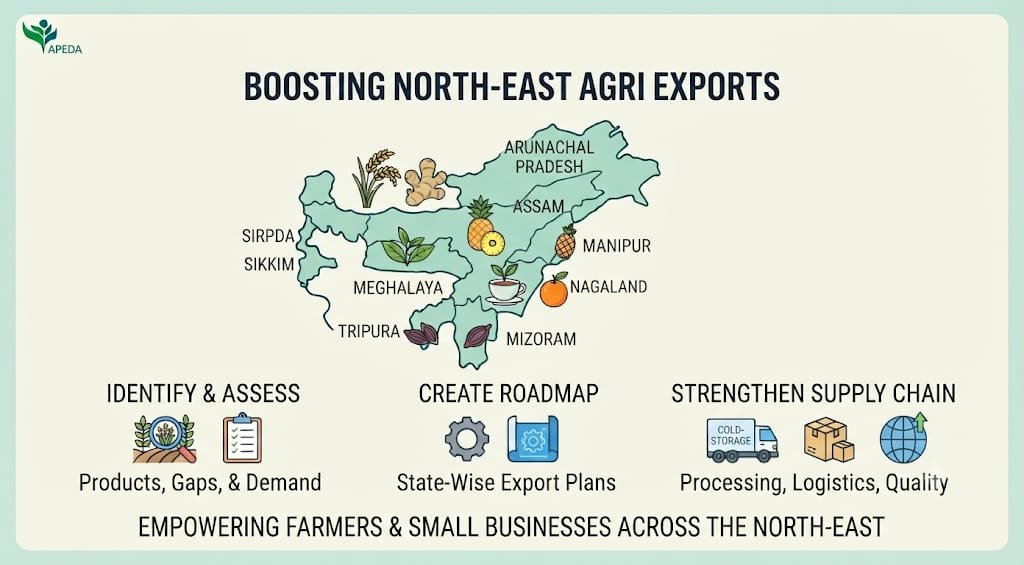
APEDA, the Agricultural and Processed Food Products Export Development Authority, is preparing a focused plan to increase agricultural exports from India’s North-Eastern states. The authority plans to create separate export strategies for each state, instead of treating the entire region as one market.
This approach is important because every North-Eastern state has different crops, production conditions, transport needs, and business opportunities. APEDA has invited bids for a study that will help prepare these state-wise plans in consultation with state governments and other stakeholders.
The main aim is to identify agricultural products that can be sold in foreign markets and help farmers, small businesses, and exporters earn better returns. The study will support Farmer Producer Organisations, start-ups, exporters, state governments, food-testing laboratories, and other institutions involved in the agriculture and food-processing sectors. It will look at how the entire export chain can be strengthened, from production at the farm level to processing, packaging, testing, logistics, and final sale in overseas markets.
APEDA has already identified five to six potential products for every North-Eastern state. These products include rice, ginger, citrus fruits, mandarin, pineapple, cardamom, jackfruit, turmeric, tea, organic products, and fruit wines.
The idea is to move beyond general promotion and focus on products where a particular state has natural strength, regular production, and scope for value addition. For example, a state known for pineapple or ginger can receive a strategy designed specifically around those crops, while another state may focus more on tea, citrus fruits, or organic produce.
The proposed study will examine production data, seasonal availability, farm-gate prices, and marketable surplus for each selected product. This information will help authorities understand how much produce is actually available for export after meeting local demand.
It will also map major production clusters, which are areas where a particular crop is grown in large quantities. By identifying these clusters, the plan can suggest better collection centres, processing units, storage facilities, testing labs, and transport links close to farming areas.
Another important part of the study will be to identify gaps in infrastructure and institutional support. North-Eastern states often face challenges related to long distances, difficult terrain, limited cold-storage facilities, higher transport costs, and weaker market connections. These issues can reduce farmers’ profits and make exports less competitive.
The study is expected to highlight where investment is needed and how existing government schemes for agriculture, horticulture, food processing, infrastructure, logistics, micro, small and medium enterprises, credit, and regional development can be better used.
The initiative will also connect these state-level efforts with the Export Promotion Mission and APEDA’s own export-promotion programmes. This coordination is important because farmers and small exporters need more than advice; they need access to finance, quality testing, packaging support, market information, and reliable transport. If central and state schemes work together, producers may find it easier to meet export standards and reach buyers abroad.
The study will assess the export readiness and competitiveness of each product. It will study global market trends, identify emerging and potential overseas markets, and suggest short-term and medium-term actions.
In simple terms, it will try to answer which products can be exported now, which markets should be targeted, what quality and packaging improvements are needed, and what investments can make the supply chain stronger.
The final outcome is expected to be a product-wise and state-wise roadmap. This roadmap will guide investments, improve value addition, and build export-ready supply chains across the North-East.
Value addition means turning raw produce into products that earn higher prices, such as processed ginger, packaged tea, fruit wines, dried fruits, or organic spices. Such products can create more jobs in processing, packaging, logistics, and marketing, while also giving farmers a better share of the final value.
For the North-East, this initiative could be a meaningful step towards turning local agricultural strengths into regular export income. If implemented properly, it may help farmers receive fairer prices, encourage small enterprises, improve rural infrastructure, and place the region’s distinctive products on global shelves.
The success of the plan will depend on practical execution, timely investment, strong coordination among agencies, and continuous support for farmers and exporters.

