
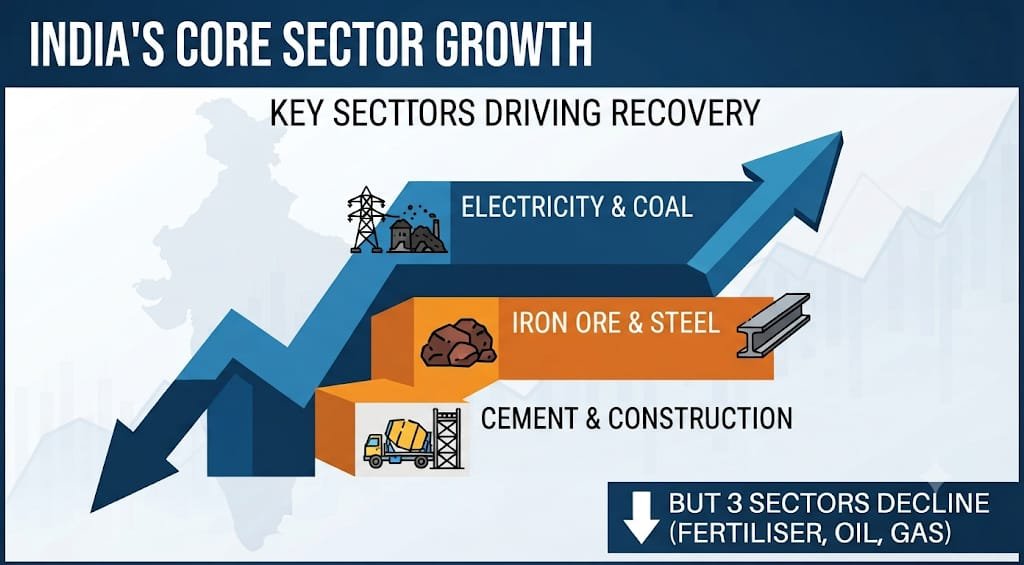
Coal, electricity, iron ore and cement lead stronger production, but falling output in three industries shows recovery remains uneven.
India’s nine core industries grew 10.9% in October 2026 compared with the same month last year, recording their fastest growth in 31 months. Data released by the Ministry of Commerce and Industry on November 20 showed stronger production across several industries that supply energy and materials for economic activity. September’s growth was revised upward to 8.2%.
The improvement matters because these industries provide essential inputs for factories, construction sites, transport and farming. Electricity keeps businesses running, coal supports power generation, and steel and cement help build homes, roads and bridges. Together, the nine sectors account for about 40% of the Index of Industrial Production, making their performance an important signal of industrial activity.
However, the headline number needs context. Core sector output had grown just 0.8% in October last year. Comparing production with that weak starting point helped lift this year’s growth rate, an effect known as a low base. The production index also rose from 118.6 in September to 123.1 in October, its highest level in seven months.
Iron ore recorded the strongest growth at 26.4%, followed by coal at 23.1% and electricity at 21.6%. Electricity growth accelerated from 12.6% in September. Higher demand during below-normal monsoon conditions and heatwaves in several states supported power generation. Electricity carries the largest weight in the core sector index, so its performance strongly influences the overall result.
Construction-related industries also strengthened. Cement production increased 15.4%, while steel output rose 7.3%, improving from 5.6% in September. Bank of Baroda chief economist Madan Sabnavis linked stronger demand to continued government spending on infrastructure and higher private investment. These gains suggest more activity in industries supplying materials for building and investment projects, although production figures alone cannot establish how widely benefits are spreading.
Not every industry shared the improvement. Refinery products grew 3.4%, slowing from 8.7% in September. Fertiliser output fell 12.2%, marking its eighth consecutive monthly contraction. Natural gas production declined 7.6%, while crude oil output dropped 4.1%. All three contracting sectors recorded deeper falls than in September, showing that strong overall growth can exist alongside persistent weakness in important industries.
The broader financial year picture was stronger. Core sector production increased 6% during April to October, compared with 2.3% in the same period last year. Still, ICRA chief economist Aditi Nayar noted that electricity had provided much of the support. Without electricity, growth during those seven months was relatively modest at around 3.2%, highlighting the uneven nature of the expansion.
The figures follow a revised measurement system using 2022–23 as the base year instead of 2011–12. Iron ore was added, taking the number of core sectors from eight to nine. October marked the fifth release under this updated series. The October estimate remains provisional, meaning later information may lead to revisions.
Attention now turns to whether stronger production continues. ICRA expects growth to moderate to mid-single digits in November and considers October and November together a better guide because festival-related comparisons can affect monthly results. October therefore offers an encouraging industrial signal, but sustained, broader growth remains the more meaningful test for the economy.

