
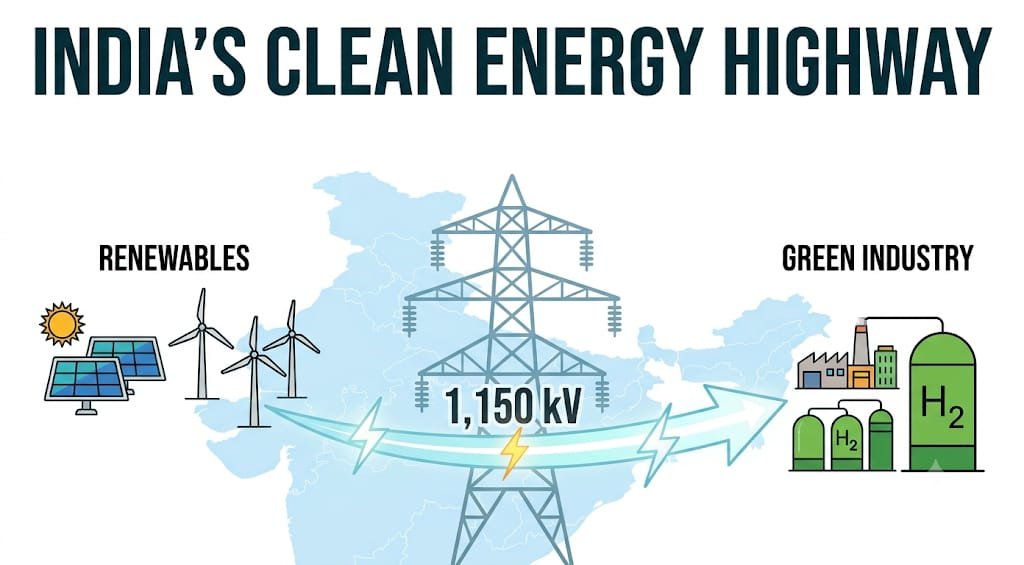
India has taken a major step towards building one of the world’s strongest electricity grids. The National Committee on Transmission has approved a ₹68,816-crore transmission project that will use 1,150 kV ultra-high-voltage alternating-current lines, the highest voltage level planned in the Indian power system. The project is designed to carry very large volumes of electricity from renewable-energy-rich western states to industrial and green-hydrogen hubs in eastern India.
The proposed corridor, known as the Raigarh-Kotra to Rourkela to Kolaghat double-circuit line, will connect power-producing areas in Gujarat and Rajasthan with growing demand centres in the eastern region. In simple terms, it will work like a huge electricity highway: solar and wind power generated in the west can travel across the country to support factories, ports, hydrogen plants and other industries in the east.
The approval is important because India is adding renewable energy at a rapid pace, but much of that clean power is produced far away from major industrial centres. Gujarat and Rajasthan have strong solar potential, while eastern states such as Odisha are expected to see rising industrial demand. The new line will help move electricity from areas with surplus generation to areas where it is needed, reducing the risk of renewable power being wasted because the grid cannot carry it.
According to the committee’s assessment for 2031-32, substantial new generation is expected in Rajasthan, Maharashtra, Chhattisgarh and the North-East. At the same time, bulk demand is expected to rise in Odisha and other industrial regions. The plan takes into account 5.2 GW of thermal capacity at Raigarh’s Kotra-III, 12 GW of renewable capacity at Bhadla-IV and Ramgarh-II, along with battery energy storage systems, hydro projects and pumped-storage projects.
The project also reflects India’s growing interest in green hydrogen and green ammonia. These fuels are expected to need large amounts of electricity, especially renewable power, for production. By connecting renewable hubs with emerging green-hydrogen nodes in the east, the transmission line could support future factories that make clean fuels for industry, shipping and exports. The committee’s studies also consider around 124 GW of battery storage and 42 GW of pumped-storage capacity, which will be important for balancing solar and wind power when generation changes through the day.
A 1,150 kV line can transfer much more electricity than the 765 kV lines commonly used in India today. Higher voltage allows more power to move through the same corridor with lower losses, making it suitable for carrying bulk electricity over long distances. Once completed, these lines will create India’s highest-voltage transmission network and could become a backbone for the country’s clean-energy transition.
However, the project has also raised questions among experts. S R Narasimhan, an expert member of the National Committee on Transmission and former chief of Grid Controller of India, has objected to some assumptions used in the planning studies. He believes that the projected 7.64 per cent annual growth in peak electricity demand between 2026-27 and 2031-32 is quite high.
Narasimhan has also warned that the new 1,150 kV lines may remain underused during non-solar hours. This concern arises because electricity demand from green hydrogen and green ammonia projects is still uncertain, and these projects may take time to begin full-scale operations. He has suggested that a 765 kV line or an extension of an existing high-voltage direct-current line to the eastern region could be a more practical and cost-effective option.
The debate is important because ₹68,816 crore is a very large public investment in infrastructure. A strong transmission network is essential for India’s energy security, industrial growth and climate goals, but it must also be planned carefully so that expensive assets do not remain idle. The challenge is to build enough capacity for future renewable power and green industry without creating a burden if demand develops more slowly than expected.
For ordinary consumers, the project may not bring an immediate change in electricity bills, but it could have a long-term impact. Better transmission capacity can help bring more renewable electricity into the grid, support new factories and jobs, improve power reliability and reduce dependence on fossil fuels. If India’s green-hydrogen plans expand as expected, this corridor could become a key link between the country’s solar-rich west and its industrial east.
The approval marks a bold attempt to prepare India’s grid for the next decade. The success of the project will depend not only on construction, but also on accurate demand forecasting, timely completion of renewable and storage projects, and the actual growth of green-hydrogen industries. If these pieces come together, the 1,150 kV corridor could become a landmark in India’s journey towards a cleaner and more reliable power system.

