
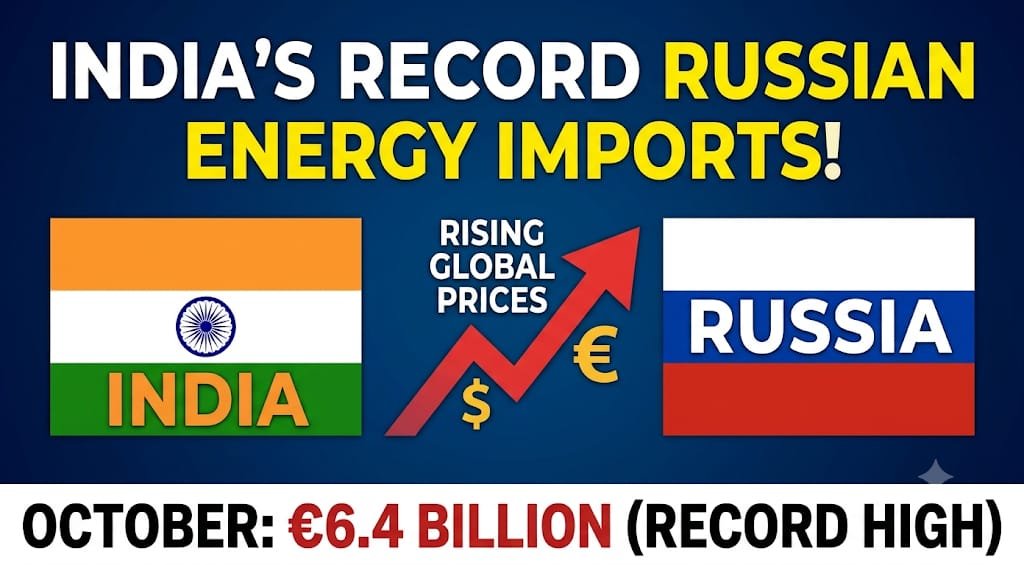
India’s purchases of Russian fossil fuels reached a record €6.4 billion in October 2026, according to an analysis by the Europe-based Centre for Research on Energy and Clean Air (CREA). This was India’s highest monthly import value from Russia since January 2022, when the available data series began.
The rise came mainly because India continued to buy large quantities of Russian crude oil at a time when global energy prices were high due to geopolitical tensions, including the West Asia conflict and the ongoing Russia-Ukraine war.
Crude oil was the biggest part of India’s imports from Russia. Out of the total €6.4 billion, crude oil accounted for €5.8 billion, or about 91 percent of the purchases. India also imported Russian coal worth €333 million and oil products worth €232 million during the month.
However, India did not buy Russian liquefied natural gas, or LNG. This shows that India’s dependence on Russia is largely linked to crude oil, which is used by Indian refineries to produce petrol, diesel, jet fuel and other petroleum products.
India became a major buyer of Russian oil after Russia’s invasion of Ukraine in February 2022. Many Western countries reduced or stopped buying Russian crude because of the war. To find new buyers, Russia began offering discounts on its oil.
Indian refiners used this opportunity, and Russia quickly became India’s largest source of crude oil. Before the war, Russia was only a small supplier to India. Today, it has replaced many traditional West Asian suppliers as the top source of crude for Indian refineries.
In October, India’s imports of Russian crude rose by 10 percent compared with the previous month. The increase was seen at all three of India’s largest importing refineries. Imports at the Vadinar refinery increased by 12 percent, at Jamnagar by 22 percent, and at Paradip by 28 percent.
The Vadinar refinery belongs to Nayara Energy, which is co-promoted by Russia’s Rosneft. Jamnagar is owned by Reliance Industries, while Paradip is operated by Indian Oil Corporation. With this rise, Jamnagar again became the biggest importer of seaborne Russian crude.
The higher import value does not mean that India bought much more oil in physical terms. A major reason for the record figure was the rise in oil prices. The average price of Russia’s main crude grade, Urals, increased by 13 percent month-on-month to $101.7 per barrel in October.
This was the highest monthly average since at least October 2021. Therefore, even when the volume of oil imports remained broadly similar, India had to spend more money to buy the same quantity of crude.
Russia also earned much more from fossil fuel exports in October. Its total fossil fuel export revenue increased by 14 percent month-on-month to €754 million per day, the highest level since December 2022. Russia’s crude oil export earnings rose by 19 percent to €449 million per day.
Seaborne crude export revenues rose even faster, by 23 percent, to €352 million per day. CREA estimated that higher oil and gas prices added $35.9 billion to Russia’s seaborne export revenues in the six months after the United States and Israel began strikes on Iran.
China remained the world’s largest buyer of Russian fossil fuels in October, purchasing energy worth €10.7 billion. India was the second-largest buyer, followed by the European Union and Turkiye. Between February 2023 and October 2026, China bought 50 percent of Russia’s crude exports, while India bought 37 percent.
The European Union and Turkiye each accounted for 5 percent. For Russian coal, China was again the biggest buyer with a 37 percent share, followed by India at 20 percent, Turkiye at 14 percent, South Korea at 12 percent and Vietnam at 4 percent.
For India, the development highlights both the benefit and the risk of buying discounted Russian crude. Lower-priced Russian oil has helped Indian refiners manage costs and support fuel supply. But when global oil prices rise sharply, even discounted Russian crude becomes expensive.
The October figures show that India’s energy security remains closely linked to global conflicts, price movements and the availability of Russian crude. As long as geopolitical tensions keep energy prices elevated, India may continue to spend more on Russian oil even without a major increase in import volume.

