
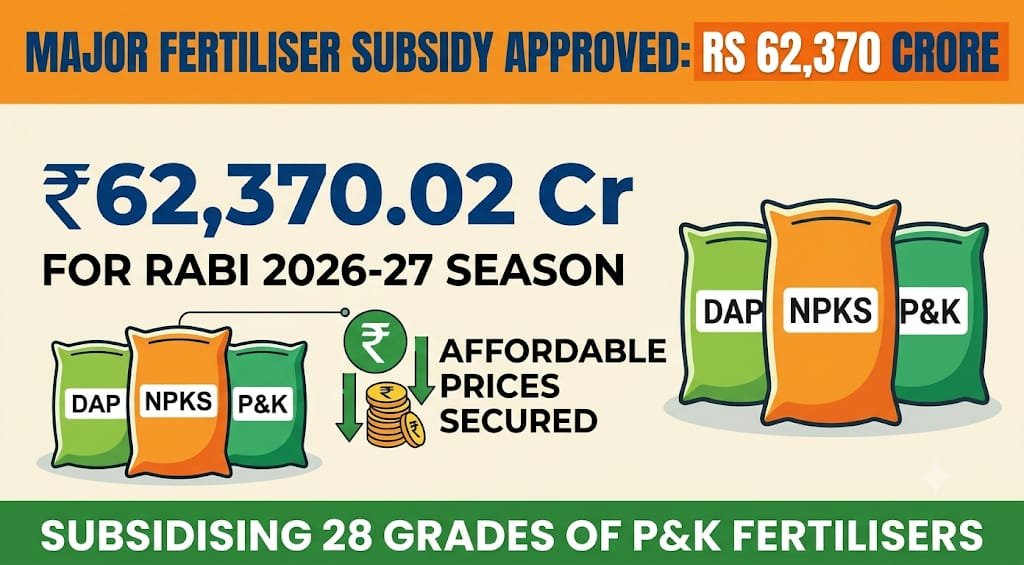
The Union Cabinet has approved a budgetary requirement of about Rs 62,370.02 crore for the Nutrient Based Subsidy, or NBS, on phosphatic and potassic fertilisers for the Rabi 2026-27 season. This decision is important because fertilisers such as DAP and NPKS help crops grow properly, and farmers need them at a price they can afford. The approved subsidy will remain in force from October 1, 2026, to March 31, 2027, covering the complete Rabi season.
The new allocation is much higher than the amount approved for the previous Rabi season. For Rabi 2025-26, the government had approved Rs 37,952.29 crore for P&K fertiliser subsidy. The latest approval is about Rs 24,417.73 crore more than that amount. This large increase shows that the government expects global fertiliser prices and input costs to remain high, and it wants to protect farmers from a sudden rise in the price of essential crop nutrients.
Phosphatic and potassic fertilisers are commonly used by farmers to improve soil health and crop production. DAP, which stands for Di-Ammonium Phosphate, is one of the most widely used fertilisers in India because it provides nitrogen and phosphorus to plants. NPKS fertilisers provide nitrogen, phosphorus, potassium and sulphur, which are important nutrients for healthy plant growth. The subsidy will cover 28 grades of P&K fertilisers, including DAP and different NPKS grades.
Under the Nutrient Based Subsidy scheme, the government provides support to fertiliser companies rather than directly fixing the final price for every type of fertiliser. Companies receive subsidy support according to notified nutrient-wise rates. The purpose is to encourage companies to make fertilisers available to farmers at reasonable prices even when the cost of raw materials, imports and production changes. This system has been in place since April 1, 2010.
The government has increased the subsidy because international prices of fertilisers and important inputs have been changing. The cost of urea, DAP, Muriate of Potash, also known as MOP, and sulphur can affect the overall cost of producing and supplying fertilisers. When global prices rise, companies may face higher expenses. If the government does not provide enough subsidy support, farmers may have to pay more for fertilisers or face shortages during the important sowing season.
The Rabi season is a crucial period for Indian agriculture because many major crops are sown during this time. Farmers generally need fertilisers at the right time to prepare fields and support early crop growth. A delay in fertiliser supply or a sharp increase in price can affect farming plans, crop yield and household income. By approving a higher subsidy amount before the season, the government aims to ensure that DAP, NPKS and other P&K fertilisers remain available across the country.
This decision is also significant because it supports food security. Fertilisers play a direct role in increasing agricultural productivity. When farmers receive timely and affordable nutrients, crops are more likely to grow well and produce better harvests. A strong Rabi harvest can help maintain the supply of food grains, oilseeds and other crops in the market. Therefore, the fertiliser subsidy is not only a support measure for farmers but also an important step for the wider food system.
The approval of Rs 62,370.02 crore reflects the government’s effort to balance two major needs. On one side, fertiliser companies need adequate support because international prices and raw material costs can be uncertain. On the other side, farmers need fertilisers at affordable prices so that cultivation remains practical and profitable. The revised NBS rates are designed to manage both concerns by helping companies maintain supply while keeping the burden on farmers limited.
For ordinary farmers, the main benefit is expected to be stable access to fertilisers during the Rabi season. The government’s message is that rising global costs should not become a reason for farmers to reduce fertiliser use or delay sowing. The subsidy is intended to make essential nutrients available at subsidised, affordable and reasonable prices. This can give farmers more confidence while planning their crop cycle.
Overall, the Cabinet’s approval of about Rs 62,370 crore for Rabi 2026-27 is a major agricultural support decision. It increases funding for P&K fertilisers by more than Rs 24,000 crore compared with the previous Rabi season and covers DAP, NPKS and 28 grades of fertilisers. The decision highlights the importance of affordable fertilisers in protecting farmers, sustaining crop production and strengthening India’s food security during a season when timely nutrition for crops matters the most.

