
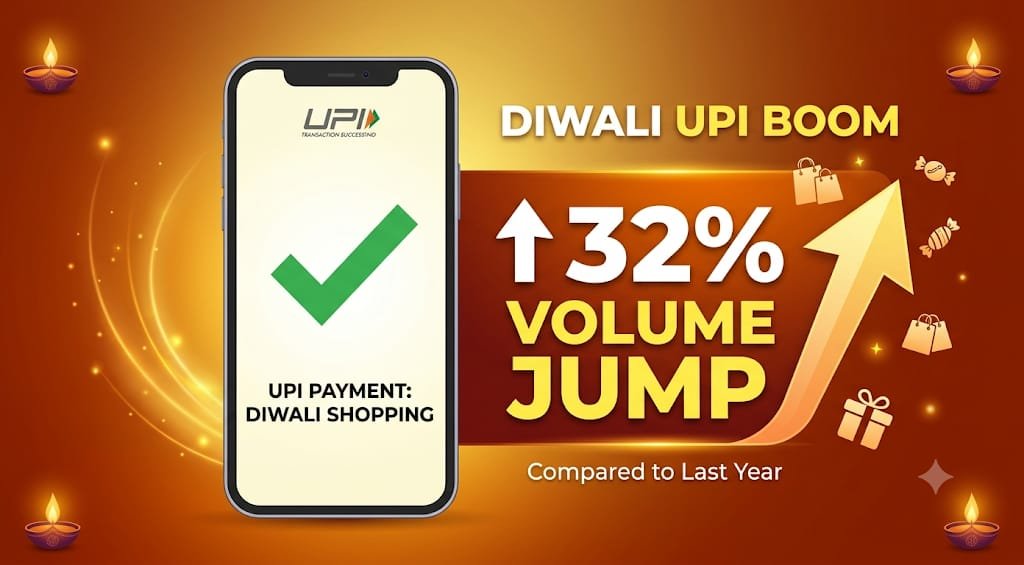
India’s digital payment system witnessed a strong festive-season surge this Diwali, as Unified Payments Interface, or UPI, transactions rose sharply on the day of the festival. According to data released by the National Payments Corporation of India, UPI volume increased by 32% on November 8 compared with the same day last year.
The rise was driven mainly by last-minute festival shopping, gifting, travel, food orders, and payments made by people during the Diwali celebrations. The report highlights how deeply digital payments have become part of everyday life in India, even during a festival when cash has traditionally played an important role.
On Diwali, UPI recorded 916.9 million transactions, which means more than 91.6 crore payments were made through the platform in a single day. This was much higher than the 695.7 million, or about 69.5 crore, transactions recorded on the same day last year.
The jump shows that people increasingly used UPI for quick and convenient payments while completing their Diwali purchases. Whether it was buying sweets, clothes, gifts, decorations, electronics, or groceries, many consumers chose to pay digitally rather than depend only on cash.
The growth was especially visible in transaction volume, but the value of payments also increased. On November 8, UPI transactions were worth Rs 90,029.43 crore, compared with Rs 88,350.79 crore on the same day last year. This means that while the number of payments rose strongly, the total money transferred also moved higher. The increase in value suggests that people were not only making more transactions but also using UPI for purchases of different sizes during the festive period.
Interestingly, the day before Diwali saw even higher activity. UPI recorded 975.8 million transactions on that day, with payments worth Rs 1,36,118 crore. This indicates that a large part of festival spending happened just before Diwali, when people were completing their shopping, paying bills, sending gifts, and making last-minute purchases. For small shops, online sellers, delivery platforms, and local businesses, this period becomes one of the busiest times of the year.
UPI was developed by the National Payments Corporation of India, which is an initiative of the Reserve Bank of India and the Indian Banks’ Association. It allows people to send and receive money instantly through a mobile phone using a UPI ID, QR code, or bank account details. Over the years, UPI has made digital payments simple for ordinary people, small traders, street vendors, and large businesses alike. Its easy use has helped it become one of the most important payment systems in the country.
The Diwali surge also reflects a wider trend in India’s digital economy. In October, UPI transactions reached 25.47 billion, while the total value of transactions stood at Rs 31.53 lakh crore. Festival buying supported this growth, showing that consumer spending and digital payments often rise together during the festive season. As people shop more, pay bills, book travel, and send money to family members, the demand for instant digital payment options increases sharply.
UPI’s reach is no longer limited to India. The payment system is now accepted in 11 countries, with Uzbekistan being the latest addition. Apart from Uzbekistan, UPI is accepted in Singapore, the United Arab Emirates, France, Mauritius, Nepal, Bhutan, Qatar, Sri Lanka, Cambodia, and Greece. This expanding international acceptance is helpful for Indian travellers, businesses, and people sending money abroad, as it makes payments easier in more places.
The growth of UPI over the past decade has been remarkable. Launched on August 25, 2016, the system has changed the way payments are made across India. In the 2016-17, UPI transactions were worth only Rs 0.07 lakh crore.
By the financial year 2025-26, the value had risen to around Rs 314 lakh crore, showing an increase of more than 4,000 times over ten years. This transformation shows how quickly digital payments have become a normal part of daily economic activity.
The Diwali numbers also point to changing consumer behaviour. People are becoming more comfortable using digital payments for festival-related spending, including small purchases at local shops and larger online orders. For businesses, this creates an opportunity to serve customers faster and manage payments more smoothly. For consumers, it offers convenience, speed, and the ability to make payments without carrying large amounts of cash.
Overall, the 32% rise in UPI volume on Diwali shows that festival spending and digital payments are now closely linked. Last-minute buying played a major role in pushing transaction numbers higher, while the growing acceptance of UPI across India and abroad continues to strengthen the country’s digital payment ecosystem. As festive spending grows each year, UPI is likely to remain at the centre of India’s changing payment habits.

