
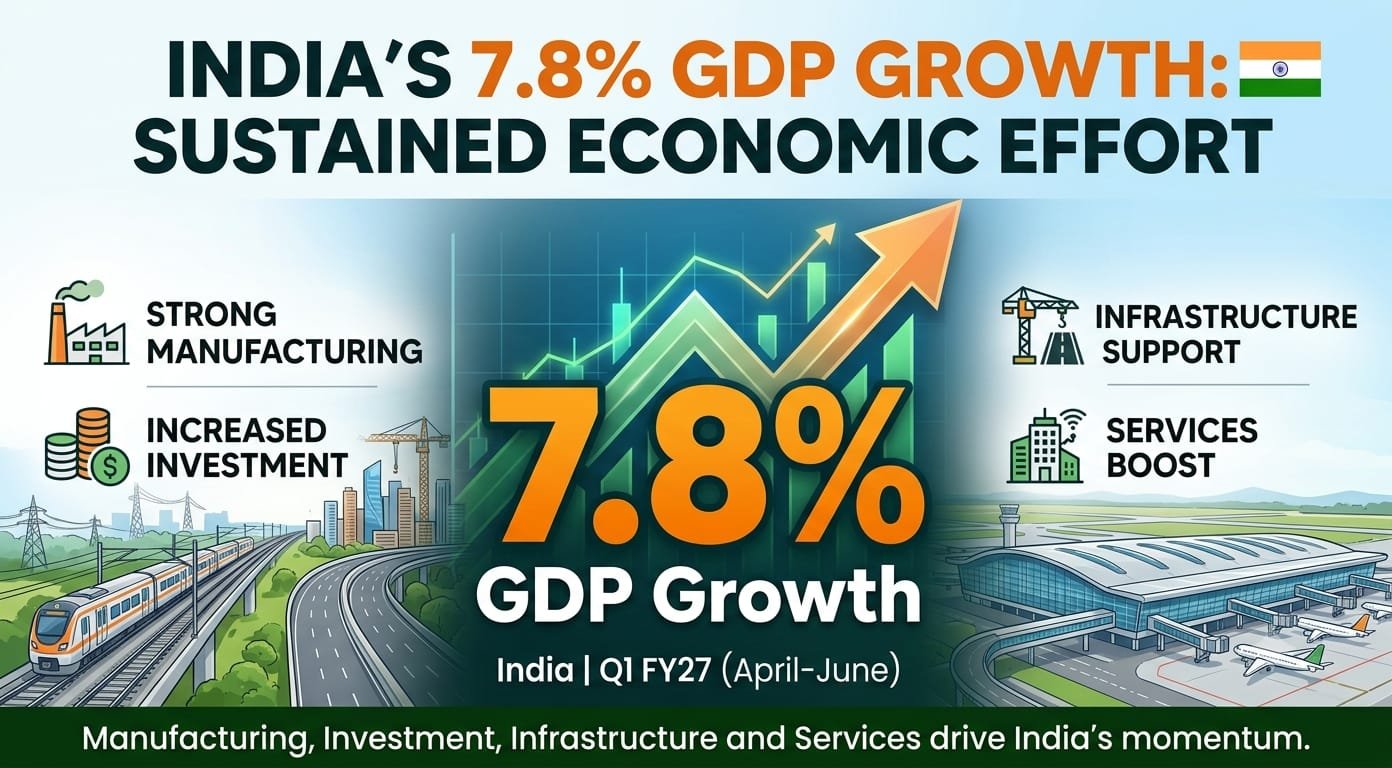
India’s economy grew by 7.8% in the April-June quarter of financial year 2026-27, according to data released by the Ministry of Statistics on August 31, 2026. The growth was higher than the 7% estimate of the Reserve Bank of India and also stronger than the 6.9% growth recorded during the same quarter of the previous year.
The figure has renewed discussion about India’s economic strength at a time when global markets have been facing geopolitical tension, higher energy prices, supply-chain difficulties and uncertainty in international trade.
The real GDP of India stood at around ₹81.36 lakh crore in the first quarter of FY27, compared with nearly ₹75.46 lakh crore in the same period of FY26.
Real GDP measures the growth in the production of goods and services after removing the effect of price changes. In simple terms, the number suggests that the economy produced more goods and services than it did a year earlier. Nominal GDP, measured at current prices, rose by 10.3% to nearly ₹88.27 lakh crore.
The wider economic picture also remained encouraging. Gross Value Added, or GVA, grew by 8.2%, compared with 7.1% in the previous year. GVA shows the value created by different sectors of the economy.
Manufacturing recorded growth of 9.2%, improving from 8.3% a year earlier. Investment also remained strong, with Gross Fixed Capital Formation increasing by 11.9%. This reflects spending on productive assets such as factories, roads, railways, ports, machinery and other infrastructure.
The performance raises an important question. Did the 7.8% growth appear suddenly, or is it part of a longer trend? The quarterly data indicates that the momentum has been building over time. Growth in the four quarters of FY26 stood at 6.9%, 7.4%, 7.7% and 8.6% after revisions, while the first quarter of FY27 recorded 7.8%. The numbers therefore point towards continuing economic activity rather than a rise created by a single month or one exceptional event.
Government capital expenditure has been an important part of this process. Spending on roads, railways, airports, ports, urban projects and other infrastructure creates demand for steel, cement, machinery, transport and labour. Such investment also reduces travel time, improves logistics and supports businesses in different regions. The impact is therefore felt beyond the original government project.
Manufacturing reforms have added another layer to the growth story. Production Linked Incentive schemes, efforts to improve logistics, support for electronics production, defence manufacturing and investment in deep technology have encouraged companies to expand domestic production.
India’s electronics industry has become a major example of this shift. Defence manufacturing has also moved towards greater domestic production, while defence exports have increased from earlier levels.
Services remained a major support for the economy. Banking, finance, real estate, information technology, communication, trade and professional services contributed to demand and business activity.
These services connect households, companies and investors, helping money and resources move through the economy. Manufacturing and services together provide a broader base for growth than dependence on only one sector.
Corporate earnings also offered a positive signal. Nifty 50 companies reportedly recorded an 18% year-on-year rise in profit after tax during the quarter, the fastest growth in ten quarters and higher than the expected 10%.
Across more than 4,200 listed companies, revenue growth reportedly reached around 21-22%, while profits also recorded double-digit growth. Strong corporate earnings can encourage investment, support hiring and improve business confidence, although earnings data alone cannot measure the experience of every household.
The latest GDP figure does not mean that all economic challenges have disappeared. Inflation, rural income, employment quality, global demand, oil prices and trade uncertainty will continue to influence future growth. A strong GDP number becomes more meaningful when it leads to better incomes, wider employment and stronger demand in smaller towns and rural markets.
Prime Minister Narendra Modi described the growth as a major achievement delivered despite oil-price pressures and supply-chain disruptions.
These numbers have presented evidence that reforms, fiscal discipline, infrastructure development, manufacturing support and improved governance are working together. Critics may continue to question the quality and sustainability of growth, but the latest data provides a clear indication that India has retained strong economic momentum.

