
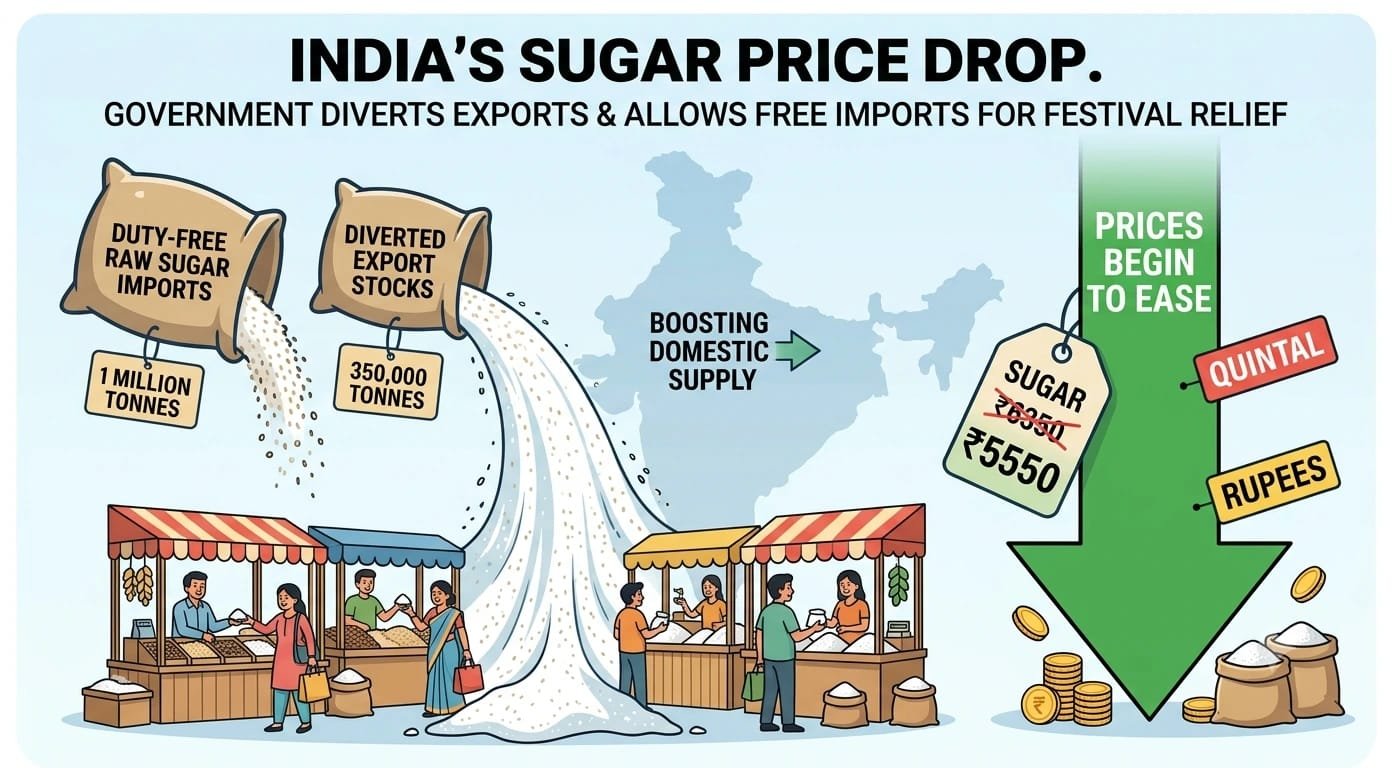
Sugar prices have started showing signs of relief after rising sharply over the past few weeks. The change has come after the government allowed duty-free imports of 1 million tonnes of raw sugar and approved the sale of nearly 350,000 tonnes of sugar that was earlier planned for export.
The additional supply is expected to reduce pressure in the domestic market, especially before the festival season when demand for sweets and other food products usually increases.
The latest decision has already influenced market prices. In Maharashtra’s Kolhapur market, the price of medium-grade sugar fell from around ₹6,350 per quintal on August 21 to nearly ₹5,550 per quintal on August 25. This represents a decline of about 12.6 per cent in only a few days.
However, the price decline has not been equal across all markets. In Muzaffarnagar, one of the important sugar markets in northern India, the price remained close to ₹5,800 per quintal during the same period.
The government’s decision to permit duty-free imports was taken after domestic sugar prices reached unusually high levels. India has not allowed such imports on this scale for almost ten years.
The approved imports will be permitted until October 31, 2026. Normally, raw sugar imports attract a 100 per cent duty, so removing the duty makes imported sugar cheaper and gives refiners a strong reason to bring more supplies into the country.
The pressure on prices became serious as domestic stocks were falling while demand was expected to rise. Sugar production estimates for the 2025-26 marketing year were revised downward, adding to concerns about its availability.
Ex-mill prices in Maharashtra had reached around ₹5,400 to ₹5,560 per quintal, while retail sugar prices had risen to about ₹52.30 per kilogram on August 18, compared with ₹46.34 per kilogram a year earlier. The increase meant that households, sweet makers, restaurants and food companies were all facing higher costs.
The release of 350,000 tonnes of export-bound sugar is another important part of the supply plan. Indian refiners are expected to redirect this sugar to local buyers, and the stock could reach the domestic market within a week.
The quantity is estimated to be enough to meet India’s total sugar demand for nearly five days. Such a release can provide quick relief because imported sugar may take more time to arrive and be processed.
Along with imports and export diversion, the government has also tightened stockholding rules for bulk buyers. Large consumers have been restricted to holding sugar equal to about 15 days of their requirement. Mills have also been asked to provide details of recent sales.
These steps are aimed at preventing excessive stocking, hoarding and speculative buying, which can push prices higher even when enough sugar is available in the wider market.
The fall in prices shows how quickly market expectations can change. Average ex-mill sugar prices, which had climbed to nearly ₹67 per kilogram, later declined to around ₹54-55 per kilogram after the import announcement. Food Secretary Sanjeev Chopra also said that ex-mill prices had fallen by about 18 per cent and could decline further as new supplies become available.
Still, the entire 1-million-tonne import quota may not be used. Estimates from traders, analysts and millers suggest that actual duty-free imports could remain between 300,000 and 600,000 tonnes by the end of October.
As domestic prices soften, mills and refiners may find imports less attractive. The final quantity will depend on international prices, shipping costs, demand and the speed at which imported raw sugar can be refined.
For households, the immediate impact may be limited because retail prices usually respond more slowly than wholesale prices. If mills continue releasing stocks and imports arrive on time, sugar prices could become more stable in the coming weeks.
The main purpose of the government’s action is not only to reduce present prices but also to ensure that festival demand does not create another sudden shortage. For the sugar industry, the move may reduce unusually high margins, while for consumers it offers the possibility of lower and more predictable prices.

