
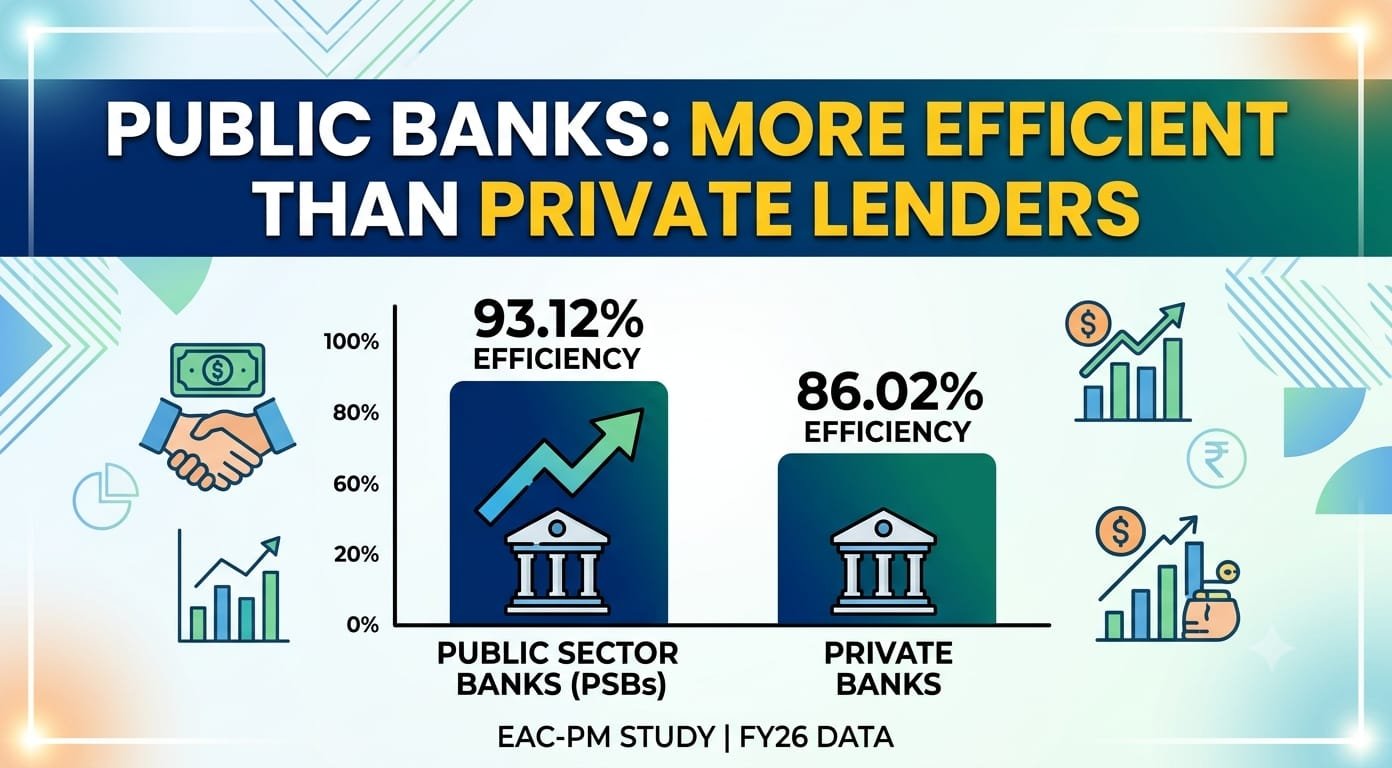
A new study linked to the Economic Advisory Council to the Prime Minister has brought an unexpected result into the banking debate. It says public sector banks, often called PSBs, have become more efficient than private banks in India, especially in the latest years covered by the paper.
The finding matters because public banks are usually seen as slower or less flexible, while private banks are often thought to be better at using resources. This report shows that the picture may be changing in a clear way.
The paper is titled Reforms, Efficiency, and Productivity of the Indian Banking Sector in the Last Decade: A DEA Approach. It was written by Soumya Kanti Ghosh, a part-time member of EAC-PM, along with SBI economist Tapas Kumar Parida.
The study looks at how well banks convert resources into output, which includes deposits, credit, investments, and profits. In simple words, it asks whether banks are doing more with the money, staff, and systems they already have.
The headline number in the study is strong. Public sector banks recorded a technical efficiency score of 93.12% in FY26, while private banks stood at 86.02% and foreign banks at 85.88%. The broader banking industry also improved, with overall mean technical efficiency rising to 88.34% in FY26 from 77.99% in FY20. This suggests that the sector has recovered well after a weak phase and is now working in a more productive way.
The study also shows that PSBs have made the sharpest jump over time. Their efficiency rose from 72.46% in FY20 to 93.12% in FY26, which is a large improvement in a short period.
Private banks also improved, but their rise was smaller, from 78.03% in FY20 to 86.02% in FY26. Over the full 12-year period from FY15 to FY26, PSBs averaged 88.53%, while private banks averaged 85.62%. That means the edge for PSBs is not only visible in one year, but also in the longer trend.
The paper also points to reasons behind this change. It says capital infusion and technology upgradation in selected PSBs helped improve performance. It also notes that mergers and rationalisation of branches and staff may have affected earlier years, especially around FY19 to FY22.
In the last three years of the study, FY24 to FY26, PSBs were said to be clearly ahead of private banks. This part is important because it shows that bank reform is not only about ownership, but also about management, scale, and adoption of new tools.
At the same time, the study does not say that private banks have become weak overall. It only says PSBs are now more efficient on the measure used in the paper. Efficiency here is a technical term, not a judgment on customer service, profits, or brand image.
Other research has often found mixed results depending on the method used, the time period, and the goal being measured. That is why this report should be read as one careful assessment, not as the final word on all aspects of banking performance.
The study also leads to a bigger policy idea. It suggests that Indian banks may need further consolidation to create large and balanced lenders. The thinking behind this is simple: bigger banks, if managed well, may be able to use technology, staff, and capital more effectively. For ordinary savers, borrowers, and businesses, this could mean stronger banks that are better prepared to handle growth, lending, and competition.
In the end, the report gives an important message about Indian banking. Public sector banks, which were often treated as weaker players in efficiency debates, have shown a strong comeback in recent years. Private banks still remain important, but the latest numbers suggest that the performance gap is no longer the same as before.The larger lesson is that reforms, capital support, technology, and better scale can change a bank’s performance over time.

