
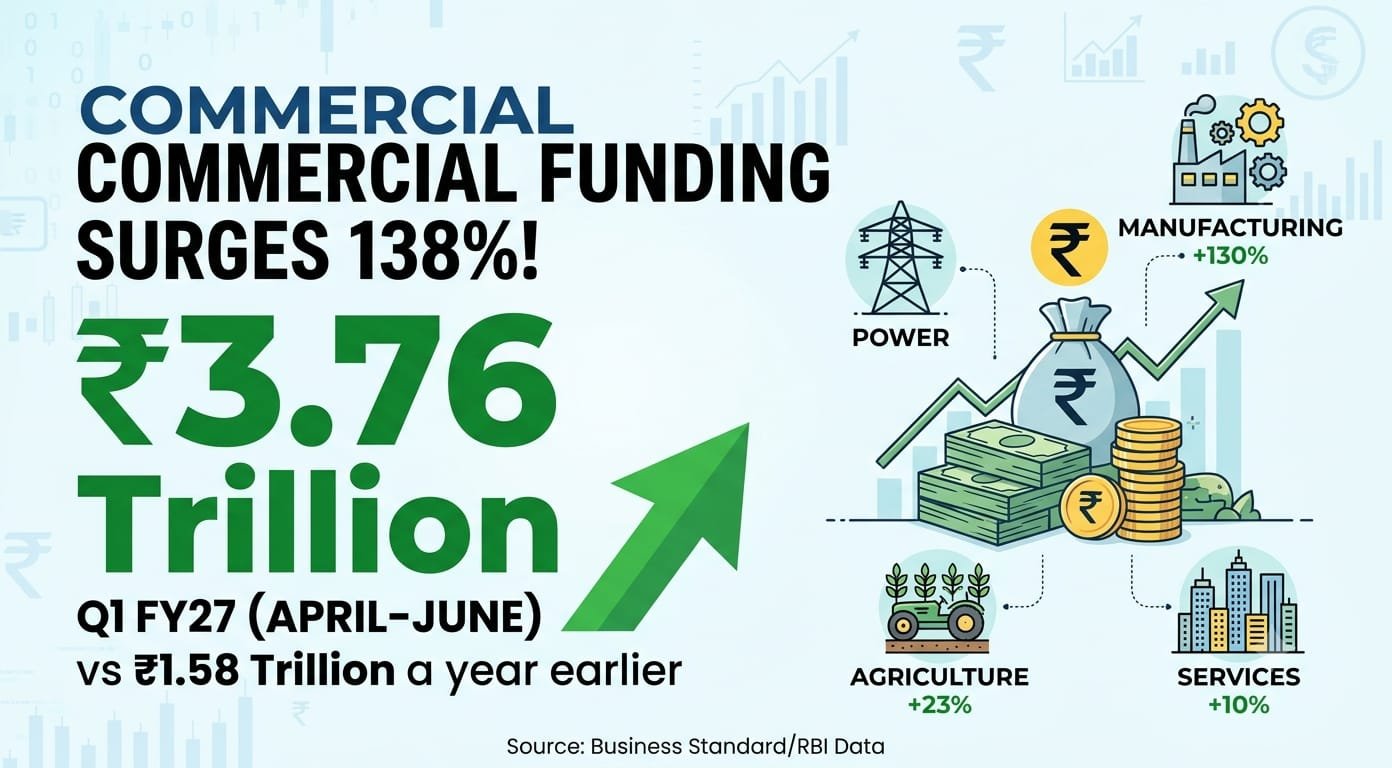
Commercial sector funding in India recorded a sharp rise during the first quarter of financial year 2026-27, showing that businesses across several parts of the economy are seeking more money for expansion, daily operations and new investment.
According to data reported by Business Standard, total funding to the commercial sector reached ₹3.76 trillion in the April-June quarter, compared with ₹1.58 trillion during the same period a year earlier. This means funding increased by 138% in one year.
The rise becomes easier to understand when compared with the overall movement in bank credit. Commercial sector credit grew by 4.8% during the quarter, while total bank credit, including personal loans and other categories, increased by 2.5%.
The figures indicate that business-related borrowing grew faster than lending in several other parts of the banking system. Such a trend often reflects greater confidence among companies and stronger demand for funds from different industries.
The Reserve Bank of India data showed that bank credit to the commercial sector grew to ₹2.08 trillion in June from ₹1.39 trillion in April. This rise came despite concerns about pressure on interest rates and changes in global economic conditions. Credit growth was also supported by the government’s continued focus on infrastructure, industrial development and investment-led economic activity.
Infrastructure remained one of the most important areas receiving bank finance. Credit to infrastructure industries increased to ₹69 trillion in June from ₹67.3 trillion in March.
Within this category, lending to roads, power, telecommunications and other infrastructure activities continued to attract attention. These sectors require large amounts of money and usually involve long-term projects, making bank funding important for construction, expansion and completion.
The power sector recorded notable credit growth during the period. Bank lending to power companies rose by 8.1% between April and June, compared with 6.8% growth in the previous quarter.
Higher funding in this area may support generation capacity, transmission networks and distribution-related work. With electricity demand increasing across homes, factories, offices and transport systems, power companies require regular investment to maintain and expand their operations.
Manufacturing also received stronger support from banks. Credit to the sector increased by 7.8% during the quarter, compared with 6.8% in the previous three months.
Loans were directed towards industries such as chemicals, engineering, food processing and textiles. Manufacturing companies generally need funds for machinery, raw materials, warehouses, technology upgrades and working capital. Higher lending may therefore help businesses increase production and respond to rising demand.
Agriculture and allied activities also remained part of the credit growth story. Bank finance to agriculture increased by 2.6% during the quarter, compared with 5.1% in the previous quarter.
Although the pace slowed, the sector continued to receive funding for farming, storage, food processing and related activities. Agriculture credit is important because it supports both rural incomes and the supply of food and raw materials to industries.
The services sector recorded a mixed performance. Credit to services increased by 2.1% during the quarter, compared with 2.4% in the previous quarter. Lending to transport operators, commercial real estate and other service businesses remained significant. However, the pace of growth was lower than in manufacturing and some infrastructure segments.
Bank lending to industries such as chemicals, engineering, food processing, textiles, leather, construction and mining also remained part of the broader improvement.
Together, these sectors connect factories, farms, transport networks, suppliers and consumers. When funding becomes easier to access, businesses can purchase equipment, pay suppliers, hire workers and expand production.
Experts have indicated that the improvement in commercial credit suggests that companies may be preparing for higher demand and fresh investment. Continued growth in bank lending could support employment, production and business activity. At the same time, banks will need to monitor repayment capacity carefully so that rapid credit growth does not create future financial stress.
The latest figures present a positive signal for India’s economy. Stronger funding to infrastructure, manufacturing and other commercial activities can help convert investment plans into real projects. If the trend continues, higher business borrowing may support wider economic growth during the remaining months of FY27.

