
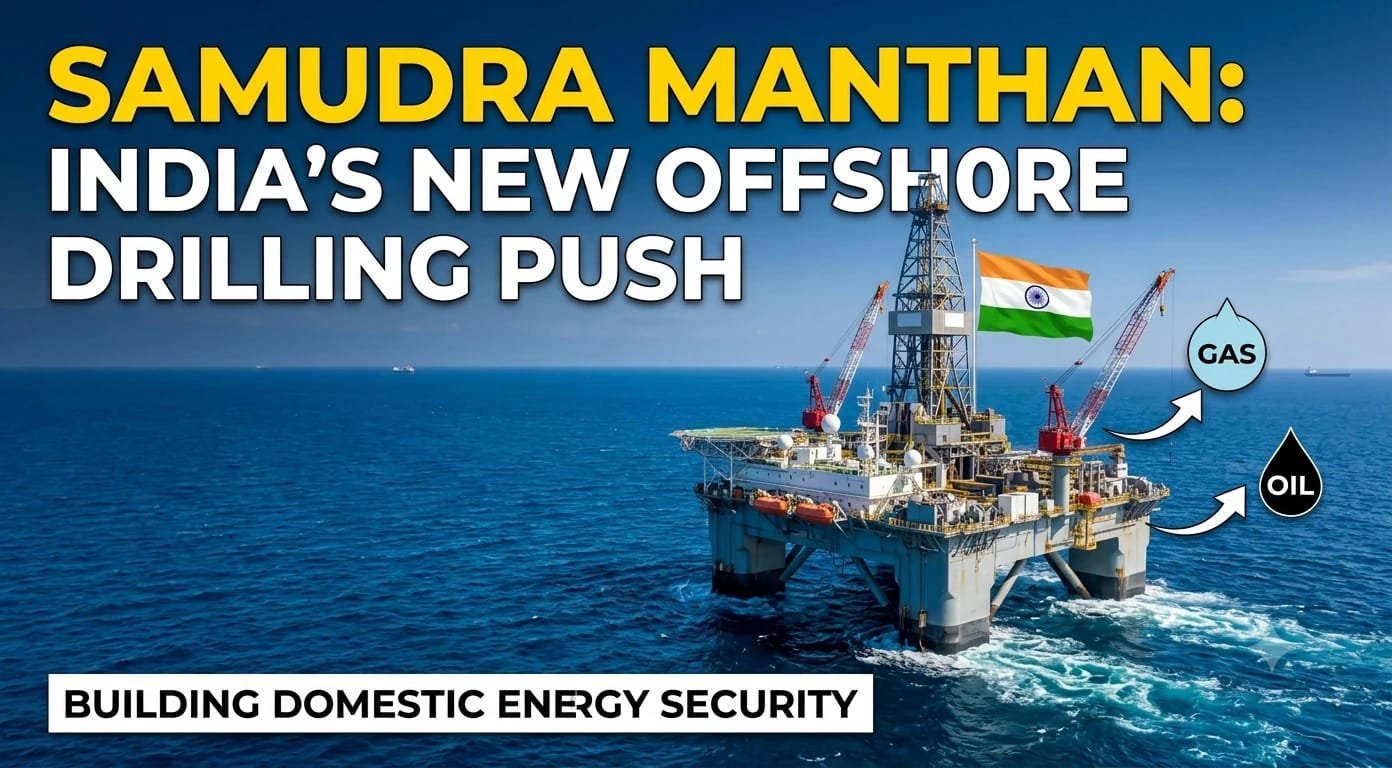
India has started shaping a year-wise plan for offshore drilling, rig deployment, and seismic surveys under the Samudra Manthan mission, which is the National Offshore Exploration Scheme. This plan is meant to turn a large policy idea into a clear working schedule, so that exploration work can move in a steady and organised way instead of depending on one-time actions.
The main aim of this mission is simple to understand. India wants to find more oil and gas from its own waters, reduce dependence on imports, and build stronger energy security for the future. The scheme has been designed as a major offshore push, with support for drilling, survey work, infrastructure, and related services.
Under this programme, the government has approved an outlay of ₹84,084 crore for implementation up to FY 2030-31. A major part of this amount has been set aside for offshore exploration and infrastructure-led production, including drilling 60 deepwater exploration wells. The support can cover up to 50 per cent of eligible drilling costs or ₹675 crore per well, whichever is lower.
The year-wise roadmap matters because offshore exploration is not a single-step job. It needs planning for survey data, well location, rig availability, drilling timelines, and support systems. By laying out work year after year, the ministry wants to keep the project moving across different phases and avoid delays that often slow large energy projects.
The focus is expected to stay on important offshore basins such as the Krishna-Godavari, Mahanadi, Andaman, and Cauvery regions. These areas are being treated as promising zones for future discoveries, and the roadmap is meant to speed up activity there through better planning and deployment of drilling rigs.
This move also shows how serious the government has become about domestic hydrocarbon production. According to official scheme details, the plan could help India raise its annual oil and gas output and expand the country’s hydrocarbon resource base if exploration succeeds. In other words, the idea is not only to drill more wells, but also to improve the long-term supply picture for the country.
The story also links to the larger energy market, where high import dependence has long been a concern. A stronger offshore exploration system can support future supply, reduce pressure from external markets, and give domestic producers a bigger role. For this reason, the Samudra Manthan plan is being seen as both an industrial and strategic move, not just a petroleum project.
Another important point is the role of rig deployment. Offshore rigs are expensive, specialised, and limited in number, so their deployment has to be carefully planned. A year-wise roadmap makes it easier to match the right rig with the right basin, the right depth, and the right drilling schedule, which can improve efficiency and lower wasted time.
In simple terms, this is India trying to build a more disciplined offshore exploration system. Instead of moving in a scattered way, the country is preparing a structured plan for drilling, surveys, and equipment use. If this plan works as intended, it could bring more clarity to energy planning and create a stronger base for future oil and gas discovery.

