
India’s factories and power plants kept churning out goods and electricity in July 2026, though the pace of growth cooled a bit compared with the previous month.
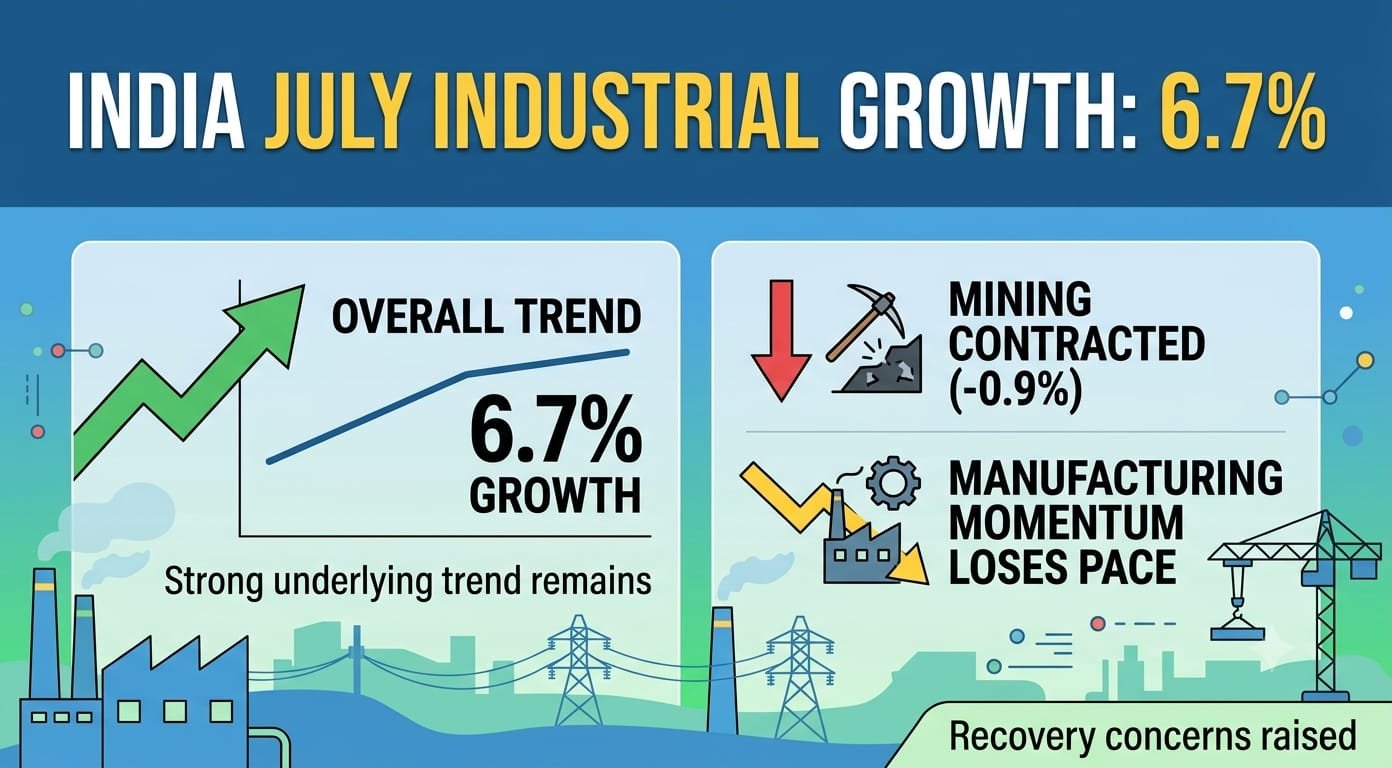
According to data released by the Ministry of Statistics and Programme Implementation, the Index of Industrial Production recorded growth of 6.7 percent in July, easing from an upwardly revised 8.8 percent seen in June .
This number reflects how much India’s mines, factories and utility companies produced compared with the same period last year, offering a broad snapshot of economic activity on the ground.
Manufacturing remained the biggest driver of this expansion, since it carries the largest weight within the index at over 76 percent . Factories producing motor vehicles, electrical equipment and general industrial machinery posted especially strong numbers, with vehicle and trailer output surging by 22.2 percent and electrical equipment climbing 28.3 percent .
Out of 23 manufacturing groups tracked, 19 showed positive growth during the month, pointing toward a fairly broad-based recovery rather than gains concentrated in just a handful of segments .
Electricity and gas supply also played a supporting role, growing 8.7 percent during July, making it the strongest performing sector among the three broad categories that make up the index . Water supply, sewerage and waste management followed with growth of 7.4 percent, continuing a steady pattern of expansion in this segment .
These utility-related numbers usually track closely with overall economic momentum, since rising electricity demand often signals more activity in homes, offices and industrial units alike.
Mining and quarrying turned out to be the one sore spot in an otherwise encouraging report. This sector actually contracted by 0.9 percent during the month, a sharp reversal from the 10.7 percent growth recorded in the same month last year .
Such a swing suggests temporary disruptions or high base effects rather than a lasting slowdown, though it clearly weighed on the overall headline number for the month.
Looking at the bigger picture, the Index of Industrial Production itself stood at 124.8 in July, up from 117.0 recorded in July last year . For the first four months of the current financial year, spanning April to July, industrial growth averaged 6.3 percent, comfortably ahead of the 4.0 percent recorded during the same stretch last year .
This comparison matters because it shows that despite month-to-month swings, the underlying trend for the financial year remains considerably stronger than before.
Capital goods, which include machinery and equipment used by other industries to produce goods, expanded in double digits for the seventh straight month, rising 16.1 percent in July [as reported by official data]. Infrastructure and construction goods also grew at a healthy 6.9 percent, while consumer durables touched an eight-month high .
Together, these figures hint at continued investment activity within the economy, since businesses tend to ramp up capital goods purchases when they expect demand to stay strong.
Economists tracking rural consumption patterns, however, flagged some caution regarding softer growth in certain consumer segments, even as overall headline numbers stayed healthy . This mixed signal is fairly common in large, diverse economies, where some sectors sprint ahead while others lag behind temporarily.
Global headwinds, including the impact of tensions in West Asia, were also cited as factors that could have affected certain segments of trade and industry during the month .
Despite this backdrop, the broader resilience shown by manufacturing and utility output suggests the domestic economy managed to absorb external shocks reasonably well, at least for now.
For India’s economy, the July data presents a mixed picture. Industrial production is still growing, and sectors such as electrical equipment, automobiles and consumer goods are performing well.
However, the slower growth across mining, manufacturing and electricity shows that the recovery is not equally strong in every segment. Future data will reveal whether July was only a temporary moderation or the beginning of a longer period of slower industrial expansion.

