
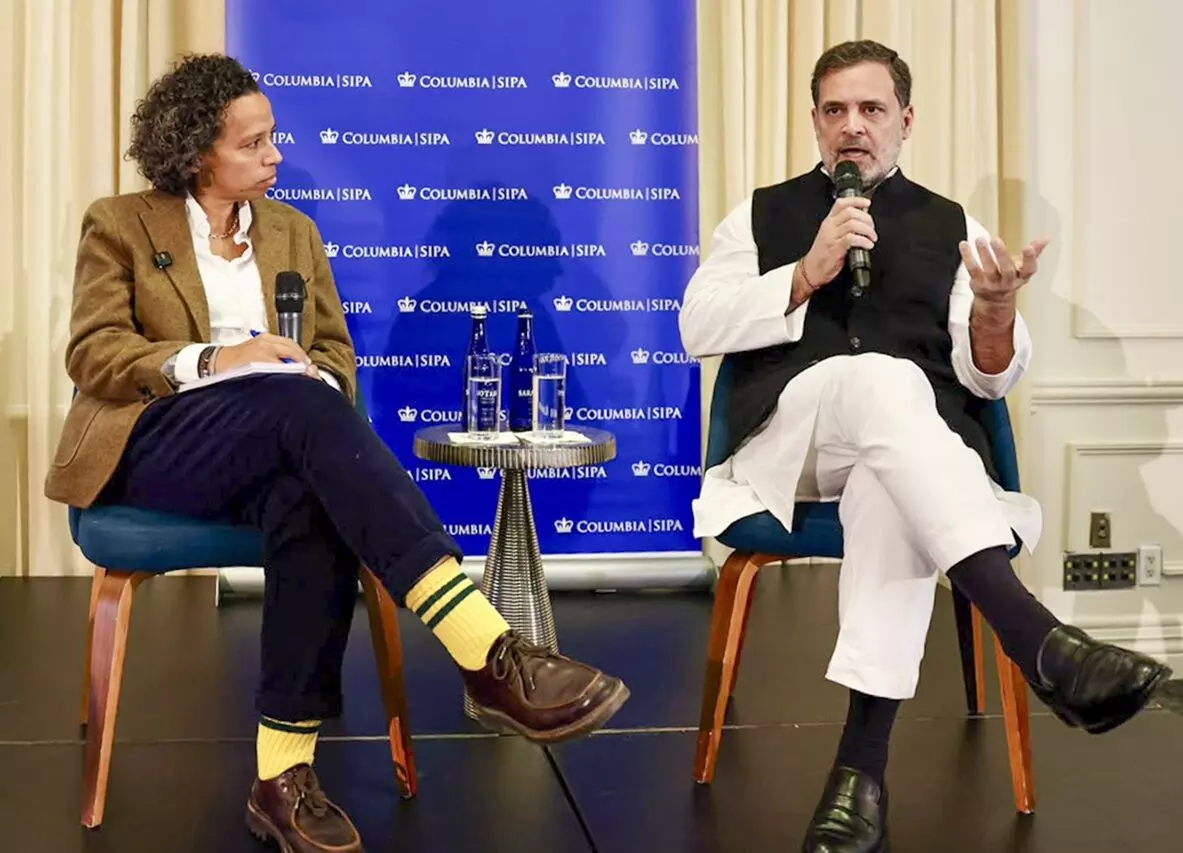
There is a familiar pattern now to Leader of Opposition and Congress’s blue eyed prince Rahul Gandhi’s foreign visits. Whenever the Congress scion travels overseas, he seems to discover a version of India that bears little resemblance to the country millions of Indians experience every day.
Instead of talking about India’s economic transformation, technological achievements, growing global influence or democratic institutions, he frequently chooses to highlight what he considers its failures. The question is not whether an opposition leader should criticise the government. Of course, he should. The question is why Rahul Gandhi so often appears more interested in portraying India negatively before foreign audiences than presenting a balanced picture of the country.
India is a democracy, and criticism of the government is perfectly legitimate. But there is a difference between holding a government accountable and repeatedly presenting the country as a fundamentally broken place. When political criticism looks like an orchestrated performance on international platforms, it raises questions about the message being conveyed and the audience being targeted. Gandhi is surely not targeting Indian audience with his utterances overseas.
Let us look at the facts, shall we. India is the world’s fastest-growing major economy. It has expanded its digital public infrastructure, strengthened its manufacturing ambitions, built world-class digital payment systems and emerged as an increasingly important voice in global affairs. None of this means India has solved all its problems. But surely a responsible national leader can acknowledge both achievements and shortcomings of the nation. And of course there are still shortcomings, India is not a perfect country by any stretch of the imagination, but it has significant achievements as well.
Rahul Gandhi’s approach often appears to prioritise the shortcomings while treating the achievements as inconvenient footnotes. Why is that? Can someone from Congress explain?
One explanation is domestic political positioning. Rahul Gandhi has struggled to convert his national political visibility into a consistent electoral mandate. Addressing international audiences allows him to project himself as a defender of democracy and constitutional values while attempting to build a narrative that the government at home is unwilling to acknowledge criticism.
There is also an obvious political incentive in attracting international media attention. Strong allegations travel further than nuanced explanations. A dramatic claim about India’s institutions or democracy can generate headlines, even when the larger picture is considerably more complicated.
But there is a cost to this strategy. Foreign audiences do not always distinguish between criticism of a government and criticism of the country itself. When a prominent Indian politician repeatedly presents a negative picture of India, the country’s image inevitably becomes part of the political collateral.
Opposition leaders are not expected to become government cheerleaders. They are expected to offer an alternative vision. Rahul Gandhi is perfectly entitled to criticise Narendra Modi. But why does that criticism so frequently need an international stage? And what is his alternate vision for India’s future? We never get to hear that.
India’s democracy is strong enough to accommodate dissent. What it deserves, however, is an opposition that can criticise its government without appearing embarrassed by its country’s achievements.

