
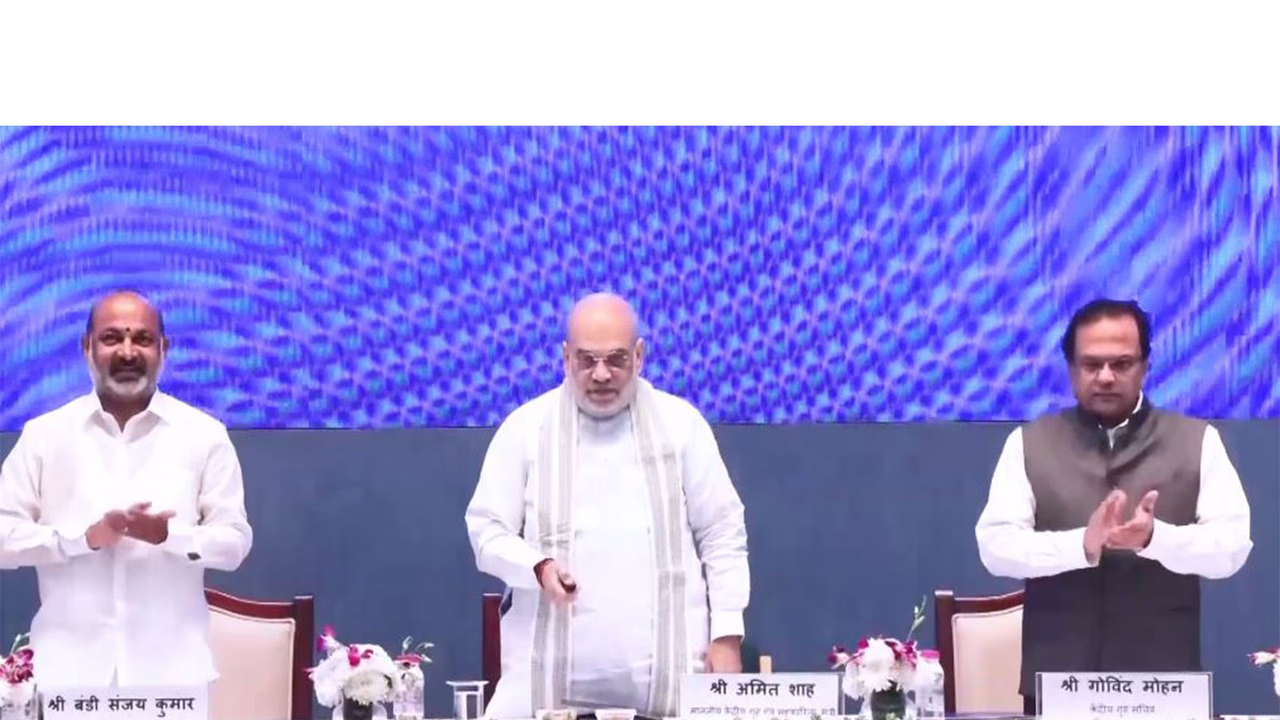
The 6th Anti-Terror Conference of the National Investigation Agency (NIA) concluded on Nov 20th with a renewed commitment to strengthening India’s collective counter-terrorism architecture through closer coordination between Central and State agencies, intelligence-led investigations and effective prosecution of terror cases.
The two-day conference, held on 19th and 20th November at DRDO Bhawan, New Delhi, was organised around the theme of ‘Cross-Border Terrorism’ and brought together senior officers of State Police forces, Central agencies and other stakeholders. The conference was attended by 40 DGs/Heads of State Police and Central Agencies and 230 participants from Anti-Terror Investigation Units of the States.
The conference was inaugurated by Union Home Minister and Minister of Cooperation, Shri Amit Shah, in the presence of Shri Bandi Sanjay Kumar, Minister of State for Home, Union Home Secretary Shri Govind Mohan, senior officers of Central and State agencies and other dignitaries.
Inaugurating the conference, Union Home Minister and Minister of Cooperation, Shri Amit Shah, reiterated the Government’s policy of zero tolerance towards terrorism under the leadership of Hon’ble Prime Minister Shri Narendra Modi. He emphasised the need for a coordinated, whole-of-government approach to dismantle the entire terror ecosystem, including its cross-border handlers, financial networks, organised crime linkages and local facilitators.
The Home Minister released NIA’s publication ‘Fail-Safe Investigation’, containing checklists covering 50 key investigative steps. The publication is aimed at minimising procedural, technical and legal lapses and strengthening the quality of investigations and evidence for effective prosecution. He laid the foundation stone for NIA office Complex at Chandigarh and inaugurated the residential complex of NIA in Delhi at Maidangarhi. The NIA portal ‘पुष्टि’, for verification of fraudulent NIA notices by citizens to prevent their misuse in digital arrests was also launched on this occasion.
Congratulating the police forces and the armed forces for making the country safer, the Home Minister focussed on the importance of preventive action by security forces to thwart terrorist incidents. He lauded the efforts taken by Central and State Agencies for bringing back 303 fugitives from 36 countries.The Union Home Minister emphasised the need to eliminate the three major challenges of terrorism, organised crime and drug trafficking. He underscored the importance of joint and coordinated action by Central and State agencies, backed by an integrated ecosystem of cooperation and information-sharing.
The Home Minister stressed on the need for seamless flow of information from and to the cutting edge level, where action is taken. He insisted on shared and joint goals with clear directions on accountability and responsibility to achieve intended results.
Stressing on the need for striking the whole chain of terror money, he brought out the importance of strengthening relationship with the agencies that conduct financial investigation.
Home Minister emphasized that to ensure completeness of investigation, the ATS structure needs to be strengthened and an ATS built on the model ATS structure will give great benefit in investigation. Considering the increasing use of technology by the terrorists, a strong Cyber Expert Unit should be an important feature of the ATS in the states.
The main track of the conference featured deliberations on the nexus between organised crime and terrorism, radicalisation, cross-border terror financing, international cooperation, technology and whole-of-government initiatives. Discussions covered the use of drones and digital platforms by terrorist and criminal networks, cross-border smuggling of arms and narcotics, online radicalisation and lone-actor threats, financial channels including hawala and trade-based money laundering, and mechanisms for extradition, deportation and international evidence-sharing. Sessions also examined the use of artificial intelligence, big data analytics and digital forensics in counter-terrorism investigations.
Track II, introduced during the previous conference and made a regular feature from this year, focused on “Prosecution of Terror Cases”. The sessions brought together investigators, prosecutors and legal experts to deliberate on the application of new criminal laws, handling and admissibility of digital evidence, investigation procedures, trial strategy and case management. Discussions also covered special provisions under the UAPA and BNSS, witness protection and the use of government platforms such as e-Sakshya, e-Prosecution and e-Forensics. The deliberations underscored the need to ensure that professional investigations culminate in effective prosecution and timely convictions.
In his concluding address, Union Home Secretary Shri Govind Mohan emphasised the need to translate the national counter-terrorism framework PRAHAAR into coordinated action at the State, district and police-station levels. He urged States to strengthen their ATSs in line with the Model ATS Structure, enhance specialised training and forensic capabilities, and ensure that financial investigations are initiated alongside investigations into the principal terror offence. He also stressed the importance of early identification of radicalisation, effective use of technology and intelligence platforms, and closer coordination between investigating and prosecuting agencies.
The Home Secretary also called for a more proactive approach towards securing the return of fugitives operating from abroad through updated dossiers, INTERPOL mechanisms and the Extradition Portal, in coordination with MHA, MEA and other stakeholders.
The conference reaffirmed the importance of a coordinated, whole-of-government and whole-of-agencies approach in tackling the evolving threat of terrorism. It provided an important platform for sharing operational experiences, identifying gaps in existing capabilities and developing actionable strategies to strengthen India’s counter-terrorism preparedness in furtherance of the vision of Viksit Bharat 2047.
During the year 2026, NIA has so far registered 82 cases this year. Of the 29 cases in which judgments were pronounced, the Agency secured conviction in 27 (93% conviction rate) in which 123 accused were convicted. The convictions included death sentences to 10 and Life imprisonment to 14. In its efforts to build the capacity of state police units in investigation of terror cases, NIA trained 5800 police personnel through 53 training programmes during this year. The Agency has taken major initiative in upgrading the ability for use of technology and digital evidence by establishing Technical Support Units in each of its 21 state units. For expeditious trial in courts, 25 Exclusive NIA courts have been established with another 14 likely to be established shortly. The Agency has also augmented its foreign investigation and extradition/ deportation capability by strengthening its Foreign Investigation Unit through appointment of International Legal Experts.

