
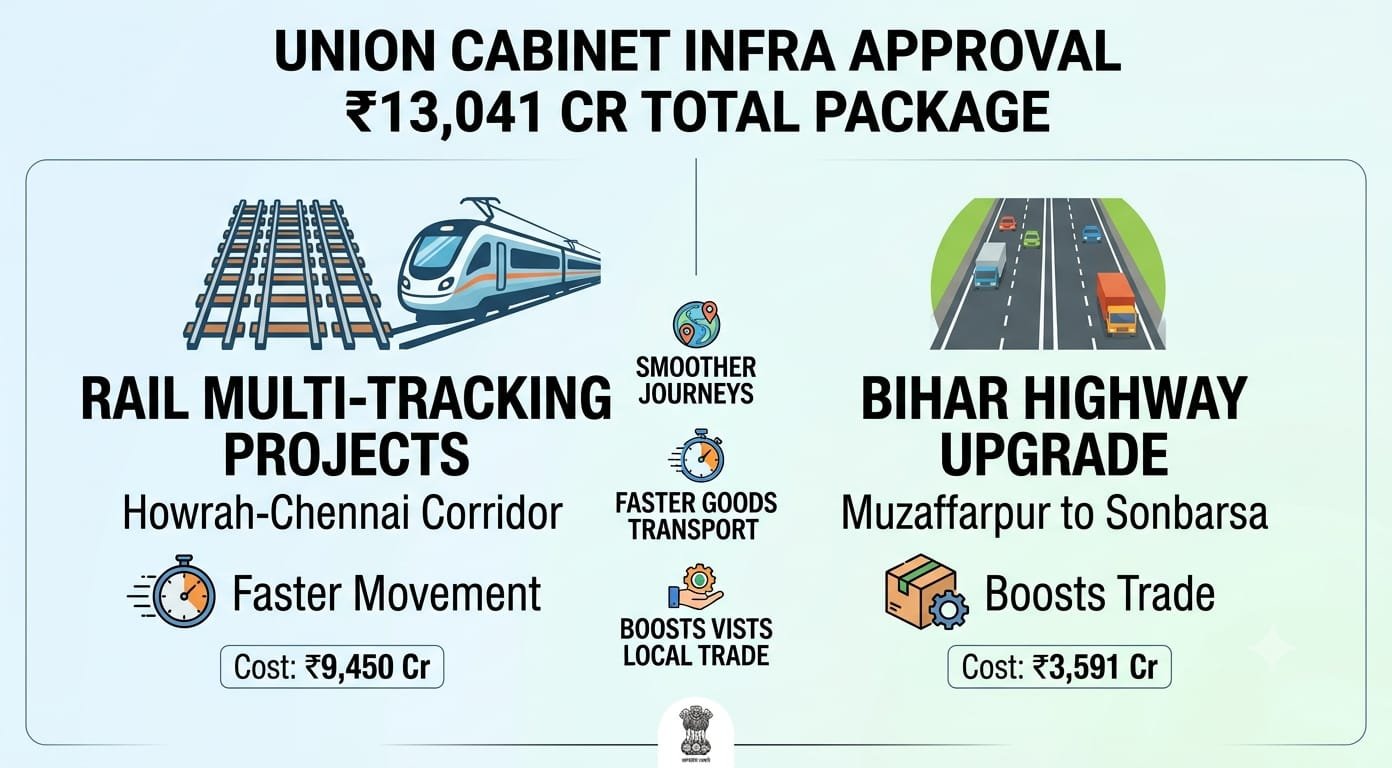
The Union Cabinet has approved a major infrastructure package that includes four railway multi-tracking projects and one four-lane highway project, with a total cost of Rs 13,041 crore. The decision is meant to improve transport capacity, reduce pressure on crowded routes, and make movement easier for passengers as well as freight traffic.
The railway part of the package is the larger share, costing around Rs 9,450 crore. It covers four projects on the busy Howrah-Chennai corridor, which is one of the country’s high-density railway routes and often faces heavy traffic.
The approved projects are the Kharagpur-Bhadrak fourth line, the Bhadrak-Haridaspur fourth line, the Gummidipundi-Gudur third and fourth line, and the Cuttack-Paradeep third and fourth line. Together, these works will add about 410 km to the railway network across West Bengal, Odisha, Andhra Pradesh, and Tamil Nadu.
This expansion matters because a crowded railway line slows down trains and affects both passengers and goods movement. With extra tracks, trains can run with less delay, and the system can handle more traffic more smoothly. The government has said that these projects will help decongest the route and improve connectivity across eight districts.
The highway project approved at the same time is the upgradation of the Muzaffarpur-Sitamarhi-Sonbarsa section of NH-22 in Bihar. This stretch is about 82.57 km long and will be developed into a four-lane road under the Hybrid Annuity Mode, with a capital cost of Rs 3,590.73 crore.
For people in Bihar, this road project is expected to make travel faster and more comfortable, especially for those moving between Muzaffarpur, Sitamarhi, and Sonbarsa. The route also has wider importance because it improves access toward the India-Nepal border region. Better roads usually help local trade, reduce travel time, and make the transport of goods easier and more reliable.
The overall impact of these approvals is linked to both daily life and the wider economy. Rail upgrades can support industrial movement, port-linked transport, and long-distance travel, while highway widening can help regional mobility and market access. When such projects move forward together, they tend to strengthen the link between states, districts, and major economic zones.
In simple terms, the Cabinet has tried to fix two common transport problems at once: too much pressure on key railway lines and the need for better roads in Bihar.
This can mean smoother journeys in the future, and for businesses, it can mean faster movement of goods and fewer delays. The approval also shows a continued push to expand basic infrastructure as part of long-term development planning.

