
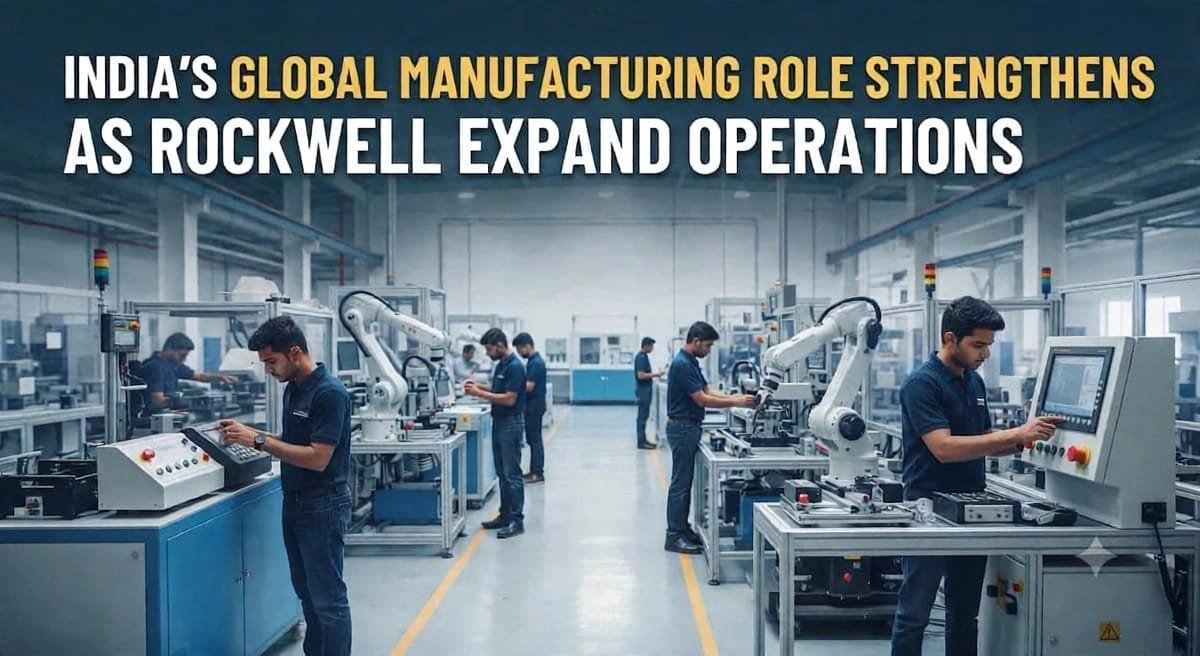
India is becoming more closely connected to global manufacturing, with new industries growing and locally made products reaching overseas markets. However, expanding factories alone will not be enough. Finding skilled workers and making production more efficient remain important challenges, according to Dilip Sawhney, Managing Director of Rockwell Automation India.
Speaking to PTI during the Rockwell Automation Fair in Boston, Sawhney said India’s place in global manufacturing was changing rapidly. The event, held from November 16 to 19 under the theme Future in Focus, brought attention to industrial operations and smart manufacturing. His comments were reported by The Economic Times on November 21, 2026.
Sawhney said India’s sustained growth was increasingly recognised internationally. New industries were developing and expanding, while the country was becoming more involved in global value chains. In simple terms, Indian factories were contributing products and components to wider production networks serving businesses across different countries.
Rockwell’s own expansion reflects this shift. The company has operated in India for 43 years and increased its Indian workforce fivefold over the past decade. Sawhney said its presence had grown beyond housing important company capabilities, with India also becoming a manufacturing base supplying products to overseas markets.
The company now has three factories in Chennai, all connected to its global supply chain. Their production supports important industries, including semiconductors. Sawhney also said modular enclosures made in India were being supplied to renewable energy projects and data centres worldwide, with data centres becoming an increasingly important destination.
Yet the growth story comes with a difficult contrast. India has a large population and many people seeking employment, but manufacturers still struggle to recruit workers with suitable skills. Sawhney said customers operating factories in industrially advanced states such as Tamil Nadu described access to skilled workers as their biggest problem.
He argued that manufacturing employment needed to become more attractive and aspirational, as it is in advanced manufacturing economies. The challenge was therefore not simply the number of available workers. It also involved whether people had the required abilities and wanted to pursue careers connected to factory operations.
India’s investment in new facilities offers another opportunity. Sawhney said fresh manufacturing capacity needed to be designed to improve competitiveness. Since businesses operate with large production volumes and strong pressure on prices, efficiency matters. He suggested that technology could deliver major improvements when businesses also committed to changing established working methods.
Demand is also emerging from quick commerce, the business of delivering orders rapidly. Sawhney said its growth was driving warehouse expansion across India. He described this development as an Indian innovation, pointing to another area where expanding operations create demand for more efficient systems and processes.
On regulation, Sawhney stressed the importance of compliance. Even a beverage can contain the correct quantity, he explained. He said systems designed for specific needs and automation were important for meeting rules and maintaining accurate manufacturing records. His broader message linked India’s industrial progress with skills, competitiveness and reliable operations.
For workers, the issue is access to suitable manufacturing careers. For businesses, it is access to capable teams. Connecting these needs remains central to the opportunity Sawhney described for India’s expanding industrial sector.

