
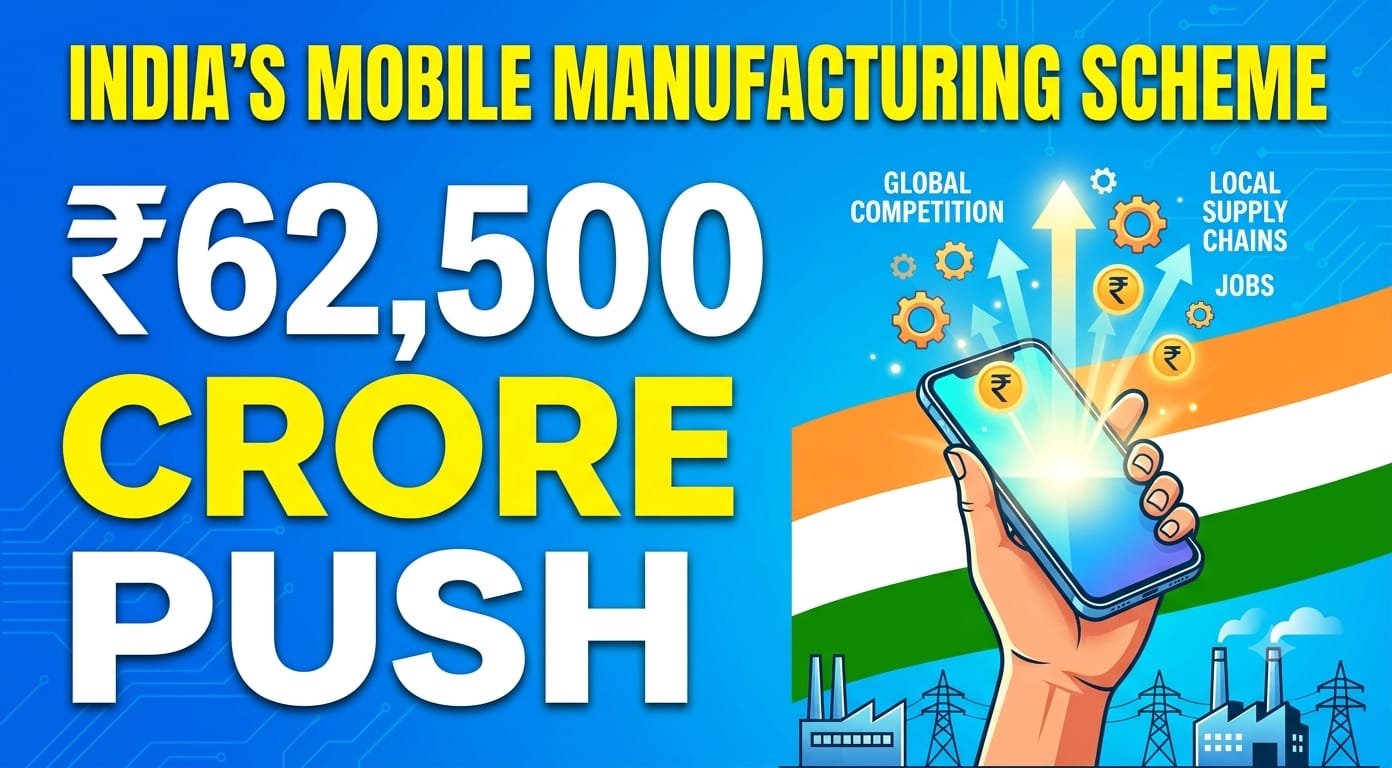
India has taken another major step to strengthen its mobile phone manufacturing industry. The Ministry of Electronics and Information Technology has notified the Mobile Phone Manufacturing Scheme, or MPMS, with a budgetary outlay of ₹62,500 crore. The scheme is designed to increase mobile phone production in the country, bring more manufacturing activity under the domestic supply chain and help Indian brands compete in international markets.
The programme will operate for five years, from financial year 2026-27 to 2030-31. During this period, companies manufacturing mobile phones in India will receive incentives based on eligible sales. The incentive rate will range from 2.25% to 5%, depending on the category and conditions fulfilled by the company. This means that higher production, stronger domestic sourcing and better compliance with the scheme can help eligible manufacturers receive greater support.
The main purpose is not limited to assembling phones in India. The government wants a larger share of the complete mobile manufacturing ecosystem to develop within the country. At present, a mobile phone depends on several parts and sub-assemblies, many of which may come from outside India. The new scheme aims to encourage companies to use more locally produced components, so that a greater portion of the phone’s value is created inside the country.
For domestic sourcing of key components and sub-assemblies, companies can receive an additional incentive of up to 1.5%. However, the components must meet the prescribed localisation conditions. The scheme requires such localised components to be used in at least 25% of the total mobile phone units manufactured during a financial year. This condition is expected to encourage suppliers of batteries, camera modules, displays, circuit boards and other important parts to expand their operations in India.
The scheme has two major target segments. The first segment supports mobile phone manufacturing by companies registered in India, including Electronics Manufacturing Services providers. The second segment focuses on Indian-owned mobile phone brands. Under the second segment, eligible Indian brands can receive a 5% incentive on eligible sales, along with an additional 3% incentive for product design and research and development carried out in India.
The special focus on Indian brands is important because the government wants India to move beyond contract manufacturing. A phone may be assembled in India, but the brand ownership, product design, software development and intellectual property may belong to a foreign company. MPMS aims to encourage Indian companies to develop their own products, hold their trademarks and patents in India, and build brands that can compete with established global names.
To qualify as an Indian brand, the company must be registered or incorporated in India. Its intellectual property and trademark must be held in India, management control must remain with Indian citizens and more than 51% of its shareholding must be held by Indian citizens. The company must also have design and research capabilities within the country. These requirements are intended to ensure that the financial benefits create long-term Indian ownership and not only short-term assembly activity.
Eligibility requirements are different for the two segments. For regular mobile phone manufacturing, an applicant must have a minimum turnover of ₹10,000 crore in the financial year 2025-26. Existing brands must achieve an annual sales threshold of ₹5,000 crore above their financial year 2025-26 sales.
A new brand must first reach total annual sales of ₹10,000 crore in India and then meet the required yearly sales target. Indian brand applicants under the second segment must have a minimum turnover of ₹1,000 crore in financial year 2025-26 and satisfy the conditions related to Indian ownership, intellectual property and in-house design.
The government expects the scheme to support cumulative mobile phone production of approximately ₹39 lakh crore during its five-year period. It also expects mobile phone exports to rise significantly as India becomes a stronger production base for global companies. Around 60,000 direct jobs are expected to be created, while additional employment may emerge through component suppliers, logistics companies, repair services, packaging units and industrial support businesses.
The immediate impact may not always be visible. The scheme does not directly promise a fixed reduction in smartphone prices. However, if local production increases and more components are made in India, companies may face lower supply-chain costs and fewer import-related risks over time. The bigger benefit could be seen in better availability of products, more technology investment, stronger Indian brands and greater employment opportunities.
Union Electronics and IT Minister Ashwini Vaishnaw has said that the scheme is intended to build Indian intellectual property, design capability and globally competitive brands. The success of MPMS will therefore depend not only on the amount of money released but also on whether companies invest in research, train workers, develop suppliers and create products that consumers in India and other countries are willing to buy.
If implemented effectively, the ₹62,500 crore scheme can help India move from being mainly a large smartphone market and assembly base to becoming a complete electronics manufacturing and innovation hub. Its long-term success will be measured by the strength of Indian brands, the growth of local component production, the rise in exports and the number of skilled jobs created across the industry.

