
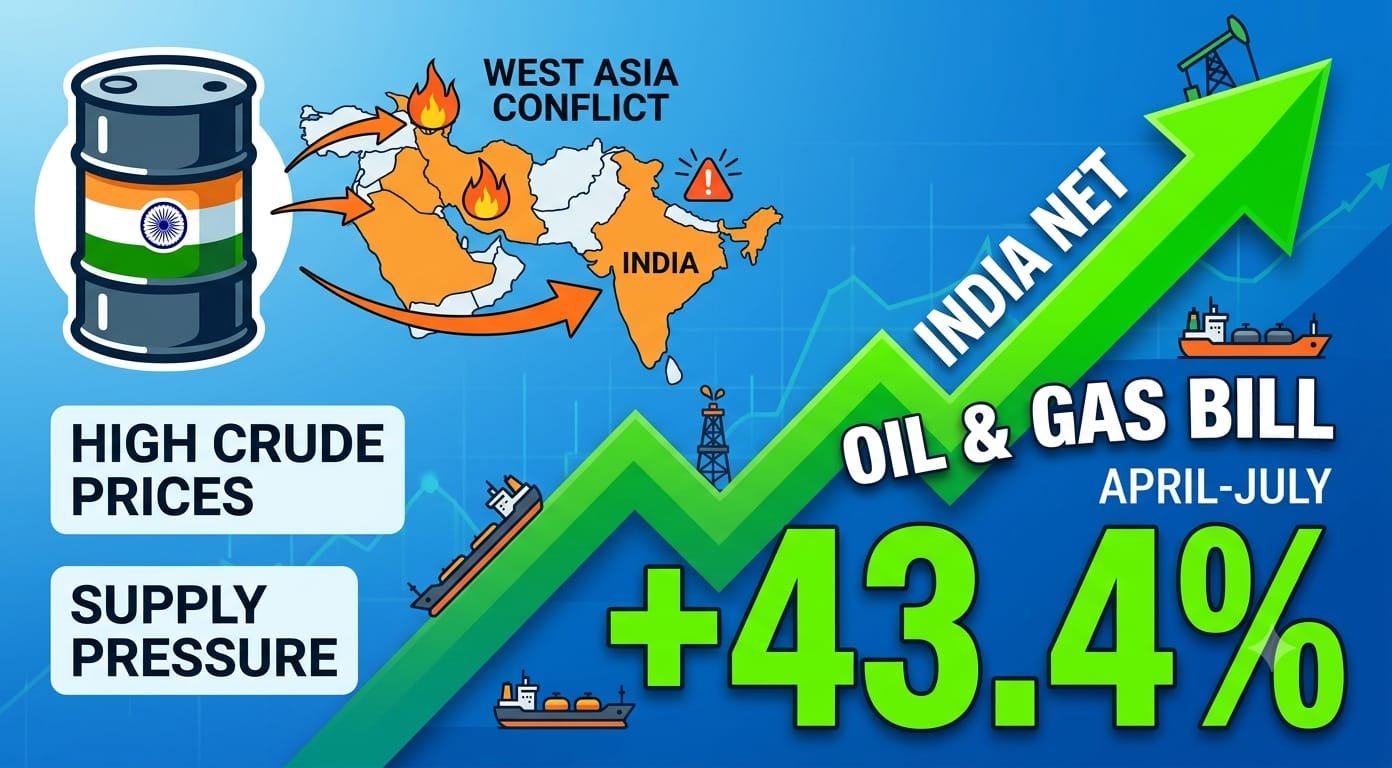
India’s oil and gas import bill has risen sharply in the first four months of the current financial year, mainly because the West Asia conflict kept global energy prices high and made supply lines uncertain .
The total net oil and gas import bill touched $57.8 billion in April-July, compared with $40.3 billion in the same period a year earlier, which means the increase was 43.4 percent. In simple terms, more money had to be paid for the same kind of energy need, because the world market became expensive and unstable.
This rise matters because India depends heavily on imports to meet its fuel needs, so any jump in global prices quickly affects the country’s spending . The crude oil import bill alone climbed to $63.4 billion in April-July, which was more than 56 percent higher than last year .
At the same time, crude import volume was almost unchanged at 81.9 million tonnes, compared with 81.5 million tonnes a year ago, showing that the cost increase came mainly from higher prices rather than from buying much more oil .
The pressure started showing up earlier in the year and continued through the months that followed . In April-June, India’s net oil and gas import bill had already jumped 45.3 percent to $44.9 billion, and the crude import bill during that quarter had reached almost $49.8 billion .
By July, the trend remained strong, with crude import spending still higher than last year because international prices stayed elevated . This pattern suggests that the conflict kept the market tense for a longer period instead of causing only a short shock .
A major reason behind the cost increase was the fear of disruptions in the Strait of Hormuz, one of the most important routes for energy movement from West Asia . When such a route becomes risky, buyers often pay more because sellers and shippers add a premium for uncertainty .
Even if ships continue moving, the market responds to the threat itself, and that is enough to raise import bills . This is why the rise in spending can be seen even when volume changes are small .
The effects are not limited to government data alone. Higher oil import costs can slowly affect transport, cooking fuel, factory costs, and inflation-linked prices in daily life . When fuel becomes expensive, businesses often face higher operating costs, and that pressure can move through the economy step by step .
For a country that imports most of its crude needs, this becomes a reminder that global conflicts can reach household budgets through fuel prices.
The current numbers also show an important lesson about energy dependence. India is paying more not because it suddenly needs much more oil, but because the global market is charging more due to fear, disruption, and tight supply.
That difference is important, because it explains why the same level of demand can still create a much bigger import bill. As long as energy imports stay central to the economy, any war or regional crisis in a major oil zone can quickly become an Indian economic issue.

