
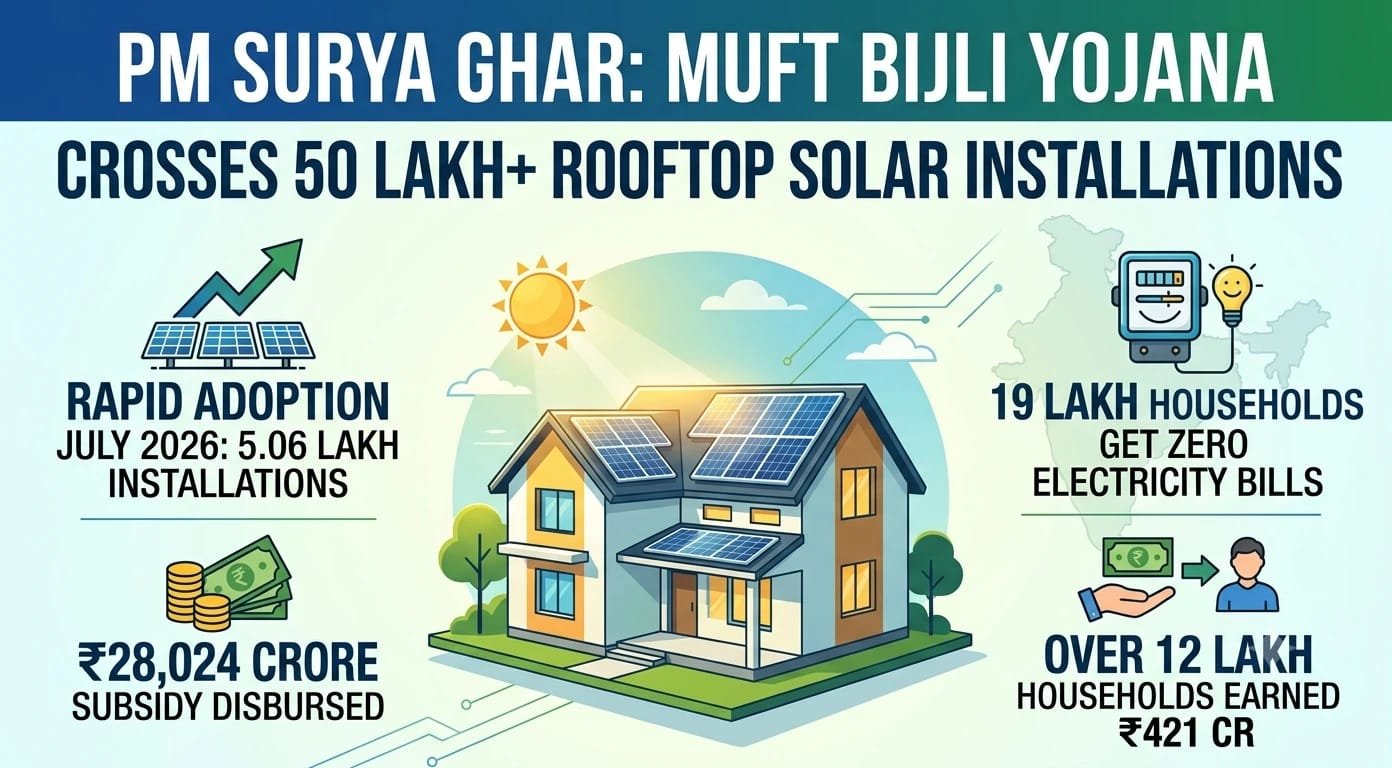
The PM Surya Ghar- Muft Bijli Yojana has now crossed a major mark, with more than 50.06 lakh households benefiting from rooftop solar installations across India.
This growth happened in a little over two years, which is much faster than the 7.94 lakh rooftop solar installations seen in the previous 10 years.
The scheme has become one of the biggest rooftop solar programmes in the world, backed by an outlay of Rs 75,021 crore. The main idea is simple and powerful: more homes produce their own clean electricity and depend less on the grid.
The latest figures show that the pace has risen sharply in recent months. In July 2026 alone, 5.06 lakh households got installations, which is the highest monthly number since the scheme began.
The government said the programme is now helping about 1 lakh households every six days, showing how quickly rooftop solar is spreading. Daily installations also climbed from 5,038 in October 2025 to nearly 16,328 in July 2026.
The financial side is also important for families. Around Rs 28,024 crore has already been sent as subsidy directly to beneficiaries through Direct Benefit Transfer. Nearly 19 lakh households are now getting zero electricity bills, which reduces monthly pressure on family budgets.
More than 12 lakh households earned Rs 421 crore in FY25 by selling extra power back to the grid, which means rooftop solar is not only saving money but also creating an additional income stream.
The scheme has also widened access through easier financing and wider support systems. Concessional loans at 5.75 per cent have been sanctioned for 21.87 lakh applicants, and 17.5 lakh installations have already been completed through loan financing.
The Utility Led Aggregation model has helped low-income groups, with 1.6 lakh installations completed for PMAY, BPL, and SC/ST households across four states, and the model has been approved for rollout in 12 states. This means rooftop solar is slowly reaching homes that earlier found it too costly or too complicated.
The scheme has also created jobs and a support network around solar installation. There are 34,219 registered vendors, of whom 29,469 are active across the country. More than 2.32 lakh people have been trained under capacity-building programmes, which helps strengthen the local solar value chain.
In total, 14.8 GW of rooftop solar capacity has been commissioned under the scheme so far, showing that the project is adding real energy capacity along with household savings.
Another notable feature is the online system behind the programme. The scheme uses Jan Samarth for paperless loans, PFMS for subsidy release within 15 days, and API links with more than 80 discoms for smoother processing.
A digital net metering agreement and vendor rating system have also been added to make the process more transparent and consumer-friendly. These steps matter because a simple, fast process often decides whether a household moves ahead with solar or gives up halfway.
The broader message is clear.The scheme is helping households save money, earn from surplus power, and take part in India’s clean energy shift. It is also supporting government buildings, urban bodies, and local distribution companies through incentives and solarisation programmes. With this pace, rooftop solar is no longer a distant policy idea; it is becoming a practical part of daily life for millions of Indian families.

