
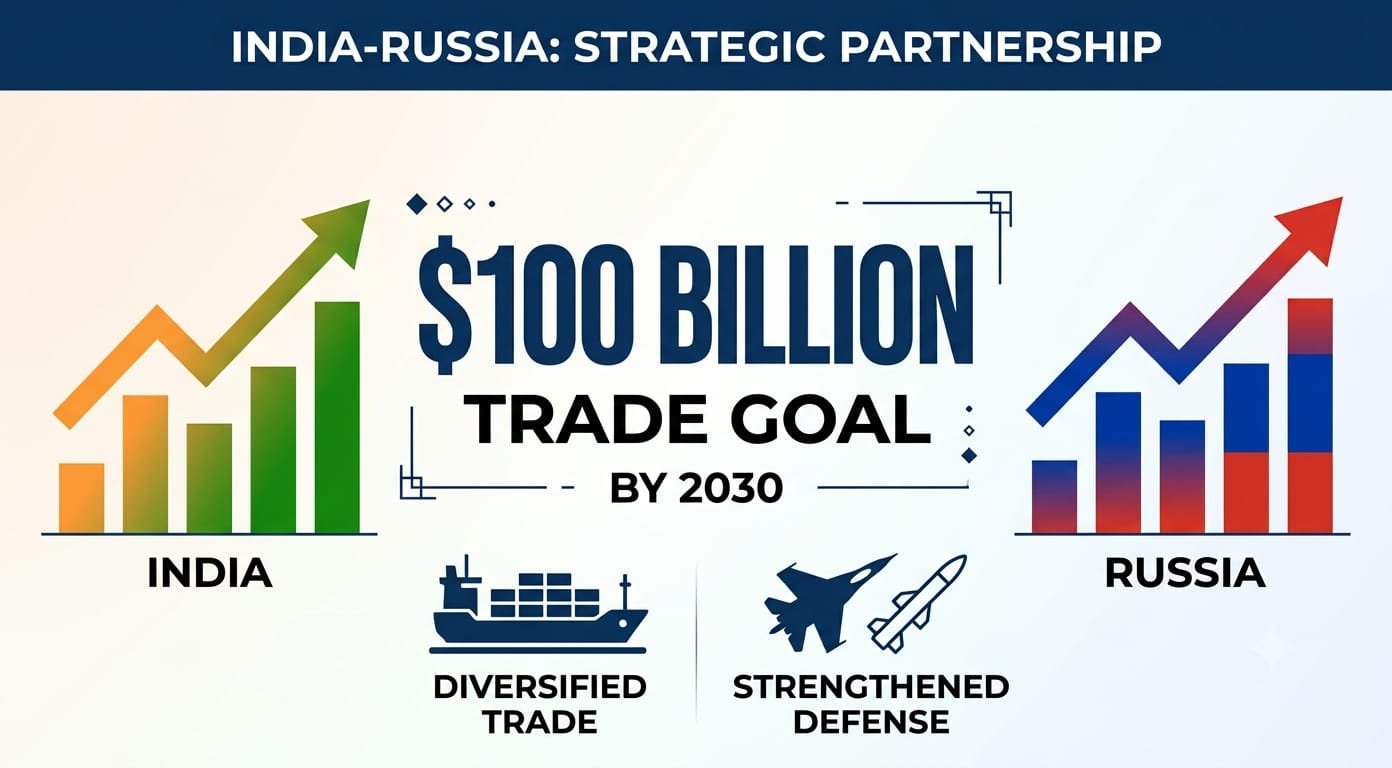
Prime Minister Narendra Modi and Russian President Vladimir Putin have discussed an ambitious plan to raise annual trade between India and Russia to $100 billion by 2030.
The target is significant because bilateral trade currently stands at around $65 billion. Reaching the new goal will require both countries to expand cooperation in several areas and reduce their dependence on a limited number of products.
The meeting took place in New Delhi on the sidelines of the 18th BRICS Summit. It was the second meeting between the two leaders in less than two weeks.
The discussions covered trade, investment, defence, energy, infrastructure, technology, space, civil nuclear power, skill mobility and people-to-people relations. Both sides also reviewed the progress of the Programme for Economic Cooperation 2030.
The most important economic challenge is the imbalance in bilateral trade. India imports large quantities of crude oil, fertilisers, defence equipment and other energy-related products from Russia. At the same time, Indian exports to Russia remain comparatively limited.
This situation has created a trade gap, making it necessary for India to increase exports and secure better access to the Russian market.
The two countries are therefore looking at cooperation beyond oil and defence. Indian companies may find greater opportunities in pharmaceuticals, engineering goods, food products, chemicals, textiles, information technology and machinery.
Russia is also expected to improve market access for Indian exporters. More business-to-business cooperation, easier payment arrangements and stronger transport links could help smaller companies participate in bilateral trade.
Industrial cooperation was another important part of the discussions. India and Russia are exploring joint work in manufacturing, railways, tunnelling, steel, infrastructure and critical minerals. Such cooperation could create new investment opportunities and support supply-chain security.
Critical minerals are becoming increasingly important because they are needed for electric vehicles, batteries, electronics, renewable energy equipment and defence technology.
Energy cooperation will remain central to the relationship. Both countries discussed oil, fertilisers, civil nuclear energy and other long-term energy projects. Russia has been an important source of energy for India, while India is interested in stable and affordable supplies. Civil nuclear cooperation could also expand, with discussions covering new reactors, fuel supply and long-term technical support.
Defence cooperation continues to be a major pillar of India-Russia relations. The two sides reviewed the delivery of the remaining S-400 missile-defence systems. Cooperation involving BrahMos missile upgrades was also discussed. Russia has indicated that it remains committed to completing pending S-400 deliveries.
There has also been discussion about the possible supply of Su-57 fighter aircraft, although the details and final decisions have not been publicly confirmed.
The direction of defence cooperation is gradually changing. Earlier, the relationship was mainly based on buying military equipment from Russia. India now wants more joint research, technology transfer, local manufacturing and co-production under the Make in India programme. This approach could help India strengthen domestic defence production, develop technical skills and reduce dependence on imported systems.
The talks also included global issues, including the war in Ukraine and the situation in West Asia. India again emphasised that dialogue and diplomacy are the best ways to resolve conflicts. Prime Minister Modi also raised concerns about the safety of Indian seafarers in the Black Sea. This issue matters because disruptions in conflict zones can affect shipping, trade routes and the movement of Indian workers.
The proposed $100 billion trade target is ambitious, but it also reflects the changing nature of India-Russia relations. Energy and defence will remain important, yet future growth will depend on manufacturing, technology, infrastructure, exports and private-sector participation.
If trade barriers are reduced and Indian products gain wider access to Russia, the target could support jobs, investment and new business opportunities.
The Modi-Putin meeting shows that both countries want to keep their long-standing partnership relevant in a changing global economy. The success of the plan will depend not only on political announcements but also on practical steps, including faster payments, reliable logistics, balanced trade and timely completion of defence and industrial projects.

