
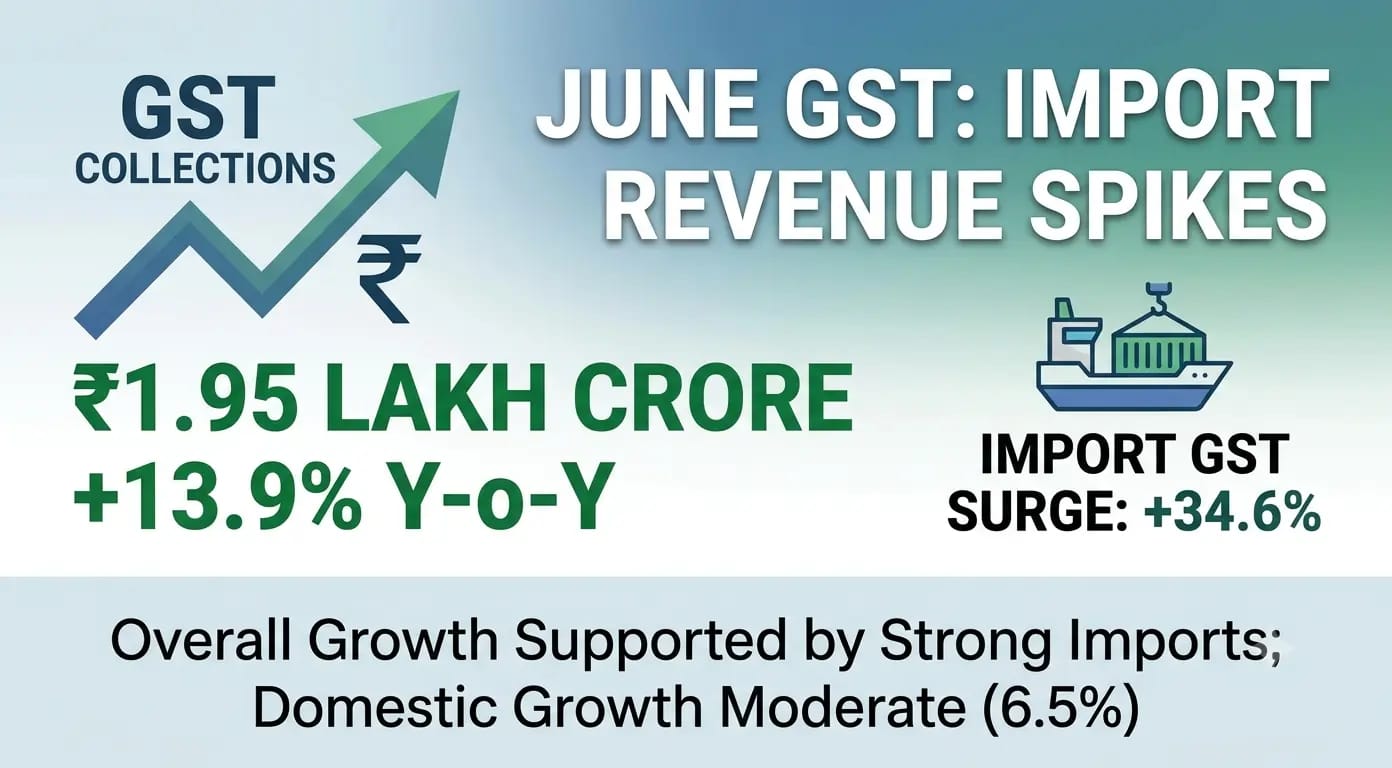
India’s Goods and Services Tax collection gave the government a strong start to the new quarter, rising to about Rs 1.95 lakh crore in June, according to the Finance Ministry’s latest data.
The figure shows a year-on-year jump of 13.9%, which is important because GST collections are often seen as a quick indicator of how much business activity is taking place across the economy. The latest numbers suggest that demand has not collapsed, and that trade-linked activity, especially imports, is playing a major role in supporting tax receipts.
What stands out most in the June data is the sharp rise in revenue from imports. Gross GST revenue from imports surged 34.6% year-on-year to Rs 60,038 crore, while domestic collections grew at a much slower pace of 6.5% to around Rs 1.35 lakh crore.
This difference matters because it shows that the overall growth is being pulled up more by goods coming into the country than by purely domestic sales. In simple terms, businesses are still buying from abroad at a healthy pace, and that is helping the tax system collect more revenue.
After refunds were adjusted, net GST collections also looked strong, rising 11.2% to Rs 1.62 lakh crore in June. Refunds themselves increased 29.1% to Rs 32,436 crore, which means the government returned more tax money to businesses than it did a year ago.
Even after that larger refund outflow, the net number remained solid, which is usually a sign that the underlying tax base is still expanding. For policymakers, this is reassuring because it shows that higher refunds did not erase the overall revenue gain.
The June figures also add useful context for the first quarter of the financial year. Gross GST collections for April to June rose 8.4% to Rs 6.32 lakh crore, while net collections increased 7.1% to Rs 5.40 lakh crore.
This suggests that the tax system has maintained steady momentum, even though the monthly pattern has become more uneven. A stronger quarter helps the government manage spending plans, especially at a time when economic growth and global trade are both being watched closely.
For ordinary people, GST data may sound technical, but it reflects everyday realities. When collections rise, it usually means more goods are being sold, more services are being used, and more imports are entering the economy.
It does not automatically mean everyone is spending more freely, but it does show that the economy is still moving rather than stalling. The latest data also hints that firms involved in trade, manufacturing, and distribution are seeing enough activity to generate higher tax payments.
At the same time, the numbers show a mixed picture. Domestic growth was positive, but not especially fast, which means the economy is not racing ahead evenly across all sectors.
The heavy contribution from imports also means that future GST growth will depend not just on local demand, but on how trade flows, production costs, and global conditions evolve. For now, though, June’s GST collection report points to a fairly resilient economy with strong trade support and stable tax momentum.

