
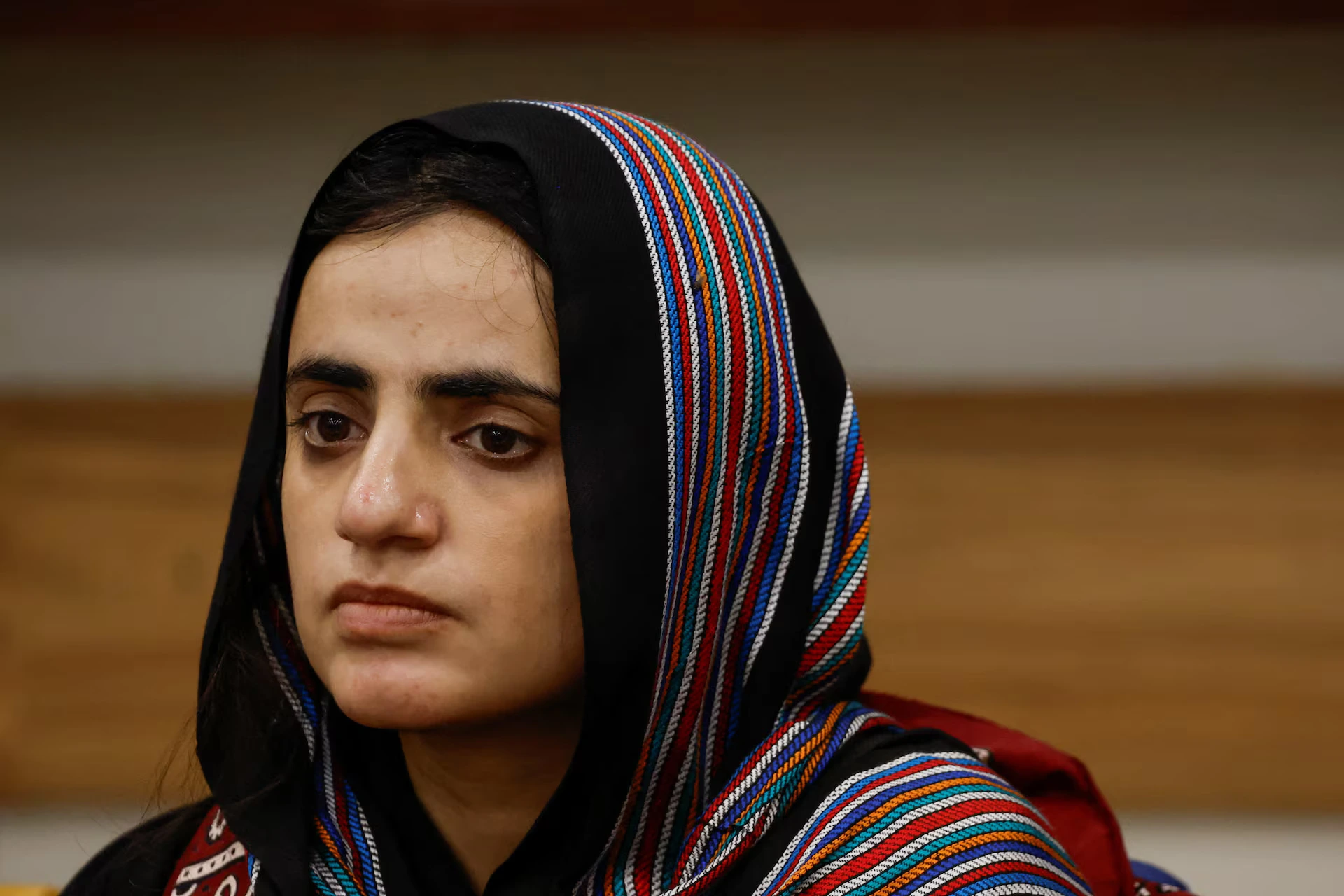
On June 22, 2026, an Anti-Terrorism Court (ATC) in Quetta, the provincial capital of Balochistan, sentenced Dr. Mahrang Baloch, founder and leader of the Baloch Yakjehti Committee (BYC), and her associate, Sibghatullah, to life imprisonment in connection with the death of Frontier Corps (FC) trooper Shabbir Baloch during the Baloch Raaji Muchi (Baloch National Gathering) held in Gwadar on July 29, 2024.
The verdict was delivered by ATC-I Judge Muhammad Ali Mubeen while the accused, other detained BYC members, and their legal counsel were boycotting the proceedings, describing them as a “faceless trial.”
According to Advocate Israr Jattak, counsel for Mahrang Baloch and other BYC leaders, the convictions relate to allegations that Shabbir Baloch sustained fatal injuries after being struck by stones allegedly thrown by participants during the gathering.
Since June 12, 2026, Mahrang Baloch and other detained leaders of BYC have been staging a sit-in inside Hudda District Jail in Quetta, demanding that their trial be conducted in an open court and that they be allowed legal representation by counsel of their own choosing. In protest against what they alleged were unfair judicial proceedings, the accused and their legal team boycotted the trial and declined to accept lawyers subsequently appointed by the Government.
Mahrang Baloch’s sister, Advocate Nadia Baloch, rejected the court’s ruling, characterizing it as the outcome of a “faceless court”, and questioned the basis of the convictions, noting that the individual allegedly responsible for the killing of the FC trooper had reportedly been acquitted, while those accused of delivering speeches at the gathering received life sentences. In a statement issued after the verdict, BYC condemned the judgment, describing it as evidence of what it termed the Pakistani state’s hostility toward the Baloch people. The organization further asserted that the ruling would usher in what it called “a historic phase of resistance and struggle.”
The Human Rights Commission of Pakistan (HRCP) called for an immediate review of the verdict, expressing concern over its implications for fundamental rights and due process. In its statement, HRCP argued that the State continued to equate advocacy for fundamental rights with extremism, resulting in what it described as administrative and judicial decisions that were “one-sided and biased.”
Detained since March 2025, Mahrang Baloch has emerged as one of the most prominent critics of state-sponsored ‘enforced disappearances’ and human rights violations in Balochistan, a province affected by a decades-long separatist insurgency. Her advocacy has received international recognition, including inclusion in Time magazine’s ‘TIME100 Next list’ in October 2024 and the BBC’s ‘100 Women List’ in December 2024. Born in 1993 into the Langove tribe in Mangochar tehsil (revenue unit) of Kalat District, Mahrang Baloch’s activism was shaped by personal experiences. Her father, Abdul Gaffar Langove, a left-wing political activist, was allegedly subjected to an ‘enforced disappearance’ in 2009, and his body was recovered in Lasbela District three years later. In 2017, her brother was also reportedly detained by the Security Forces (SFs) and held for nearly three months, during which he was allegedly subjected to torture. These experiences became the catalyst for her sustained campaign against ‘enforced disappearances’ and ‘extrajudicial killings’ in Balochistan.
Mahrang Baloch founded BYC in July 2018 as a grassroots movement advocating the rights of the Baloch community, with a particular emphasis on mobilising women and the families of individuals allegedly subjected to ‘enforced disappearances’.
The BYC, in its annual report released on February 3, 2026, documented 1,223 cases of alleged enforced disappearances and extrajudicial killings across Balochistan and adjoining regions during 2025, including affected areas in Sindh and Punjab. On February 11, 2026, the Baloch National Movement’s (BNM) human rights wing, PAANK, reported 1,355 enforced disappearances and 225 alleged extrajudicial killings. The Human Rights Council of Balochistan (HRCB) recorded 1,455 disappearances, with 1,052 persons remaining missing. The Voice for Baloch Missing Persons (VBMP) estimates that more than 7,000 persons have disappeared since the insurgency began, while its continuous protest against enforced disappearances in Quetta reached 6,207 consecutive days by June 26, 2026.
Mahrang Baloch gained national and international attention after leading a protest march from Balochistan to the federal capital, Islamabad, between November 23, 2023, and January 23, 2024. The march, which covered more than 1,000 miles (1,600 kilometres), involved hundreds of women and family members of individuals allegedly subjected to ‘enforced disappearances’. During the course of the march, Mahrang Baloch was arrested on two occasions.
Mahrang Baloch served as the chief organizer and principal speaker at the Baloch Raaji Muchi (Baloch National Gathering) held in Gwadar in July 2024, an event that drew thousands of participants. The gathering focused on issues including alleged resource exploitation and enforced disappearances in Balochistan. The demonstrations culminated in a prolonged sit-in marked by confrontations between protesters and the authorities, followed by a security crackdown. In the aftermath of the protests, Mahrang Baloch was kept under detention.
Mahrang Baloch was arrested on March 22, 2025, while leading a protest in Quetta following the burial of 13 unclaimed bodies, which protesters believed were those of individuals subjected to enforced disappearances. The Balochistan Government accused Mahrang Baloch and other leaders of the BYC of orchestrating an attack on Quetta Civil Hospital and inciting violence during protests demanding the return of the bodies of those killed in the military operation following the 2025 Jaffar Express hijacking. She has remained in detention at Hudda District Prison in Quetta since her arrest.
The life sentence imposed on Mahrang Baloch represents a significant deterioration in the Pakistani state’s engagement with Baloch rights activism. The verdict is likely to intensify concerns over the human rights situation in Balochistan and deepen mistrust between the State and Baloch people, which will further aggravate the longstanding insurgency.
Author: Tushar Ranjan Mohanty – Research Associate, Institute for Conflict Management

