
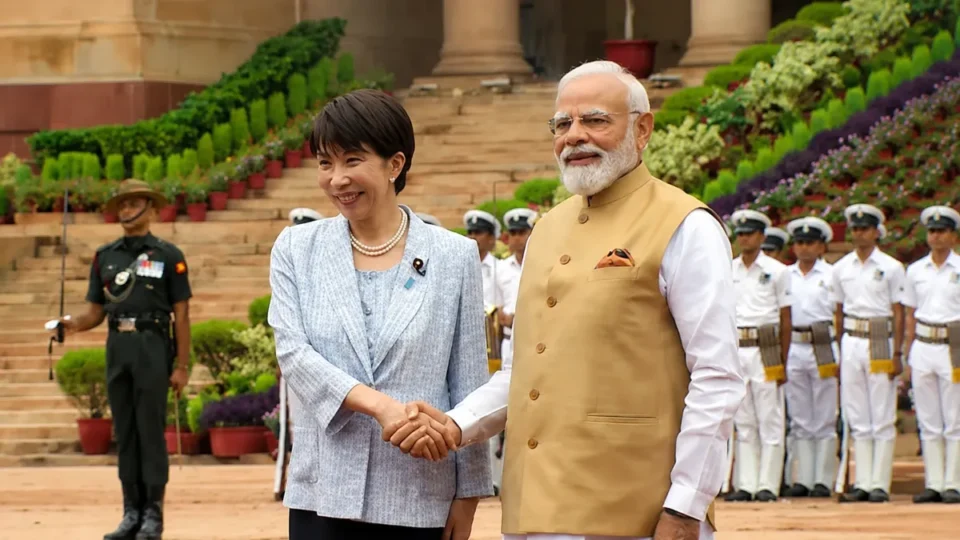
Japan’s Prime Minister Sanae Takaichi has landed in New Delhi on her first official visit to India since taking the office in October last year. The Japanese PM’s visit will focus on increasing cooperation to achieve mutual economic growth. Both countries, which have been historically close partners, will also seek to deepen their strategic partnership amid growing geopolitical uncertainties.
The visit of the Japanese PM to India comes at a time when New Delhi and Tokyo are steadily expanding their strategic partnership beyond traditional infrastructure cooperation.
The country which will be watching this visit of the Japanese PM to India very closely is China. Both India and Japan are increasingly focused on reducing China’s dominance over critical supply chains, especially in the rare earth minerals sector. China has used its near monopoly in the rare earth minerals sector as an advantage in geopolitics, using it to exert great influence in the world. Now, India and Japan are looking to come together to counter that with a joint declaration on economic security, to safeguard critical industries, emerging technologies, and strategic supply networks.
China currently controls a significant share of the global rare earth mining and processing industry. These minerals, including neodymium, dysprosium and terbium, are vital for manufacturing electric vehicles, semiconductors, wind turbines, defence equipment and advanced electronics. With 60% of the mined production, and 90% of the refining and processing capacity of the world, China seeks to use this advantage to negotiate with other countries through export controls.
Beijing has repeatedly demonstrated its willingness to use its control over these critical materials as a geopolitical tool, making countries dependent on Chinese supplies vulnerable to export restrictions and political pressure.
India and Japan are now working together to change that equation.
Both nations have emphasized cooperation in securing resilient supply chains for critical minerals. India possesses sizeable rare earth reserves but lacks advanced processing capabilities, while Japan has world-class technological expertise in mineral refinement and manufacturing but depends heavily on imported raw materials. This complementarity presents a natural opportunity for strategic collaboration.
By combining India’s resource base with Japan’s technological capabilities, the two countries aim to create an alternative supply chain that reduces dependence on China. Joint investments in mining, processing facilities, recycling technologies and research can help diversify global rare earth supplies while strengthening economic security for both nations.
For China, this emerging partnership carries implications beyond economics. Beijing has long sought to maintain its influence through its near-monopoly in rare earth processing. A successful India-Japan partnership could gradually weaken that leverage, encouraging other countries such as Australia, the United States and members of the European Union to participate in diversified critical mineral networks.
India and Japan have consistently advocated secure supply chains, trusted technology partnerships and resilient manufacturing ecosystems. These priorities have gained urgency amid growing geopolitical tensions and increasing concerns over economic coercion.
Sanae Takaichi’s visit is therefore significant not merely as a diplomatic engagement but as part of a larger strategic realignment in Asia. Her discussions with Prime Minister Narendra Modi are expected to reinforce cooperation in economic security, advanced technologies, semiconductor manufacturing, clean energy and critical minerals—all sectors that have become central to geopolitical competition.
While neither India nor Japan frames their partnership as being directed against any particular country, the practical outcome of their cooperation—creating alternative supply chains, strengthening technological collaboration and reducing strategic dependence on Chinese-controlled industries—could diminish Beijing’s economic leverage over time.
Sanae Takaichi’s visit signals that both nations are committed to building a more secure and diversified economic future, one that could gradually reshape the balance of influence in the Indo-Pacific and make China’s rare earth monopoly less formidable.

