
Ceasefire? What ceasefire? Tensions in West Asia have reached a dangerous new level as Iran’s Islamic Revolutionary Guard Corps (IRGC) issued a stern warning that American military bases across the region would “experience hell” if the United States continues its military campaign against Iran.
The warning came after fresh US strikes on Iranian military targets, triggering another round of retaliatory missile and drone attacks that have further destabilized an already volatile region.
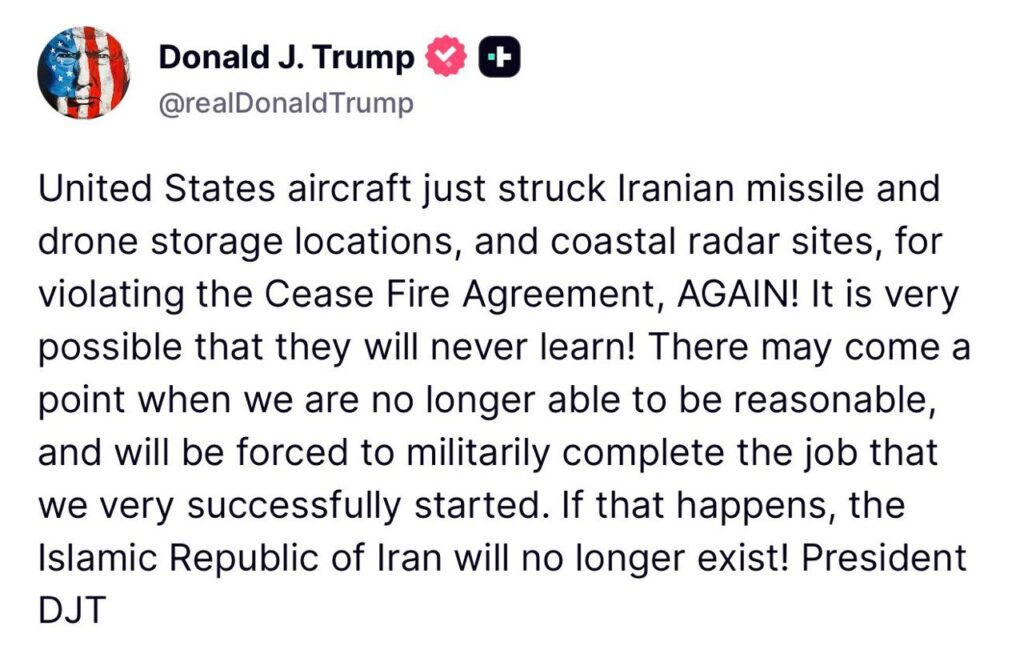
The US President Donald Trump had shared that US forces had struck Iranian missiles and drone facilities.
According to Iranian state media and statements released by the IRGC, the organization’s naval and aerospace forces launched a coordinated missile and drone operation targeting US military facilities in Kuwait and Bahrain in response. Notably, Bahrain hosts the largest naval base outside US.
Tehran described the attacks as retaliation for American strikes on Iranian military infrastructure, accusing Washington of violating previous understandings. The IRGC declared that American bases throughout West Asia would “experience hell” if further attacks were carried out against Iran.
The United States has defended its latest military operations, stating that the strikes were conducted in response to continued Iranian aggression, including attacks on commercial shipping and regional security threats. US officials said the targets included military surveillance systems, air defence installations and drone-related infrastructure. Washington has also warned Tehran that any further escalation would invite a stronger military response.
The latest exchange has effectively shattered hopes that recent diplomatic efforts would prevent a wider regional conflict. Just weeks earlier, international mediators had attempted to stabilize the situation through negotiations, but mutual accusations of ceasefire violations and renewed military actions have pushed both sides back toward direct confrontation.
The conflict now threatens to engulf much of West Asia. Several Gulf nations hosting American military installations have been placed on high alert, while air defence systems remain activated amid fears of further Iranian missile and drone strikes. Regional governments have urged restraint, warning that continued escalation could severely impact energy supplies, international shipping and civilian security.
The strategic Strait of Hormuz, through which nearly a fifth of the world’s oil passes, remains a key flashpoint. Any disruption to maritime traffic through the narrow waterway could send global energy prices soaring and trigger wider economic repercussions. Iran has repeatedly linked its military posture to the security of the Strait, making the waterway central to the current confrontation.
With both Washington and Tehran adopting increasingly uncompromising positions, analysts fear that the region could be moving closer to a prolonged military confrontation rather than a limited exchange of strikes. Unless diplomatic channels are revived quickly, the risk of miscalculation remains high, threatening not only the security of West Asia but also global economic stability and international energy markets.

