
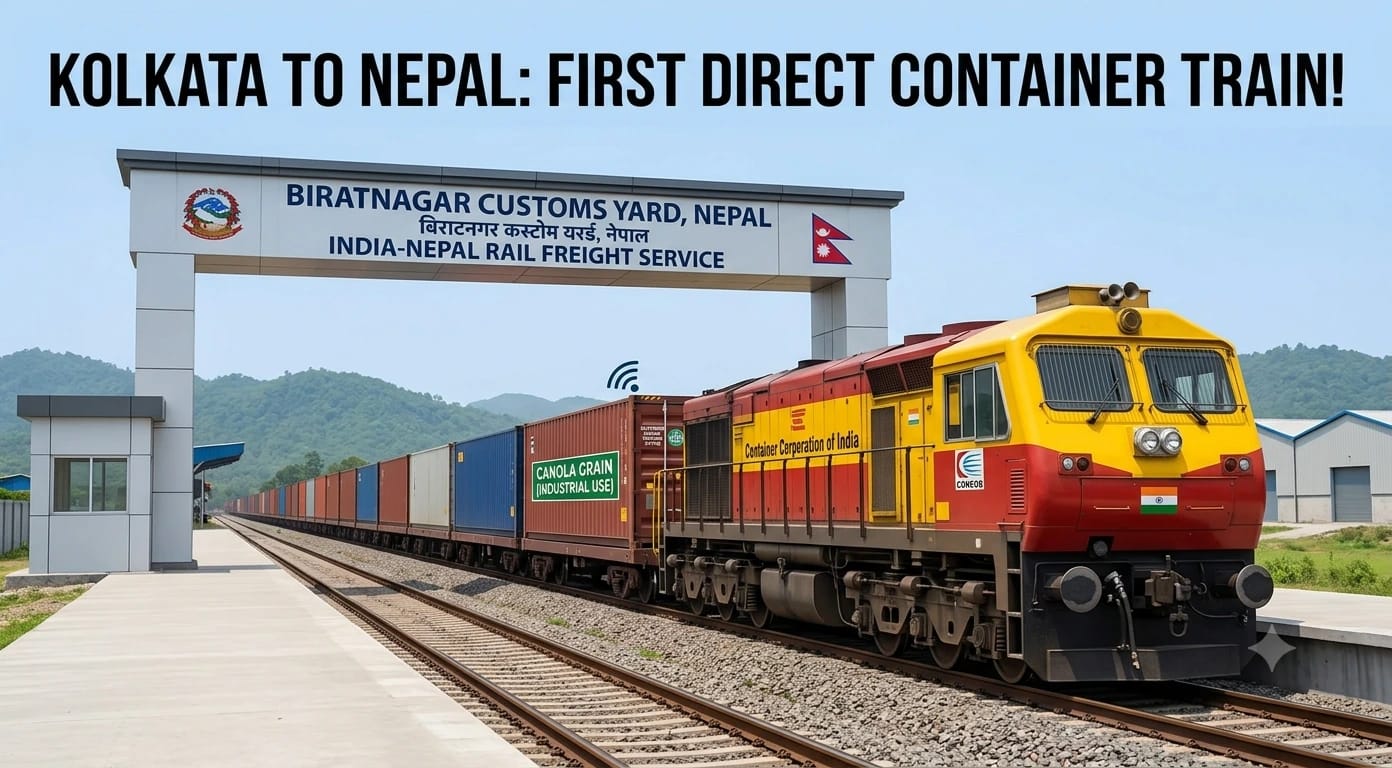
India has taken a major step in cross-border trade by launching its first direct commercial container freight train from Kolkata Port to Nepal’s Biratnagar Customs Yard, and the move is being seen as an important change for trade between the two neighbours.
The train carried 40 wagons of canola, with the shipment reported at 1,225 tonnes, and it moved under the revised India-Nepal Rail Transit Protocol, which allows freight to travel directly by rail without the old border transhipment process.
In simple terms, this means goods no longer need to be unloaded at the border and shifted to another vehicle before entering Nepal, which saves time, lowers handling costs, and reduces the risk of delays or damage. For businesses, this is not just a symbolic launch; it is a practical improvement that can make imports faster and more reliable.
The route matters because Biratnagar is an important commercial hub in eastern Nepal, and the direct rail link gives it a stronger connection to Kolkata Port, one of the major gateways for trade in the region.
According to reports, the service was made possible after policy coordination between India and Nepal and follows the broader framework of the revised transit arrangement signed in November 2025, which opened the door for direct commercial rail movement to Biratnagar.
The rail service builds on the Jogbani-Biratnagar broad-gauge link, which had already been inaugurated earlier, but this new step is different because it enables end-to-end movement of containerised cargo in a more seamless way. That is why the launch is being described as a milestone, not only for rail logistics but also for bilateral trade cooperation.
The shipment itself gives a clear picture of how the system works. The inaugural movement reportedly used 40 high-capacity containers, and the cargo was canola grain meant for industrial use in Nepal.
Some reports say the train was expected to complete the journey in around 24 hours, showing how rail can be far quicker and more predictable than older multi-step transport methods. The train was operated with CONCOR, the Container Corporation of India, which plays a key role in container logistics and cross-border freight handling.
The use of the Electronic Cargo Tracking System on the containers also adds another layer of control, helping authorities monitor the movement of goods more efficiently. Small technical details like these matter because they improve visibility, security, and trust in the entire supply chain.
For Nepal, the benefit is especially important because it can help industries in the eastern part of the country receive raw materials more quickly and at a lower cost. For India, the new route strengthens its role as a transit partner and supports broader efforts to improve regional connectivity through rail infrastructure. The commercial value is straightforward: less waiting, fewer transfers, lower logistics costs, and faster delivery times, all of which can make cross-border trade more competitive.
Even a single train carrying 1,225 tonnes can signal how a larger system may develop if the route runs regularly and efficiently. In that sense, this first direct train is both a transport story and a trade policy story, because it shows how a well-planned rail link can turn paper agreements into real movement on the ground.
Overall, the launch of the first direct container freight train from Kolkata Port to Biratnagar is a concrete example of how infrastructure and policy can work together to simplify trade.
It replaces a slower border-based process with a direct rail corridor, carries a sizable 40-wagon consignment, and introduces a model that could be used for more shipments in the future. This is not just about one train, but about a new, more efficient trade lane between India and Nepal.

