
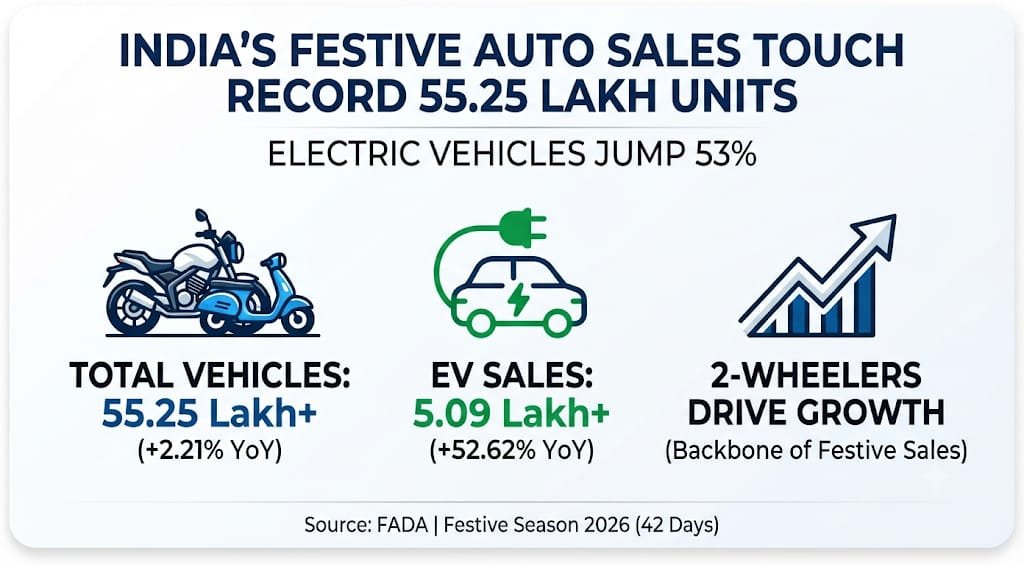
The festive season in India is not only about lights and sweets. It is also the time when many families bring home a new bike, scooter, car or tractor. This year, that tradition created history, with 55,25,490 vehicles sold during the 42-day festive season of 2026, compared with 54,05,956 units a year ago. This represents a 2.21% increase over last year and marks the highest-ever vehicle sales recorded during a festive season.
Now the question may arise why a 2% rise is such big news. The answer lies in last year’s sales. In 2025, tax changes under GST 2.0 made vehicles more affordable, encouraging buyers to visit showrooms in large numbers. Beating that high sales figure looked challenging, yet the market managed to register another record.
Compared with the 2024 festive season, when 44,57,691 vehicles were sold, sales have increased by 23.95%. This reflects the continued strength of India’s automobile market.
The festive season ran from October 11 to November 21, starting on the first day of Navratri and ending 15 days after Dhanteras. The additional 15 days are included because vehicle registration takes some time after purchase.
The season began on a relatively slow note, with Navratri sales remaining below last year’s levels. However, demand picked up during Dhanteras and Deepawali, bringing more customers back to showrooms and helping the market move from an initial decline to overall growth.
Two-wheelers remained the backbone of India’s festive automobile market. Around 43.13 lakh bikes and scooters were sold, registering growth of 3.67% over last year and 26.02% compared with 2024. Three-wheeler sales increased 5.32% to 1,93,576 units, while commercial vehicles such as trucks and buses grew 7.13% to 1,55,761 units.
Tractor sales also moved up 2.24% to 1,03,809 units. Meanwhile, construction equipment recorded the fastest growth of 26.06%, reaching 10,452 units. The growth across these categories highlights rising demand among daily commuters, transport operators, farmers and infrastructure-related businesses.
The only weak spot was the passenger vehicle segment, which includes cars and SUVs. Sales declined 7.16% to 7,48,616 units from 8,06,322 units last year. This decline came after an exceptional surge in passenger vehicle purchases during the previous festive season, creating a challenging comparison.
Although the segment was initially facing a decline of more than 18% during Navratri, the gap narrowed significantly by the end of the festive period. Compared with 2024, passenger vehicle sales are still up 16.43%, while several festive bookings are yet to be converted into deliveries.
The real star of the season was the electric vehicle segment. EV sales jumped 52.62% to 5,09,667 units from 3,33,935 units last year, crossing the five-lakh mark in a single festive season for the first time. Electric two-wheelers recorded growth of 61.10%, reaching 3,30,846 units, while electric three-wheeler sales increased 25.45% to 1,20,330 units.
Electric car sales climbed 72.91% to 52,104 units, and electric commercial vehicle sales more than doubled to 6,387 units. This means nearly one in every ten vehicles sold during the festive season was electric. Lower running costs, improved driving range and a wider choice of models are making EVs increasingly attractive to Indian buyers.
Festive EV sales have also grown 67.55% over the past two years, indicating that electric mobility is becoming an increasingly important part of the automobile market.
Looking ahead, India’s automobile market is approaching another major milestone, with the country close to recording more than three crore vehicle sales in a single calendar year for the first time. The continued momentum in vehicle purchases, particularly across two-wheelers, commercial vehicles and electric mobility, points towards a broad-based expansion in the sector.
The festive season’s record performance also highlights the impact of changing consumer preferences and policy support. GST 2.0 reforms have helped improve vehicle affordability, while the growing focus on clean mobility is encouraging the adoption of electric vehicles. With more than 15,000 automobile dealerships and over 30,000 outlets across the country, India’s automobile retail network is witnessing this transformation across both urban and rural markets.
The message is clear that the India’s festive automobile demand remains strong, smaller cities and the heartland continue to play an important role, and electric vehicles are no longer a side story. They are becoming an increasingly significant driver of the country’s automobile growth.

