
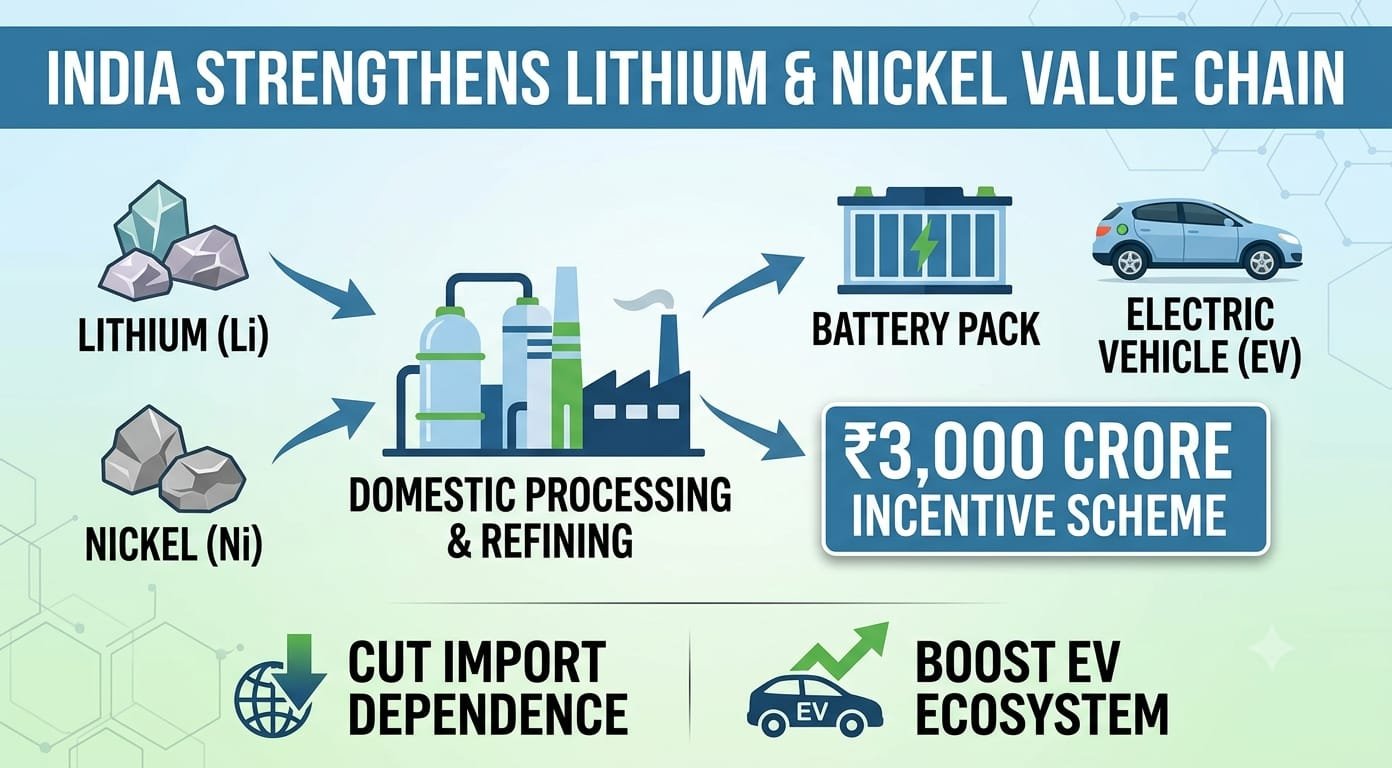
The Union Ministry of Mines is preparing to introduce a new incentive scheme focused on lithium and nickel processing within the country, marking a significant step toward reducing reliance on imports for these critical minerals.
Mines Secretary Keshav Chandra shared this information during the 60th Annual General Meeting of the Federation of Indian Mineral Industries, where it was highlighted that the scheme would be launched soon and would support the creation of a stronger domestic value chain for critical minerals.
Lithium and nickel have become essential in today’s economy because lithium is a key ingredient in rechargeable batteries used in electric vehicles, mobile phones, and energy storage systems, while nickel supports stainless steel production and improves battery performance.
Reports suggest that the proposed scheme could involve an outlay of around three thousand crore rupees, indicating a serious financial commitment toward building processing capacity inside India rather than depending on other countries for refined materials.
This move is seen as part of a larger strategy to secure supply chains for clean energy technologies and to position India as a more self-reliant player in the global battery and electric vehicle ecosystem.
The emphasis is not only on mining these minerals but also on processing them domestically, which adds more value and creates opportunities for downstream industries such as battery manufacturing and electric vehicle production.
Alongside the incentive plan, approval has already been given for setting up critical mineral processing parks in four states, namely Gujarat, Maharashtra, Odisha, and Andhra Pradesh. According to the Mines Secretary, recent reviews showed that each of these states has made good progress in identifying mineral sources, working out processing methods, and mapping downstream industries that could grow around these parks.
This suggests that the foundation for large-scale mineral processing infrastructure is being laid in a structured manner across multiple regions, which could eventually lead to more jobs, industrial activity, and reduced import bills.
However, the update also brought attention to a concern regarding several mining blocks that remain non-operational even after completing auctions, receiving all statutory clearances, and signing mining leases.
This situation was described using the term squatting, referring to cases where companies hold on to allotted blocks without starting actual mining work. The Mines Secretary expressed discomfort with this trend and urged industry members to treat the issue seriously, noting that the government does not look favourably upon such delays.
Taken together, this development reflects a broader effort to strengthen India’s position in the global critical minerals landscape while addressing practical challenges that slow down implementation.
The real impact of the scheme will depend on how effectively it encourages processing activity on the ground and how quickly idle blocks are put to use in the coming months.

