
India’s export story is taking an interesting turn, with a notable rise in shipments to some of the world’s largest emerging economies. In the first five months of the 2026–27 financial year, India’s exports to the four core BRICS nations China, South Africa, Brazil, and Russia increased by 34%, reaching $19.9 billion. This marks a clear shift in trade patterns, as India looks beyond its usual partners in the West and deepens economic ties with fellow developing giants.
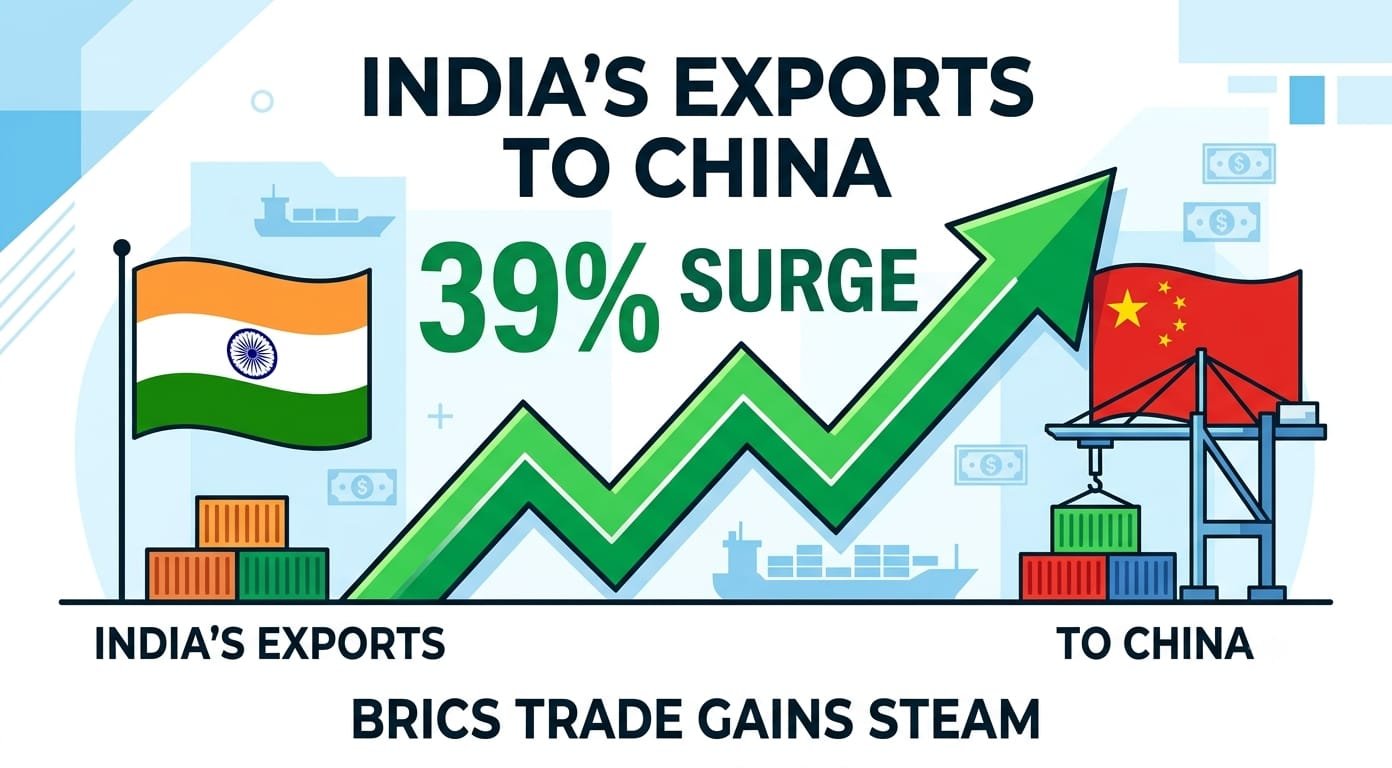
Among these, China stands out as the biggest driver, with Indian exports jumping 39% to $9.6 billion during this period. South Africa recorded even sharper growth at 58%, while Brazil and Russia saw more modest but steady increases of 13% and 11% respectively. Together, these four countries now account for 9.2% of India’s total exports, up from 8.1% a year earlier, according to commerce ministry data shared with PTI.
The rising trade numbers reflect a broader strategy by India to diversify its export base and reduce dependence on traditional markets like the US and Europe. With global demand patterns shifting and supply chains being reconfigured, Indian businesses are finding new opportunities in fast-growing economies that need everything from raw materials to finished goods.
A commerce ministry official noted that the strongest momentum in India’s BRICS engagement is coming precisely from these founding members, suggesting that the bloc is becoming more than just a political forum it is turning into a meaningful trade corridor. Exports to the core four rose from $14.9 billion in the same period last year to $19.9 billion now, showing consistent growth across sectors.
What makes this trend especially significant is the nature of the goods being shipped. While the article does not break down every product category, past data and related reports indicate that India’s exports to these nations often include minerals, fuels, chemicals, pharmaceuticals, engineering goods, and agricultural products.
For instance, shipments to South Korea which also saw a 22% rise in exports were driven by industrial raw materials, energy products, and intermediate goods feeding into its manufacturing sector. It is likely that similar categories are fueling growth in BRICS trade as well.
The fact that core BRICS exports are growing nearly three times faster than the broader BRICS grouping (which now includes newer members like UAE, Saudi Arabia, and Indonesia) shows that India’s deepest commercial links within the bloc remain with its original partners.
This trade expansion also comes at a time when India is actively pursuing stronger economic diplomacy through forums like BRICS, the Shanghai Cooperation Organisation, and bilateral agreements. The grouping itself has grown significantly since its inception, with five new full members joining in 2024 and another ten becoming partner countries in 2025.
Yet, despite this expansion, the original fourexcluding India itselfremain the most dynamic markets for Indian exporters. This suggests that familiarity, established logistics routes, and complementary economic structures continue to play a major role in shaping trade flows.
Beyond BRICS, India’s export momentum is visible in other key markets too. Shipments to Japan rose 43%, driven largely by a 76% jump in mineral fuel exports. Italy saw a 30% increase, while South Korea recorded a 22% rise. These numbers indicate that India’s export engine is firing on multiple cylinders, not just in the Global South but also in advanced economies seeking reliable suppliers amid global uncertainty.
The commerce ministry has described this as a sign of India becoming more integrated into global value chains, not just as a consumer but as a critical supplier of energy, raw materials, and manufactured inputs.
For ordinary observers, this trend matters because stronger exports translate into more jobs, higher factory output, and greater foreign exchange earnings for the country. When Indian companies sell more abroad, they hire more workers, invest in better technology, and contribute to national income.
It also reduces vulnerability to downturns in any single market. If demand slows in the US or Europe, robust sales in Asia, Africa, and Latin America can help cushion the blow. In that sense, the 39% rise in exports to China is not just a statistic; it represents real economic activity, from ports buzzing with cargo to factories running extra shifts.
For years, India imported far more from China than it exported, leading to a large trade deficit. Now, while the imbalance may still exist, the direction of trade is becoming more two-way.
Chinese buyers are increasingly turning to Indian suppliers for certain goods, whether due to cost advantages, quality improvements, or supply chain diversification. This does not mean all tensions in the bilateral relationship have vanished, but it does show that economic interdependence can grow even amid strategic competition.
Overall, the latest export data paints a picture of an Indian economy that is gradually finding its footing in global markets beyond the usual suspects. The rise in BRICS trade, led by China and South Africa, is a promising sign that India’s export strategy is working.
As global trade patterns continue to evolve, India’s ability to tap into emerging markets could prove crucial for sustaining long-term growth. The numbers may seem dry at first glance, but they tell a story of resilience, adaptation, and quiet ambitionone where India is not just participating in global trade but actively reshaping its role within it.

