
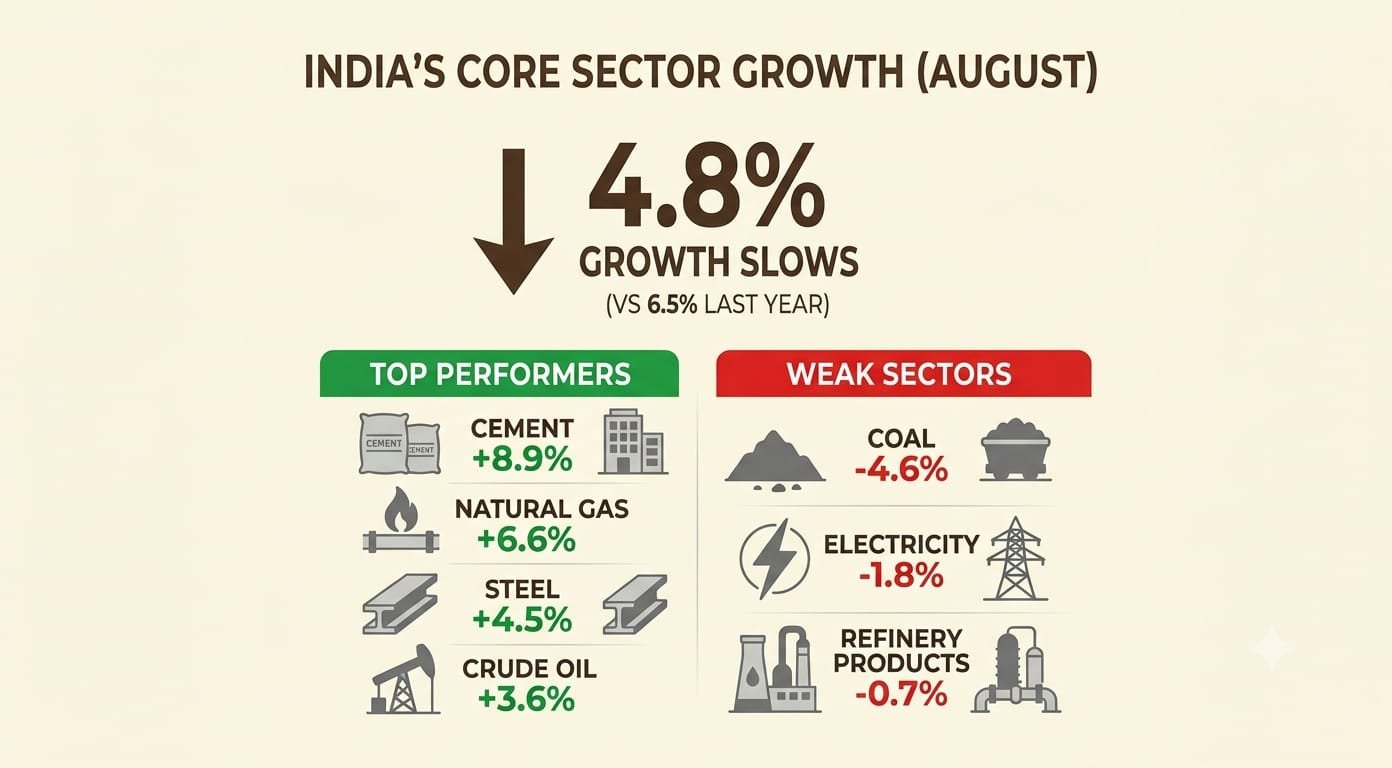
India’s core sector growth slowed to 4.8% in August, compared with 6.5% recorded during the same month last year. The latest performance suggests that the country’s most important infrastructure-related industries faced pressure from weak coal production, lower electricity generation and a decline in refinery output. These eight industries together account for nearly 40% of the total weight in the Index of Industrial Production, making their performance an important indicator of the wider economy.
The slowdown became visible mainly because of weakness in three major sectors. Coal production fell by 4.6% in August, while electricity generation declined by 1.8%. Refinery products also recorded a contraction of 0.7%. Since coal and electricity support transport, manufacturing, construction and household demand, lower output in these areas can affect several other parts of the economy. A weak monsoon season and a high comparison base from last year also made the annual growth rate appear softer.
However, the overall data was not uniformly weak. Crude oil production grew by 3.6%, marking its strongest performance in several months. Natural gas production increased by 6.6%, while cement output rose by 8.9%. The cement sector’s strong growth reflects continuing activity in housing, roads, bridges and other construction projects. Steel production also remained positive, growing by 4.5% during the month.
The August figures show a mixed picture of India’s economic performance. Sectors connected with construction and domestic infrastructure demand continued to expand, but energy-related activities faced difficulties. In simple terms, the demand for building materials remained healthy, while the production of some fuels and electricity did not keep pace. This difference explains why the core sector managed to grow but failed to match last year’s stronger performance.
The cumulative picture for the first five months of the financial year also points to moderation. Core sector output grew by around 4.8% between April and August, compared with 7.8% during the corresponding period of the previous year. This indicates that growth has not stopped, but its speed has reduced. Such moderation may influence the pace of industrial production in the coming months, especially if coal availability, power generation and refinery activity remain under pressure.
Economists are likely to watch the next few months closely. A recovery in coal production and electricity generation could improve the overall industrial outlook. At the same time, continued growth in cement, steel, crude oil and natural gas may provide support to infrastructure and manufacturing activity. Government spending on roads, railways, housing and other public projects could also help maintain demand.
The August data therefore presents neither a complete slowdown nor a broad-based boom. It shows an economy moving forward at a slower pace, with strong construction-linked sectors balancing weakness in energy and refinery-related industries. The immediate message is clear: India’s core industries are still expanding, but the recovery remains uneven and dependent on improvements in fuel production, electricity supply and industrial demand.

