
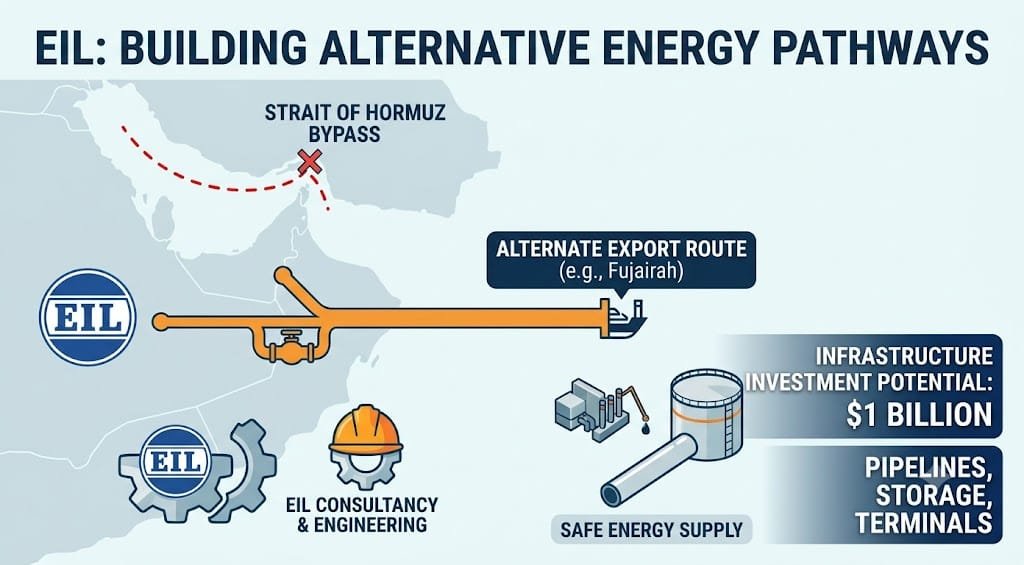
Engineers India Ltd., or EIL, is discussing new oil and gas infrastructure projects with Saudi Arabia and the United Arab Emirates. The proposed work could help Gulf countries move crude oil and petroleum products to global markets through routes that do not fully depend on the Strait of Hormuz.
The discussions are still at an early stage. EIL is seeking consultancy, engineering and feasibility-study assignments related to the planned projects. The company’s Chairman and Managing Director Atul Gupta said Saudi Arabia and the UAE were considering investments of around $1 billion in pipelines, storage facilities, oil terminals and other supporting infrastructure.
The importance of these projects has increased because shipping through the Strait of Hormuz has been severely disrupted amid the conflict involving Iran and the United States. The waterway is one of the most important energy routes in the world. A large share of crude oil and petroleum products produced in the Gulf region normally passes through this narrow maritime route before reaching international markets.
For Gulf oil producers, any prolonged disruption creates a serious business and security concern. If ships cannot move smoothly through the strait, deliveries may be delayed, transport costs may rise and global oil supplies may face additional pressure. This is why Saudi Arabia and the UAE are examining other ways to transport and store energy products.
The planned infrastructure may include long-distance pipelines, additional crude storage, export terminals and facilities connected to ports. Such projects could provide greater flexibility during a crisis. Oil could be moved through land-based systems to ports outside the most affected route, while storage facilities could help producers continue supplying customers even when shipping faces temporary difficulties.
The UAE is also considering more underground oil-storage facilities at Fujairah. Fujairah is located outside the Strait of Hormuz and has become an important centre for oil storage and shipping. Additional storage capacity there could strengthen the UAE’s ability to handle crude exports and petroleum trade during periods of regional uncertainty.
For EIL, the situation presents both difficulties and opportunities. The conflict has slowed fresh orders from the Gulf because energy companies are currently focused on protecting and restoring their existing installations. However, once the situation becomes more stable, spending on new pipelines, terminals and storage facilities could increase.
Gupta said inflows from the region had slowed after the conflict, but the company expected activity to improve during the third and fourth quarters. In his view, the crisis could eventually create more opportunities for EIL because Gulf countries may accelerate investments aimed at protecting their energy supply chains.
The Middle East is an important market for EIL. The company has projects and business relationships in Saudi Arabia, the UAE, Bahrain and Kuwait. It has also opened an office in Saudi Arabia and has a long-term in-country services agreement with Saudi Aramco.
International projects now form a major part of EIL’s business. Overseas work represents about 43 per cent of its order book. During 2025-26, international consultancy contributed nearly ₹4,929 crore, or around 62 per cent, of the company’s new business.
EIL secured fresh orders worth ₹7,978 crore during the year ended March 2026. Its order book reached a record ₹15,109 crore on March 31 and has since increased to around ₹17,000 crore. The company also secured Gulf-region orders worth ₹510 crore after the Iran conflict began.
The company is trying to use its engineering experience to expand beyond traditional oil and gas work. Its newer focus areas include infrastructure, renewable energy, green hydrogen, biofuels, nuclear energy and defence. In Nigeria, EIL has received an engineering, procurement and construction management mandate for the expansion of the Dangote refinery, valued at about $360 million. It has also secured a separate assignment for a four-train fertiliser project.
The immediate challenge is converting discussions into confirmed contracts. The proposed Gulf investments are still in the planning stage, and final decisions will depend on regional stability, project approvals and the pace of investment. Even so, the disruption around the Strait of Hormuz is encouraging energy producers to rethink how oil is stored and transported.
For EIL, this creates a mixed situation. Existing projects and new orders may face delays in the short term, but the same crisis could generate a new wave of engineering work. If Saudi Arabia and the UAE move ahead with alternative export routes, storage terminals and pipelines, EIL could gain a significant role in building infrastructure designed to make Gulf energy supplies safer and less dependent on one critical shipping route.

