
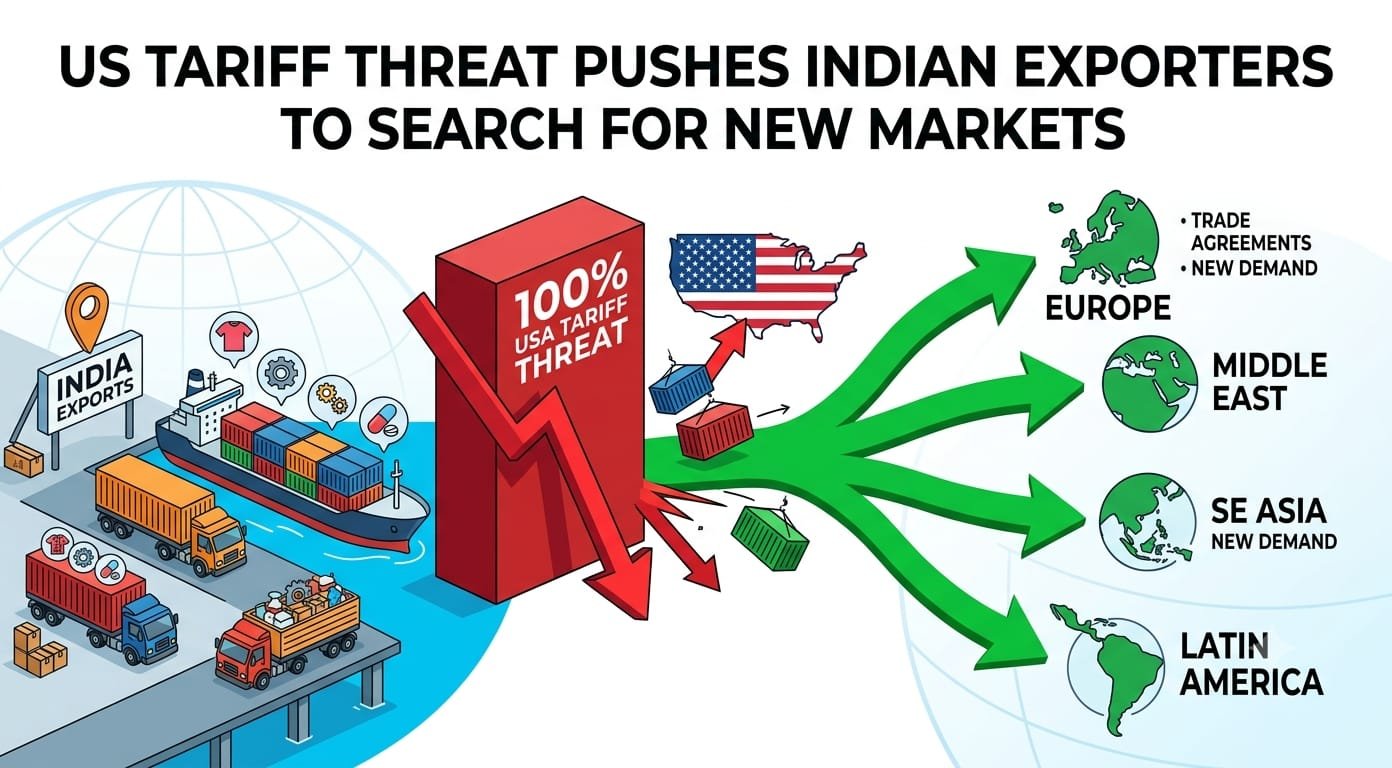
India’s exporters are facing a major challenge as the United States considers imposing a tariff of up to 100% on Indian goods. Such a move could make Indian products much more expensive for American buyers and reduce their competitiveness in one of the world’s largest markets.
The possibility has created concern across industries, especially textiles, engineering goods, pharmaceuticals,seafood, gems and jewellery, and other sectors that depend heavily on American demand.
The issue has become important because the United States is one of India’s biggest trading partners. A large number of Indian companies sell products to American customers, while millions of workers are connected to these export businesses.
If the proposed tariff becomes a reality, exporters may have to either reduce prices, accept lower profits or search for customers in other countries. In all three situations, the pressure on businesses could increase.
The impact may not remain limited to large companies. Small and medium-sized businesses often operate with lower profit margins and depend on regular export orders to pay workers, purchase raw materials and manage daily expenses.
A sudden rise in the cost of Indian goods in the US market could lead to cancelled orders or delayed payments. In some industries, this may affect factory production and employment.
Textile and garment exporters could face particular difficulty because buyers in the US can shift orders to countries offering lower prices. Engineering companies may also experience pressure if American importers decide to source machinery, components or industrial products from other markets. Pharmaceutical exporters could face a different kind of challenge, as higher duties may increase the final price of medicines and reduce the advantage of Indian suppliers.
However, the situation also presents an opportunity to reduce excessive dependence on one market. Indian exporters are increasingly looking towards Europe, the United Kingdom, the Middle East, Africa, Latin America and Southeast Asia.
These markets may not immediately replace the demand coming from the US, but a wider customer base can make businesses more stable. When sales are spread across several countries, weakness in one market does not create the same level of risk.
The search for new markets, however, cannot happen overnight. Exporters need to understand local rules, consumer preferences, payment systems, product standards and transportation costs.
A company selling garments in the US may need a different design, packaging style or pricing strategy for the European or Middle Eastern market. Government support, trade agreements and easier export procedures can help companies make this transition faster.
Domestic demand could provide another layer of support. India has a large population and a growing consumer market, which may help some businesses sell more products within the country.
The tariff concern also highlights the importance of adding greater value to Indian products. Instead of exporting only basic goods, companies may benefit from developing branded products, specialised machinery, processed food, advanced components and technology-based services. Products with better quality, unique features or strong brand value are usually less vulnerable to price competition.
For ordinary citizens, the issue is connected to jobs, income and economic growth. Exports bring foreign currency into the country and support businesses ranging from manufacturing units to transport companies, warehouses and ports. If exports weaken for a long period, the effect can spread across the wider economy.
The proposed US tariff is therefore more than a trade dispute. It is a reminder that Indian businesses must become more competitive, more innovative and less dependent on a single market.
The immediate challenge may be serious, but better trade partnerships, stronger domestic demand and higher-value products could help Indian exporters turn pressure into a long-term opportunity.

