
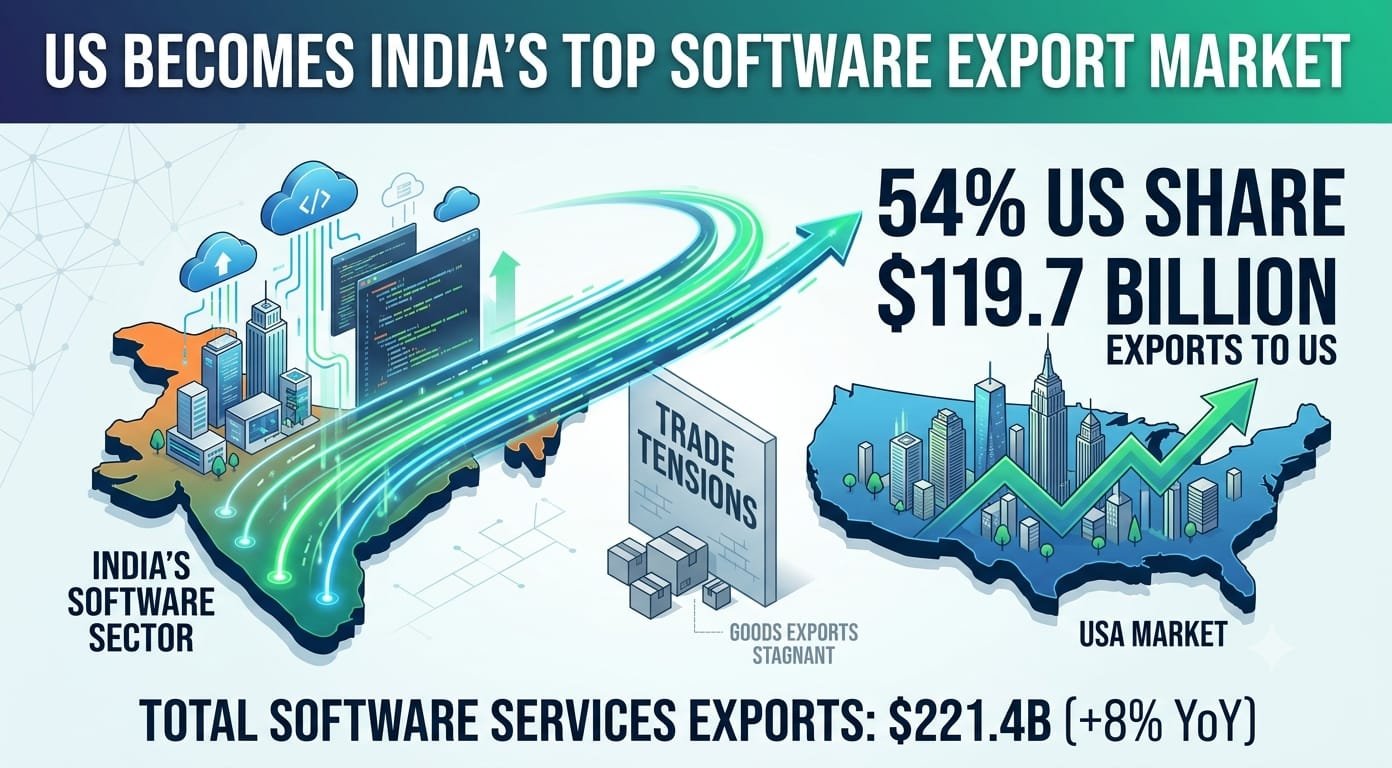
At a time when global trade faced fresh stress due to new US tariffs and rising protectionism, India’s software and IT services sector found stronger footing in the American market.
According to Reserve Bank of India data for 2025–26, the United States absorbed 54.1% of India’s total software services exports, up from 52.9% the previous year. This means more than half of all money earned by Indian tech firms from overseas came from a single country, even as that same country was trying to make imports of physical goods more expensive through steep duties.
The shift shows how India’s tech industry has become both resilient and strategically aligned with the world’s largest economy, despite political and trade turbulence.
Total software services exports from India reached $221.4 billion in 2025–26, an 8% rise from the year before. Of this, $119.7 billion came from sales to the US alone, marking an 11% jump. The UK remained a distant second with a 15.4% share, slightly down from 15.5%.
What stands out is that while India’s goods exports to the US grew by less than 1% due to high tariffs reaching $87.31 billion, services kept flowing strongly. Software and IT services alone accounted for 53% of India’s total services exports, which touched $421.29 billion.
This contrast highlights how intangible services like coding, consulting, and digital support are less affected by border taxes than physical products like textiles or machinery.
The composition of these exports also tells an important story. IT services formed the largest chunk at $147 billion, followed by business process outsourcing (BPO) at $56 billion. Software product development contributed a smaller $6.4 billion.
This pattern reflects India’s strength in delivering customized tech solutions and back-office support rather than selling packaged software. Most of this work happens remotely from Indian offices, which became even more critical as US visa rules tightened.
On-site work where Indian engineers travel to client locations abroad fell to $18.4 billion from $19 billion, signaling a clear move toward remote delivery models. Companies adapted by building stronger digital collaboration systems, reducing dependency on physical presence while maintaining service quality.
The backdrop to these numbers is a year of trade uncertainty. In April 2025, the US announced what were called “Liberation Day” tariffs, initially targeting goods imports and later expanded in ways that briefly imposed up to 50% duties on some Indian products, especially after India continued buying oil and arms from Russia.
Though the US Supreme Court later struck down parts of these tariffs, the policy environment remained tense. For Indian exporters of goods, this meant slower growth and higher compliance costs. But for software firms, the impact was muted because digital services cross borders without passing through customs checkpoints. This structural advantage allowed India’s tech sector to keep growing even when merchandise trade stalled.
Another layer of insight comes from how the data was collected. The RBI surveyed 7,569 software export companies and received responses from 2,363, including most large players. These respondents represented about 89% of India’s estimated software services exports, making the findings highly reliable.
The survey also captured sales by foreign affiliates of Indian companies, which added another $17.9 billion in revenue not included in the $221.4 billion headline figure. This shows that Indian tech firms are not just exporting from home but also earning through local entities abroad, deepening their global integration.
The bigger picture is clear: India’s economic story is increasingly driven by knowledge work rather than factory output. While factories face tariff walls and shipping delays, lines of code and customer support calls flow seamlessly across continents.
The rising US share also reflects trust American companies continue to rely on Indian partners for everything from cloud migration to AI support, even during political friction. At the same time, the dip in on-site work suggests a permanent shift in how global tech teams operate, with remote collaboration becoming the norm rather than the exception.
This trend carries implications beyond balance sheets. It reinforces India’s position as a go-to destination for high-value digital services, supports millions of skilled jobs, and helps offset weaknesses in goods trade. However, it also means the sector remains exposed to US economic cycles and policy changes, especially around data rules, taxation, and immigration.
Still, the 2025–26 numbers show that when one door narrows, like goods exports, another widens, as long as the foundation is built on adaptability, talent, and digital readiness. In a world of trade wars and shifting alliances, India’s software exports have proven to be both a shield and a spear.

