
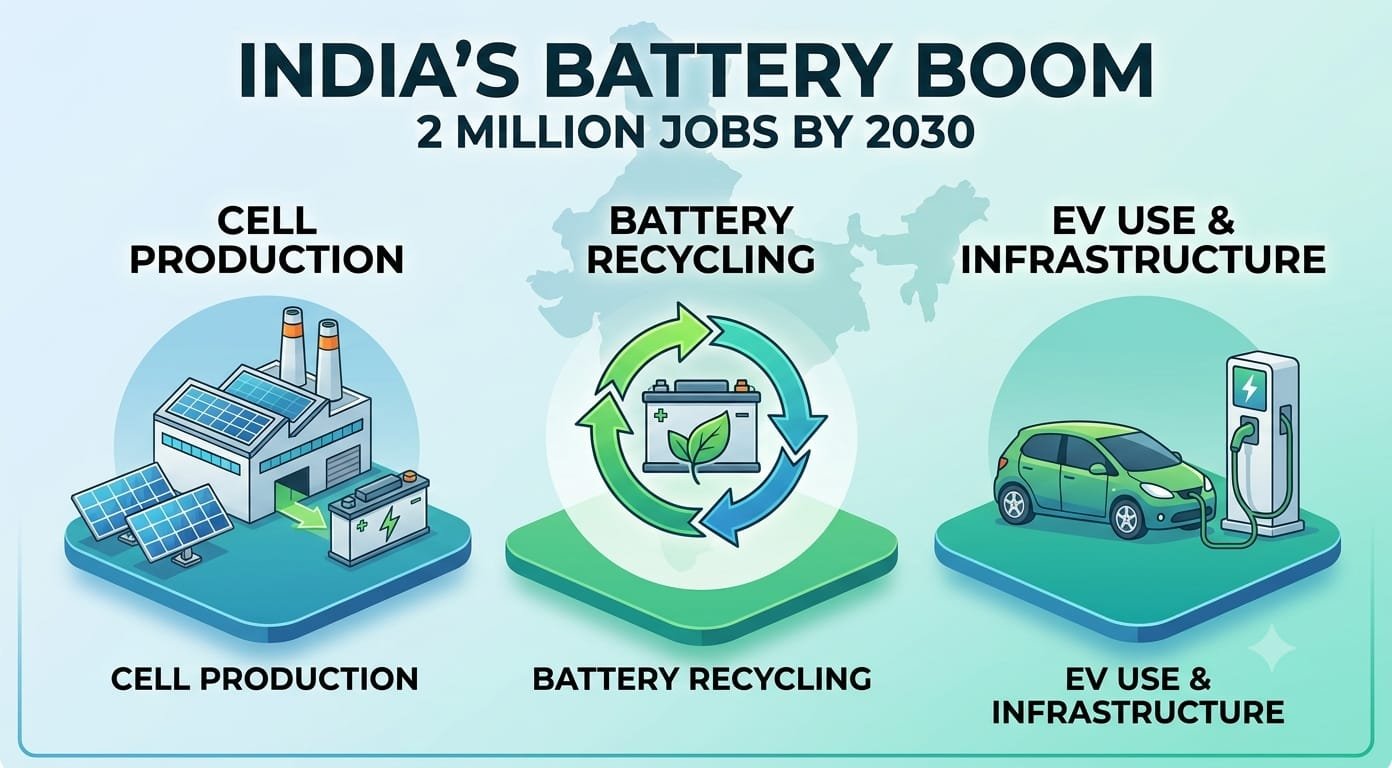
India’s battery industry is entering a transformative phase where employment creation is becoming as significant as production capacity. According to talent solutions firm Adecco India, the sector is projected to generate between 1.5 and 2 million jobs by fiscal year 2029–30.
This growth reflects a structural shift from importing and assembling lithium-ion cells to building a complete domestic ecosystem that covers cell manufacturing, pack assembly, component supply and recycling. The change is not just about making more batteries; it is about creating an industrial base that can support electric mobility, grid storage and clean energy goals while offering diverse career paths.
The employment picture is broadly split into direct and indirect roles, with around one-quarter expected to be direct jobs in factories, engineering and operations, and the remaining three-quarters coming from indirect opportunities in supply chains, logistics, services and ancillary industries.
Hiring in the battery space is anticipated to grow at 25–30 per cent annually over the next few years, driven by rising demand for electric vehicles, government incentives for domestic manufacturing and large-scale investments in gigafactories across states like Gujarat, Karnataka, Haryana and Telangana.
Current battery manufacturing capacity stands near 60 GWh and is likely to approach 100 GWh by end-2026, setting the stage for deeper value-chain development beyond simple assembly.
Cell manufacturing and battery components are likely to account for the largest share of new hiring, roughly 42–45 per cent, as companies move from importing cells to producing them locally. This shift demands specialised skills in electrochemistry, materials science, process engineering and quality control, moving the workforce profile away from conventional assembly-line roles toward more technical positions.
At the same time, battery recycling and circular economy activities are emerging as fast-growing segments, with end-of-life battery volumes expected to rise sharply by 2030. Recycling-related hiring is projected to grow at 25–30 per cent, creating demand for hydrometallurgy engineers, battery diagnostics specialists and compliance experts who can manage environmental norms and extended producer responsibility.
Infrastructure expansion is another major employment driver. As charging networks, battery-swapping stations, grid integration projects and energy corridors scale up, the need for electrical engineers, charging infrastructure specialists and energy network architects is rising.
While the battery sector itself is expected to contribute 50–60 per cent of India’s projected green manufacturing jobs by 2030, the wider EV ecosystem could generate 30–40 million jobs, with battery manufacturing, power electronics and automotive software among the fastest-growing talent segments.
Salary premiums of 35–40 per cent over conventional manufacturing roles are already visible for specialised battery engineers, reflecting the scarcity of skilled talent and the strategic importance of this sector.
The story also connects to broader economic trends. Just as India has begun exporting refined petroleum products to markets like Kenya, Russia and more recently diesel to Europe, the battery industry represents the next frontier where domestic capability can translate into global competitiveness. Local cell production reduces import dependence, strengthens supply chains and positions India as a potential export hub for batteries and related components.
With industry estimates pointing to domestic lithium-ion cell demand reaching around 130 GWh by 2030, of which nearly 100 GWh may come from electric vehicles, the scale of opportunity is substantial. Companies like Exide Industries are already committing significant capital to set up lithium-ion cell plants, with production expected to begin in the near term, signalling confidence in long-term demand.
For job seekers, the implications are clear. Entry-level opportunities are strongest in manufacturing engineering, testing, validation and quality functions, while mid-level demand is rising for battery management system engineers, embedded software developers, power electronics and thermal engineers.
Senior roles are centred on R&D scientists, cell chemistry specialists and advanced manufacturing leaders who can drive innovation and scale. As gigafactory clusters develop in key states, these regions are likely to become primary employment engines, each facility ranging from 6 GWh to over 16 GWh in capacity.
The transition also means that skilling and reskilling will be critical, with training programmes needing to align with industry requirements in electrochemistry, automation, safety standards and sustainability practices.
The momentum in battery manufacturing is not isolated; it is part of a larger push toward green industrialisation that ties together energy security, climate goals and job creation.
With policy support, private investment and rising EV adoption, the battery sector is poised to become one of the most dynamic employment generators in India’s economy over the next decade.
The shift from assembly to full-scale domestic production marks a turning point where India is not just consuming technology but building it, creating opportunities that extend far beyond factory gates into research, design, services and global markets.

