
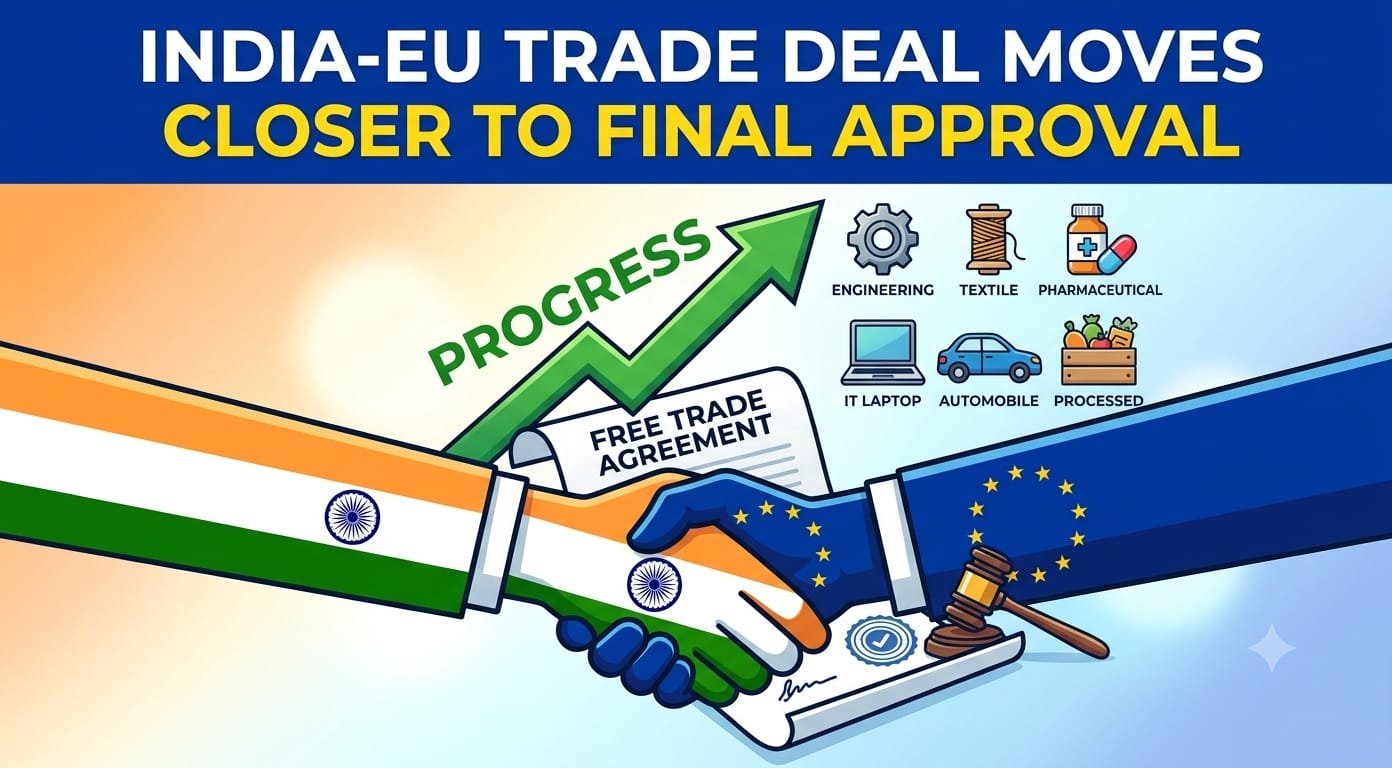
India and the European Union are now close to completing a major free trade agreement. The European Commission has forwarded its proposal for the conclusion of the deal to the European Council in Brussels. This move suggests that the agreement may soon reach the signing stage, although some important legal and political steps are still pending.
The European Council is responsible for setting the broad political direction and priorities of the European Union. Its approval is therefore necessary before the agreement can be formally signed. Once the Council gives its consent, the proposal will also require approval from the European Parliament. At the same time, Indian authorities are carrying out their own internal procedures before the agreement can be fully accepted and implemented.
The proposed agreement is expected to become the largest trade deal concluded between India and the European Union. It aims to make business between the two sides easier by reducing customs duties, improving market access and removing unnecessary trade barriers. It is also expected to create clearer and more predictable rules for companies involved in trade and investment.
The scale of the proposed tariff reduction is significant. The European Union has said that duties on 96 per cent of its goods exports to India will either be removed or reduced. European companies could save nearly €4 billion every year in customs duties as a result. This could make several European products more competitive in the Indian market and may also reduce the cost of importing certain goods.
The agreement could also create new opportunities for Indian exporters. With easier access to European markets, Indian companies may gain better opportunities in sectors such as engineering goods, textiles, pharmaceuticals, information technology services, chemicals, automobiles and processed food. However, greater access to the European market will also mean that Indian businesses must meet strict European standards related to quality, safety, environment and labour practices.
For European companies, India is an important and rapidly expanding market. The country has a large consumer base, a growing middle class and strong demand for technology, machinery, luxury products, medical equipment and advanced industrial goods. The agreement could help European businesses expand their presence in India while giving Indian companies improved access to one of the world’s biggest trading blocs.
India and the European Union already trade more than €180 billion worth of goods and services every year. This business relationship also supports nearly 800,000 jobs in the European Union. The proposed trade agreement is expected to increase this economic connection by encouraging more exports, investment and cooperation between companies on both sides.
The agreement is also important because global trade is facing growing uncertainty. Higher tariffs, supply-chain disruptions, geopolitical tensions and excess production in several markets have made international business more difficult. In such a situation, stronger trade ties with the European Union could help India diversify its export markets and attract more investment.
Negotiations between India and the European Union had been difficult for many years because of differences over tariffs, market access, professional services, sustainability rules and intellectual property rights. Talks restarted in 2022, partly because both sides wanted to strengthen their economic partnership during a period of changing global supply chains and rising dependence on China.
Even after the political approval, the agreement will not immediately change every business rule. The final text must be signed, approved by the European Parliament and completed through India’s domestic procedures. After that, the agreement will enter into force according to the conditions agreed by both sides.
The next major development will therefore be the decision of the European Council. If approval is granted, India and the European Union could move towards formal signing. The deal would then mark a major shift in India’s trade relationship with Europe, helping both sides reduce barriers and build a more stable economic partnership.

