
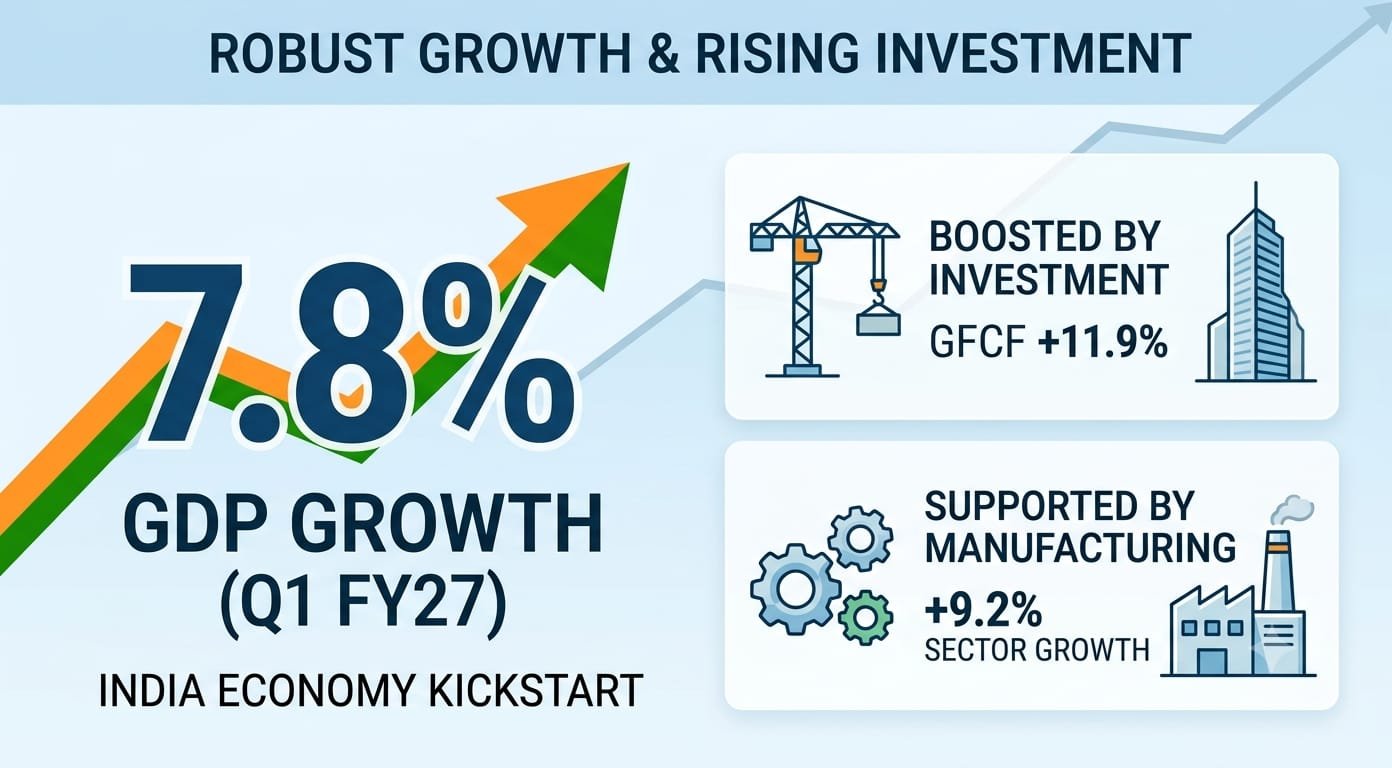
India’s economy began the financial year 2026-27 on a strong note. Real gross domestic product, or GDP, grew by 7.8 percent in the April-June quarter, also known as the first quarter of FY27. The growth came despite continuing global uncertainty and disruptions linked to the West Asia crisis.
The latest figures released by the National Statistics Office show that investment activity and manufacturing provided important support to the economy during this period.
The most important change in the growth pattern was the faster rise in investment demand. Gross fixed capital formation, commonly called GFCF, grew by 11.9 percent in Q1 FY27. GFCF is used to understand how much is being invested in buildings, roads, machinery, equipment and other productive assets. Its growth was higher than the 10.5 percent recorded in the previous quarter and almost twice the 5.8 percent growth seen in the same quarter last year.
The growing role of investment can also be seen in its share of the economy. At current prices, GFCF accounted for 34.3 percent of nominal GDP in Q1 FY27. A year earlier, its share was 31.4 percent .
This means investment occupied a much larger space in economic activity compared with the previous year. The trend suggests that public infrastructure spending, construction activity, capital goods demand and business-related investment are supporting growth.
Manufacturing also added strength to the economic performance. The sector expanded by 9.2 percent during the quarter, while the broader secondary sector grew by 8.6 percent . Stronger manufacturing generally creates demand for raw materials, transport, power, machinery and services. It can also create jobs and improve income if the expansion continues for a longer period.
However, the consumption side of the economy did not grow at the same pace. Private final consumption expenditure, or PFCE, increased by 7.1 percent in real terms during Q1 FY27. Although this remains a healthy rate, it was lower than the 7.5 percent growth recorded in the previous quarter. Consumption represents household spending on food, clothing, transport, housing, healthcare, education and other daily needs.
The share of private consumption in nominal GDP also slipped slightly. It stood at 55.6 percent in Q1 FY27 compared with 55.8 percent in the same quarter a year earlier. The fall is small, but it indicates that investment grew faster than household demand.
In simple terms, factories, construction projects and infrastructure activity moved ahead more quickly, while household spending lost some momentum.
This does not mean that consumers have stopped spending. A 7.1 percent rise shows that demand remains active. Vehicle sales, bank credit, lower interest rates and expected tax-related support have helped keep consumption steady.
At the same time, higher input costs, uncertain incomes and weather-related risks may make households more careful about spending in the coming months.
The difference between investment and consumption is important because both are needed for balanced growth. Investment can build future capacity, improve productivity and create employment.
Consumption, on the other hand, keeps businesses running today by creating demand for products and services. If investment rises without a matching improvement in household demand, companies may eventually face difficulty selling their increased output.
The Q1 figures therefore present largely a positive picture. India has recorded strong growth, and investment has become the main engine supporting the expansion. Manufacturing and infrastructure activity are encouraging signs, but the slower pace of private consumption needs attention.
Economists have raised some full-year growth estimates after the strong Q1 performance, with Morgan Stanley projecting 7.3 percent growth and HDFC Bank estimating 7.1 percent for FY27.
The key question now is whether household demand can regain strength while investment continues to expand. If jobs, incomes, credit availability and consumer confidence improve, India’s growth story could become broader and more balanced.
For now, the message from the Q1 FY27 data is clear: investment is moving faster, consumption is still healthy but slower, and the next few quarters will show whether this shift becomes a temporary trend or a lasting feature of the Indian economy.

