
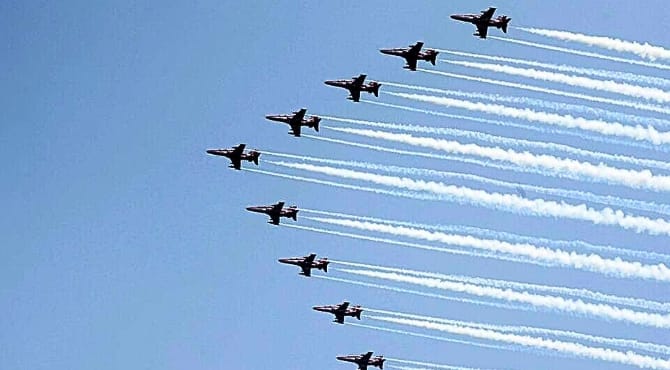
India is getting ready for an ambitious Air Force exercise that will stretch across its northeastern borders, skirting some of the most sensitive frontiers in Asia. Over the next few months, squadrons of the Indian Air Force will fly missions along the boundaries shared with China, Bhutan, Myanmar, and Bangladesh.
The exercise, backed by a formal Notice to Airmen (NOTAM), will test how quickly and effectively India’s air wings can mobilize, coordinate, and sustain operations in one of the country’s most complex terrains.
The NOTAM, issued in late October, identifies six dates for exercises from November 2025 until mid-January 2026. Dates start on November 6 and run until January 15; these are points of major operational windows where civilian flights will be stopped from flying in the selected airspace to make room for military operations. This is common practice during major drills, ensuring safety and freedom to maneuver for the Air Force.
What is unique about this round of exercises, however, is the scale and geography. The drills will unfold over several forward bases in northeast India, including areas in Arunachal Pradesh and Assam, where the topography and weather conditions introduce very real complications for pilots and logistical teams.
The operations will include air-to-air combat training, ground strike simulations, and reconnaissance sorties. Advanced aircraft such as the Rafale and Sukhoi Su-30 fighters will lead the charge, while Prachand attack helicopters will simulate close air support missions in rugged environments.
The air component has been christened “Gajraj“, borrowing from strength and stability. The name also rhymes with the larger national defense calendar, which already has “Trishul 2025,” an ongoing tri-service exercise on the western front. “Trishul 2025” brings together the Army, Navy, and Air Force in coordinated maneuvers across Gujarat and Rajasthan, with a focus on the joint warfighting capability along the Pakistan border. Together, these exercises reflect a two-front readiness approach-one concentrated on the western frontier, the other strengthening air presence in the east.
Military analysts see the northeastern exercise as a timely reinforcement of India’s preparedness in a region where aerial surveillance, logistics, and rapid deployment matter just as much as combat skills. The area borders four nations and includes key mountain approaches where quick response is critical. Conducting drills here is both a signal of deterrence and a rehearsal for real-world contingencies.
Behind the scenes, these operations also test how efficiently air traffic is managed under military conditions. A NOTAM itself is not just some bureaucratic warning, it’s a safety measure that clears civilian aircraft from active training zones. This way, it prevents commercial flights from being inadvertently caught in military activities, a factor of safety for both parties. It allows fighter jets and support aircraft to operate freely and without interruption.
These scheduled air exercises are part of a broader pattern of deepening coordination between India’s armed forces. Coming after “Operation Sindoor” earlier this year, which concentrated on rapid deployment and networked joint combat operations, the current drills build upon lessons learned during the operation. They place particular emphasis on communication, logistics, and combined firepower in high-pressure situations. The upcoming exercises of the Indian Air Force will mark an important milestone in India’s evolving defense strategy.
The IAF reinforces its readiness for conventional and hybrid threats by spreading training across multiple borders and integrating advanced assets into realistic scenarios. The combination of the northeastern “Gajraj” and western “Trishul 2025” underlines a comprehensive approach to national security, which seeks to ensure that the armed forces of India continue to be agile, connected, and ready to meet the challenges ahead.

