
Imagine someone in your family falls seriously ill. Every expense, Medicines, hospital bills, diagnostic tests, doctor consultations, has to be paid entirely from your own pocket. No insurance support, no government coverage, just you and your savings trying to survive a medical emergency.
That was the reality for millions of Indians a decade ago.
In 2013-14, Indian households were paying more than 64% of the country’s total healthcare expenditure directly from their own pockets. Today, that picture is slowly but significantly changing. India’s Out-of-Pocket Expenditure (OOPE) has seen a major decline over the last decade, reflecting a gradual transformation in the country’s healthcare system.
But what exactly is OOPE, and why does it matter so much?
What is Out-of-Pocket Expenditure (OOPE)
Out-of-Pocket Expenditure refers to the amount people pay directly from their own income or savings for healthcare services that are not covered by the government or insurance providers. This includes doctor consultation fees, medicines, hospital admissions, surgeries, tests, and emergency treatment.
Globally, OOPE is considered one of the most important indicators of a country’s healthcare strength. High OOPE means families are financially vulnerable during medical emergencies. The World Health Organization and the World Bank have repeatedly warned that excessive healthcare spending pushes millions into poverty every year.
India’s own National Health Policy 2017 acknowledged this challenge and set a target to reduce the number of households facing “catastrophic health expenditure” by 25% by 2025.
India’s healthcare burden a decade ago
In 2013-14, Indians were paying nearly 64.2% of healthcare expenses from their own pockets. Government spending and insurance coverage played only a limited role. For families living in rural areas without access to government hospitals or private insurance, even a single illness could trigger severe financial distress.
This created what experts call a “medical poverty trap,” where healthcare expenses forced families into debt, disrupted children’s education, and pushed millions below the poverty line.
The shift after 2014
The situation began to improve gradually over the next decade.
Between 2014-15 and 2021-22, Government Health Expenditure (GHE) increased from 29% to nearly 48% of total healthcare spending. During the same period, OOPE fell sharply from 62.6% to 39.4%.
This change did not happen overnight. It was driven by multiple large-scale healthcare initiatives launched over the years.
Ayushman Bharat: The biggest driver
The most significant step was the launch of Ayushman Bharat in 2018.
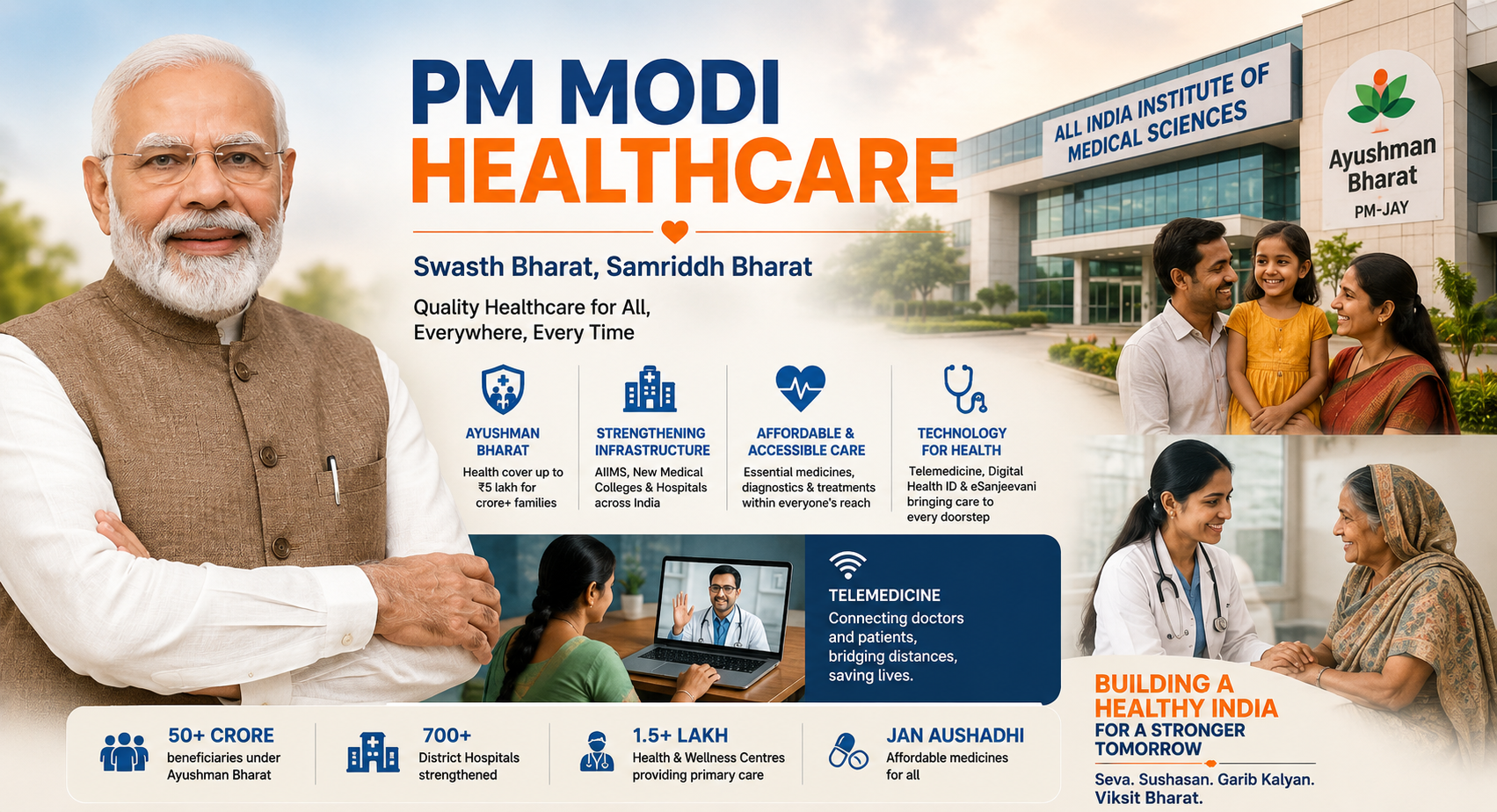
Often described as the world’s largest government-funded health insurance scheme, Ayushman Bharat provides free treatment coverage of up to ₹5 lakh annually to more than 12 crore poor and vulnerable families — roughly 55 crore people.
The scheme dramatically expanded access to secondary and tertiary healthcare, especially for economically weaker sections who earlier avoided hospitalization due to cost concerns.
Alongside this, the government also developed nearly 1.5 lakh Health and Wellness Centres aimed at strengthening primary healthcare access across the country.
Free dialysis, medicines and diagnostics
Several parallel initiatives also contributed to lowering OOPE.
The Free Dialysis Scheme launched in 2015-16 has reportedly benefited around 25 lakh patients so far. Jan Aushadhi Kendras have expanded access to low-cost generic medicines, while government-supported free diagnostic schemes and medicine distribution programs reduced expenses for routine treatment and testing.
Together, these interventions helped reduce dependence on expensive private healthcare spending.
What the latest data shows
According to the latest National Health Accounts data, India’s OOPE declined from 64.2% in 2013-14 to around 43.4% in 2022-23 — a drop of nearly 21 percentage points within a decade.
Government spending per person on healthcare also nearly tripled, rising from ₹1,108 in 2014-15 to ₹3,169 by 2021-22.
Private health insurance participation has also increased gradually, reflecting growing awareness and purchasing capacity among citizens.
The Economic Survey 2024-25 stated that Ayushman Bharat PM-JAY alone has generated healthcare savings exceeding ₹1.25 lakh crore by reducing direct medical expenses for beneficiaries.
By September 2024, more than 35.4 crore Ayushman Cards had been issued. The scheme had already supported 7.79 crore hospital admissions with financial coverage worth over ₹1.07 lakh crore.
The expansion continued further in October 2024, when the government announced universal PM-JAY coverage for all senior citizens aged 70 years and above, regardless of income. Eligible beneficiaries are now being provided special Ayushman Vaya Vandana Cards for free treatment up to ₹5 lakh annually.
By August 2025, PM-JAY reportedly crossed 10.3 crore hospital admissions with more than ₹1.48 lakh crore worth of cashless treatment delivered.
The road ahead
Despite the progress, India’s healthcare journey is far from complete.
India currently ranks 64th among 192 countries in terms of Out-of-Pocket Expenditure per capita (PPP). Experts believe OOPE must be reduced further to around 30-35% to ensure that no family is pushed into poverty because of illness.
To achieve this, India will need stronger primary healthcare systems, wider insurance penetration, better public hospitals, digital health infrastructure, and faster implementation of initiatives such as the Ayushman Bharat Digital Mission.
Through ABHA (Ayushman Bharat Health Account), the government is now building digital health records for citizens to make healthcare more seamless, portable, and data-driven.
More than just a statistic
The journey from 64% to 43% is not just a statistical improvement.
It represents crores of families saving money during medical emergencies. It means fewer children dropping out of school because of hospital bills. It means fewer families falling into debt because a loved one needed treatment.
India’s healthcare system is still evolving, and many challenges remain. But over the last decade, the direction of change has become clear — healthcare is gradually becoming more accessible, more affordable, and less financially devastating for ordinary citizens.

