
The Central government has notified the final rules under all four labour codes, bringing them fully into effect months after their implementation in November 2025. While the move is being projected as a step toward simplifying and modernising India’s labour framework, a key change in the wage rules has triggered concern among economists and labour experts.
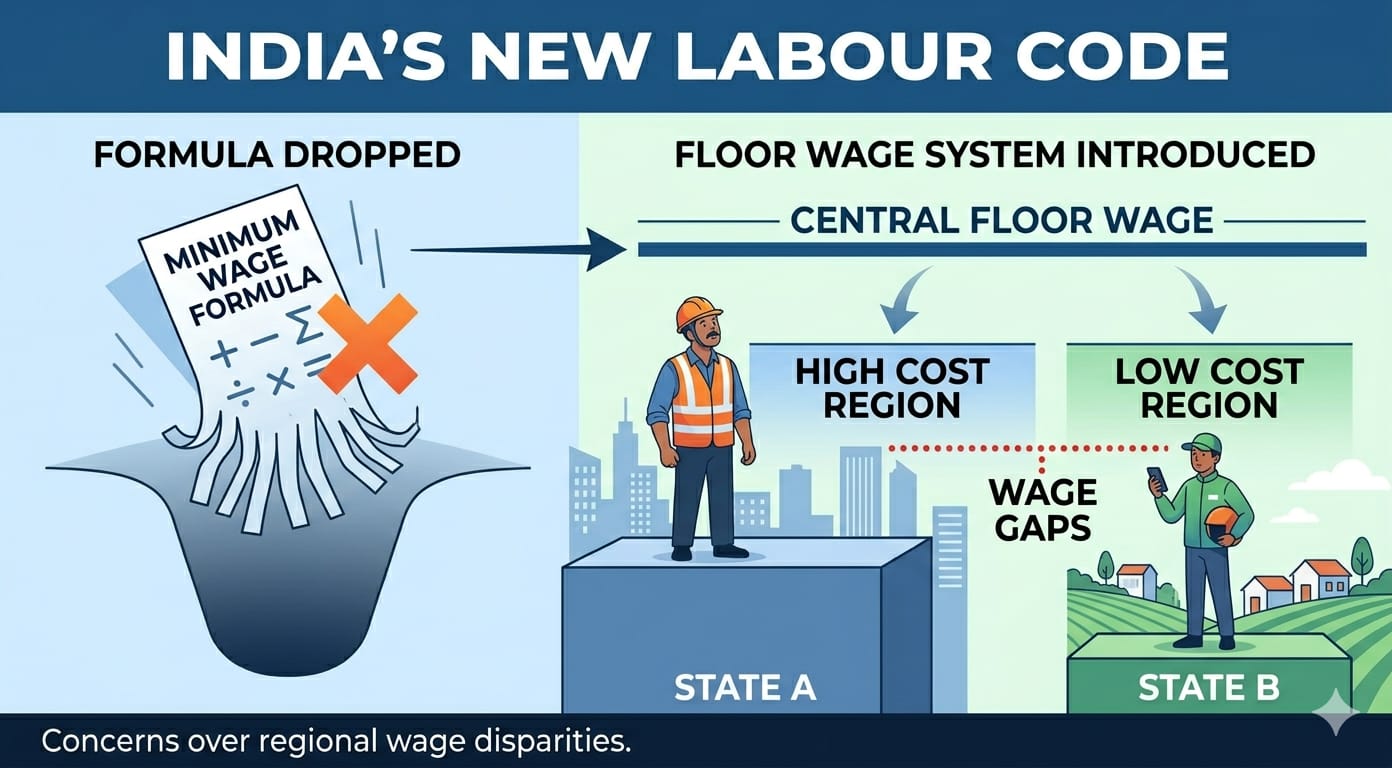
The government has dropped the detailed formula used to calculate minimum wages, stating that the criteria will now be specified separately through future orders. This shift could significantly impact how wages are determined across states and sectors.
Earlier draft rules released in January had retained a well-established formula for fixing minimum wages. This formula was based on basic living standards, including daily calorie intake, clothing needs, housing expenses, and costs related to education, healthcare, and other essentials. It drew from the 1957 Indian Labour Conference and was reinforced by the Supreme Court’s Reptakos Brett judgment in 1991.
By removing this structured benchmark, the Centre has created room for flexibility, but also uncertainty. Experts warn that without a uniform scientific basis, wage determination could become inconsistent, potentially widening wage gaps between states for similar categories of workers.
Instead, the government will now rely on a “floor wage” mechanism. This floor wage will be set by the Centre in consultation with states and will act as a baseline below which no state can fix its minimum wages. However, the rules allow for different floor wages across regions depending on living standards and economic conditions.
While this gives policymakers flexibility, it also means that actual wage levels may vary widely, especially in less developed regions where bargaining power is weaker.
Alongside wage changes, the rules bring clarity on working hours. A standard working day has been fixed at eight hours, with a maximum weekly limit of 48 hours.
This aligns India with global labour norms and is expected to benefit employees in both traditional and emerging work setups, including hybrid and remote work models. Rest intervals and workplace safety norms will be governed separately under the Occupational Safety, Health and Working Conditions Code.
The new framework also places strong emphasis on social security, particularly for unorganised and gig workers. Mandatory Aadhaar-linked registration has been introduced for all unorganised workers above the age of 16. Aggregator platforms will be required to register gig workers in real time and provide exit details when workers leave.
A National Social Security Board will oversee welfare measures for these workers, ensuring representation from various stakeholders including workers, employers, states, and vulnerable groups. This is a significant step toward formalising a large segment of India’s workforce that has historically lacked social protection.
Another major reform targets delays in wage payments, especially for contract workers employed in government-linked projects. The government has tightened compliance rules, making it mandatory for wages to be paid within defined timelines and only through bank transfers or electronic modes.
Contractors who fail to comply face strict penalties, including blacklisting and debarment from government tenders for up to three years. Importantly, the responsibility of ensuring timely payment now also lies with the principal employer, such as a ministry or public sector unit, adding another layer of accountability.
To further strengthen enforcement, the government has mandated monthly verification of wage payments and faster reimbursement cycles for contractors.
In cases of persistent delays, authorities can directly pay workers and recover the amount from defaulting contractors. This move is aimed at addressing long-standing issues of delayed or unpaid wages, which have often triggered protests in industrial areas.
Overall, the notified rules mark a major shift in India’s labour regulation landscape. While they introduce greater flexibility, digital compliance, and expanded social security coverage, the removal of a clear minimum wage formula raises concerns about fairness and uniformity.
The real impact will depend on how the Centre defines wage criteria in the future and how effectively states implement these rules on the ground.

