
As we all know, Pakistan came into existence in 1947, before that, there was no country or even civilisation called Pakistan. The area was carved out on religious ground and Muslims got a piece of land of India that they called Pakistan. 24 years later, East Pakistan rebelled against the domination of Punjabi Muslims, and with the help of India, became Bangladesh.
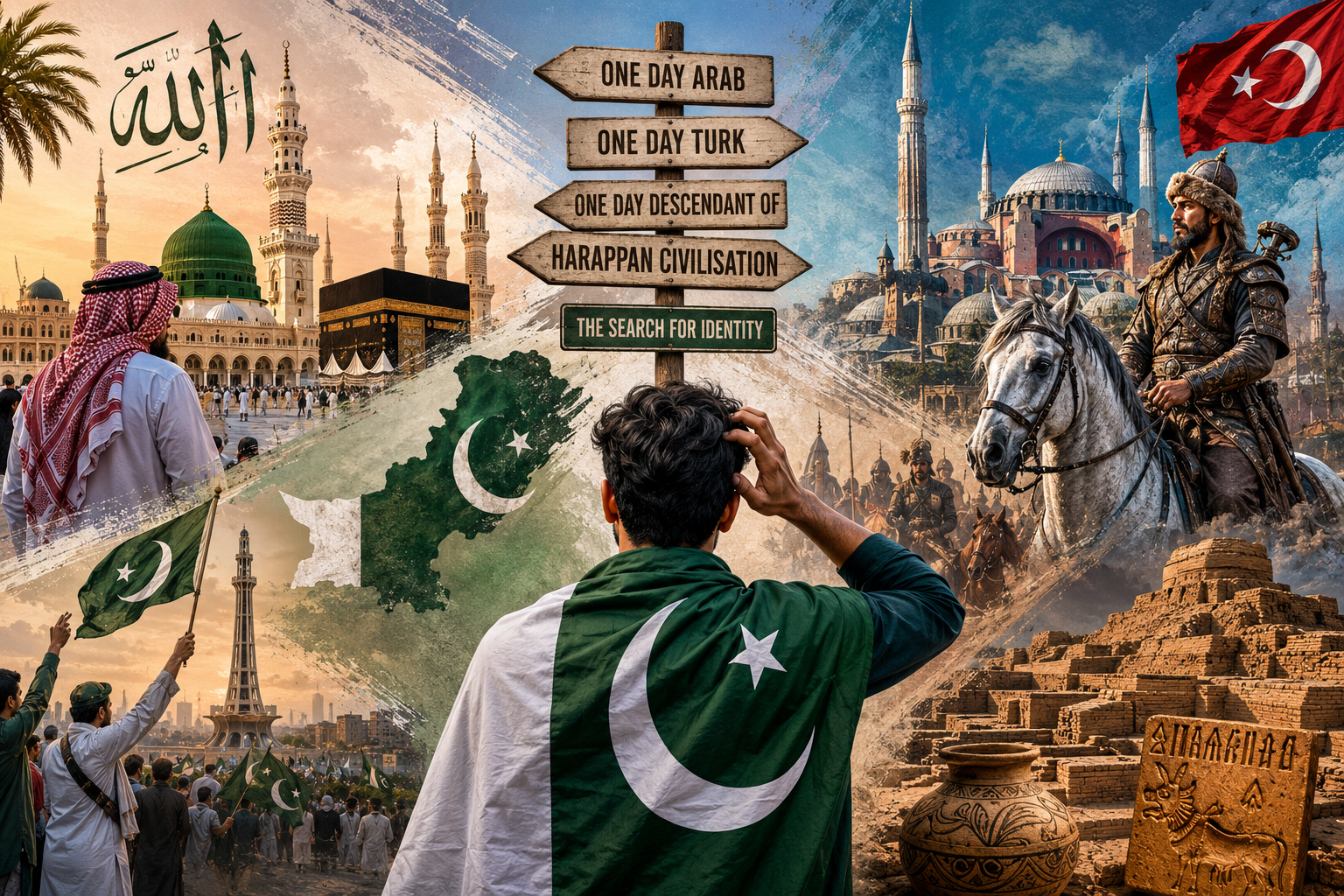
All that is documented history, but this has left Pakistanis without a real cultural identity, what are they? For the world, they are just an Islamic nation which was created on the basis of religion. As the dialogue in the hit show Homeland goes, Pakistan isn’t even a real country, it is a f***ing acronym. Since its creation in 1947, Pakistanis have been wondering what is their real identity, sometimes they pretend to be Turks, sometimes they pretend to be Arabs, and these days they are pretending they are the descendants of the Indus Valley Civilization.
National identity is rarely simple. Most modern states are built on layers of language, culture, religion, geography and history. But in Pakistan, the question of identity has remained unusually unsettled since their creation in 1947. Across different moments in its political and cultural journey, Pakistan has alternately presented itself as Arab in spirit, Turkic in inspiration, Central Asian in heritage, Islamic in civilisation, and increasingly in past few days, an inheritor of the ancient Indus Valley or Harappan civilisation. This shifting self-definition has often sparked debate about whether Pakistan suffers from an identity crisis or is simply searching for a coherent national narrative.
Pakistan emerged not as a civilisational state but as a separate country for Muslims who couldn’t live with Hindus. That has been their only identity, Hindu-hatred. Shrinking Hindu population in Pakistan, rampant abduction of Hindu girls in Pakistan, bear testament to this fact.
Unlike many countries that could point to a single linguistic or civilisational continuity, Pakistan inherited extraordinary diversity. However, they never valued that diversity.
The challenge began almost immediately after Pakistan’s creation- What would unite them? Pakistan’s authorities decided it will be Islam and ran roughshod over other religions and beliefs.
Religion became the primary answer. The idea of Pakistan was rooted in Muslim political identity in British India, and successive governments attempted to strengthen national cohesion through Islamic symbolism. Arabic phrases entered official discourse, cultural references increasingly leaned toward the wider Islamic world, and historical storytelling often highlighted connections with Muslim conquerors and empires rather than local pre-Islamic histories.
This produced an interesting contradiction. Geographically and culturally, Pakistan remained deeply South Asian, but politically there was often an effort to emphasise distinction from India through association with a broader Islamic identity.
At different points, Turkish influence became especially visible. Turkish historical dramas found huge audiences in Pakistan, Ottoman symbols gained popularity, and some political leaders projected Turkey’s rise as a model of Islamic modernity. For many Pakistanis, admiration for Turkey reflected aspirations for strength and international influence rather than actual ethnic identification.
At other times, especially during moments of closer Gulf ties, Arab cultural influence became more visible. Arabic names, dress styles and religious expressions gained prestige in certain circles. Yet Pakistan’s everyday life—from food and language to music and customs—remained unmistakably rooted in the Indian subcontinent.
More recently, however, another trend has emerged: renewed interest in Pakistan’s ancient civilisational roots. Archaeological sites such as Mohenjo-daro and Harappa have increasingly been highlighted in cultural diplomacy and national storytelling. The argument is straightforward: Pakistan’s history did not begin in 1947, nor with the arrival of Islam—it stretches back thousands of years to one of the world’s oldest urban civilisations.
This turn toward the Indus Valley civilisation represents a notable shift. Rather than defining identity solely through religion or external cultural references, it attempts to anchor Pakistan in geography and historical continuity.
But whether this is an identity crisis may itself be the wrong question.
Many countries carry multiple identities simultaneously. Modern Turkey balances Ottoman, Islamic and republican legacies. Arab states combine tribal, national and religious identities. India itself contains civilisational, linguistic and regional identities that coexist and sometimes compete.
Pakistan’s debate may therefore reflect not confusion but an unfinished nation-building process—one still negotiating the relationship between faith, ethnicity, region and history.
The real challenge is not whether Pakistan chooses to see itself as Arab, Turkic or Harappan. It is whether it can create a national identity that accommodates all these influences without denying the realities of its own geography and cultural inheritance.
Identity, after all, becomes strongest not when it is borrowed, but when it is understood.

