
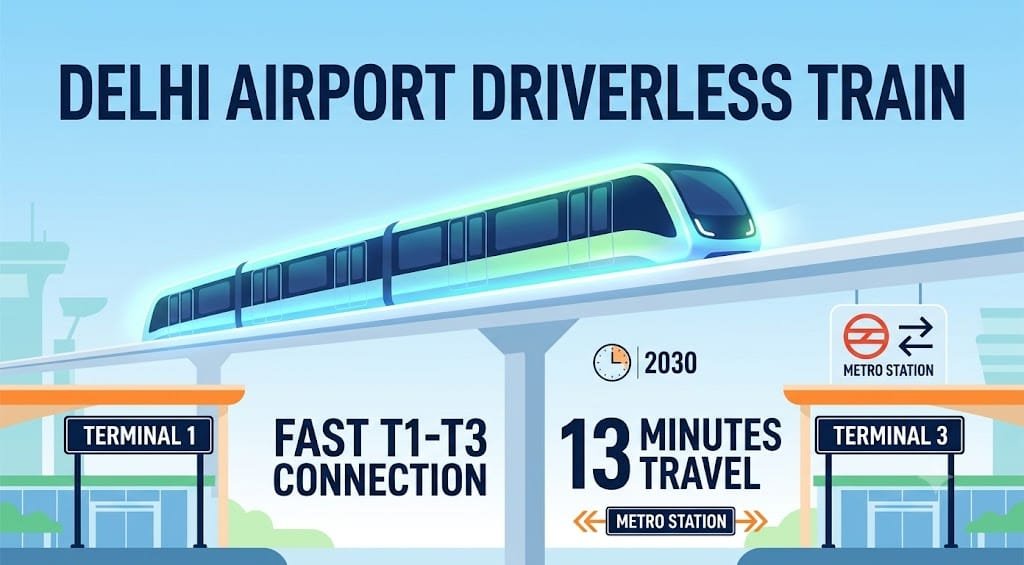
Delhi’s Indira Gandhi International Airport is planning a major improvement in passenger movement through a driverless inter-terminal train, also known as an automated people mover or APM. The proposed system is expected to be ready by 2030 and will connect Terminal 1 with Terminal 3, reducing a road journey that can currently take around 15 to 20 minutes to just 13 minutes by train. The project is part of the airport’s long-term development plan and is designed to make travel between terminals smoother for passengers, airport staff and visitors.
At present, passengers who need to change terminals at Delhi airport often depend on road transport. This can become difficult during busy hours, traffic congestion or VIP movement, even though Terminal 1 and Terminal 3 are part of the same airport. The planned driverless train is expected to remove much of this inconvenience by offering a direct, frequent and predictable connection between the two terminals. It will also help passengers who have connecting flights and need to reach another terminal without wasting time.
The proposed APM system will be 7.3 km long and will have six stations. These will include one station at Terminal 1, three stations in different parts of Aerocity, one station at the airport’s cargo area and one station at Terminal 3. The Terminal 3 station will also serve passengers using Terminal 2. In this way, the train will not only connect the main passenger terminals but will also improve access to Aerocity and the cargo zone, which are important parts of the airport ecosystem.
The project is estimated to cost around Rs 3,500 crore. Delhi International Airport Limited, or DIAL, which operates the airport, has said that the design and other details of the system are being finalised. Once completed, Delhi airport will join several leading international airports where driverless trains help passengers move quickly between terminals. The idea is to make the airport experience less stressful, especially for travellers with luggage, elderly passengers, families and those facing tight flight connections.
The train service is expected to run at a frequency of 10 minutes. This means passengers will not have to wait long for the next train. The journey between Terminal 1 and Terminal 3 is expected to take 13 minutes. DIAL estimates that the system may carry about 55,000 passengers every day in the beginning, and this number could rise to 85,000 daily riders over time as air travel and airport activity increase.
A major benefit of the planned system will be its connection with the Delhi Metro. According to DIAL, the APM stations at Terminal 1 and Terminal 3, along with one Aerocity station, will be built close to existing Delhi Metro stations. This will allow passengers and airport workers to change between the Metro and the airport train more easily. It could reduce the need for private vehicles, taxis and other road transport for many people travelling to or from the airport.
The service is likely to be free for passengers who are travelling between terminals to catch connecting flights. However, DIAL has not yet decided whether other users, such as airport staff, visitors or people travelling only within the airport area, will need to pay a fare. This decision will be important because the train is expected to serve not only airline passengers but also thousands of people who work in Aerocity, the cargo area and other airport-related locations.
The track is planned to be elevated for 5.3 km, while the remaining 2 km will be at ground level. An elevated track can help the train avoid road traffic and maintain a steady travel time. At the same time, the ground-level section may make construction and integration with existing airport infrastructure more manageable. The combination is expected to support smooth and reliable movement across a busy airport campus.
The driverless train is part of IGI Airport’s proposed Master Plan up to 2036. Under this plan, the airport expects to handle 125 million passengers every year, with the possibility of increasing this capacity to 129 million. At present, the airport’s passenger-handling capacity is 106 million per year. The master plan has been submitted to the government for consultation with different stakeholders. Under the airport’s Operation, Management and Development Agreement, the master plan is required to be updated every 10 years.
Terminal 1 is also expected to see an increase in capacity from 42 million to 45 million passengers annually. Terminal 2 is expected to remain at 14 million passengers per year. Both terminals will continue to handle domestic flights. Terminal 3, the largest terminal at the airport, will see a bigger expansion. Its domestic passenger capacity is planned to rise from 19 million to 27 million per year, while international capacity is expected to increase from 31 million to 39 million annually.
To support this growth, a new pier is planned at Terminal 3. This will take the total number of piers at the terminal to five. The new pier and related works are estimated to cost about Rs 2,500 crore. The master plan also includes more check-in counters, security screening machines and parking stands. The number of parking stands across the three terminals is expected to increase from 230 to about 260. Road-widening projects and additional parking space are also planned to manage the growing number of passengers and vehicles.
Overall, the proposed driverless train can become one of the most useful upgrades for Delhi airport. It will make terminal-to-terminal travel quicker, reduce dependence on road transport and improve connections with the Delhi Metro. If completed on time by 2030, it will help the airport handle more passengers while offering a simpler and more comfortable travel experience.

