
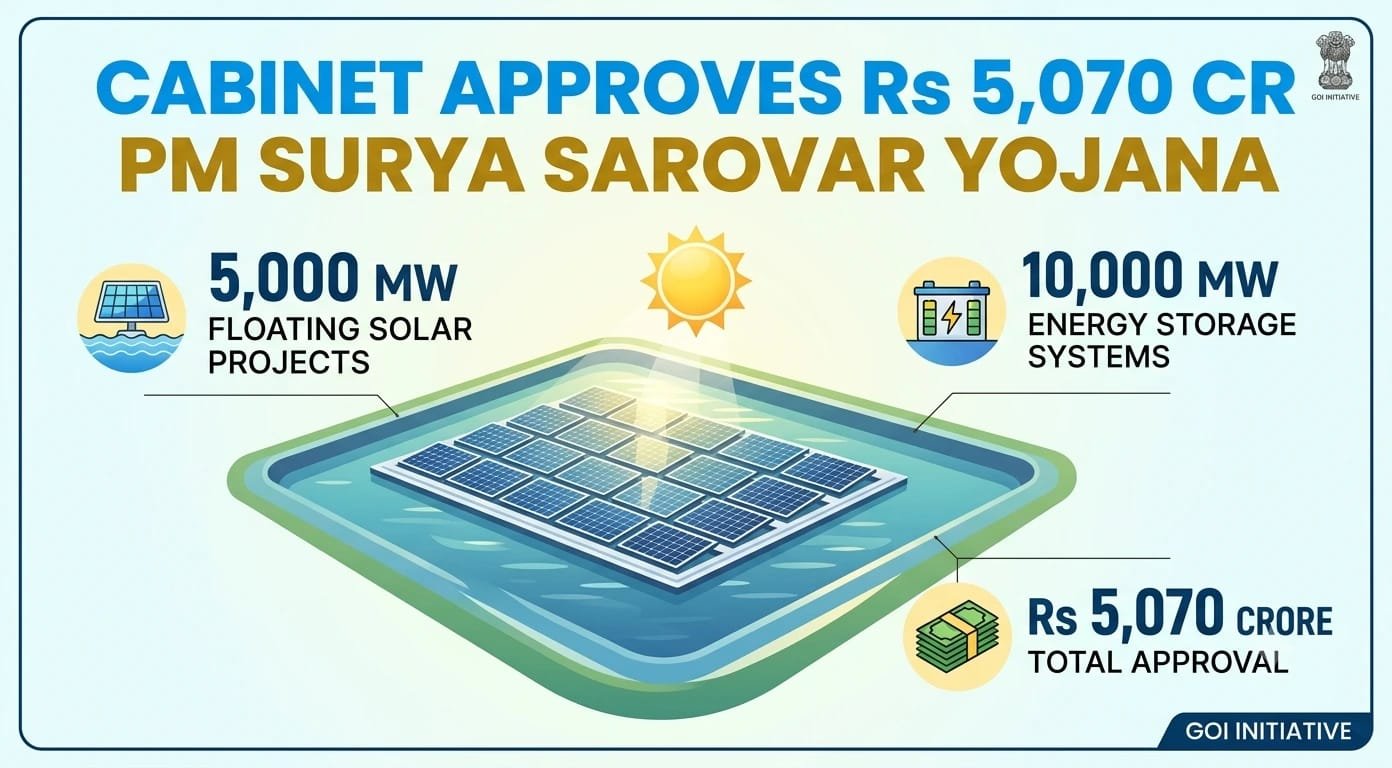
The Union Cabinet has approved the Rs 5,070 crore PM Surya Sarovar Yojana, a large-scale national program designed to develop 5,000 MW of floating solar photovoltaic projects with associated energy storage systems.
The scheme was cleared under the leadership of Prime Minister Narendra Modi and is meant to strengthen India’s renewable energy capacity in a practical and modern way by using water bodies for solar generation.
The approval shows that the government is pushing for cleaner energy sources while also trying to solve land-use challenges that often slow down solar expansion.
In simple terms, floating solar means solar panels are installed on water surfaces instead of on open land, which helps save space and can improve efficiency in certain conditions.
This scheme is not just about producing electricity; it is also about building a more balanced energy system. The program includes a minimum energy storage capacity of 10,000 MW, which means the electricity generated can be stored and used when demand is high or when sunlight is unavailable.
It also mentions that the project will be implemented over four years, from FY 2026-27 to FY 2029-30, with the first phase running from FY 2023-24 to FY 2032-33 in a staged approval and disbursement structure. That kind of time frame shows that the plan is meant to be long-term, carefully monitored, and linked to measurable progress rather than being a short announcement.
The scheme is expected to support the development of floating solar power projects across the country, with a focus on reservoirs and other suitable water bodies.
It says the National Institute of Solar Energy will act as the technical support institution, helping with assessments, feasibility studies, and other preparatory work needed before construction begins.
The Central Financial Assistance part of the program is designed to make the projects more viable for developers, especially because floating solar installations require special planning, equipment, and site-specific engineering.
This is important because solar power projects on water need stronger anchors, careful layout planning, and environmental checks compared with standard ground-mounted projects.
The larger benefits of the scheme for the economy and environment. It states that the initiative is expected to reduce around 10 million tonnes of carbon dioxide emissions annually, which is a significant number for a single clean energy program. In addition, it is projected to generate about 16,000 to 17,000 full-time equivalent employment opportunities across the value chain.
These jobs may arise in project development, manufacturing, installation, operations, maintenance, and related service sectors, which means the scheme has both an energy benefit and a livelihood benefit. The plan can help save land, improve energy generation, and make use of existing reservoirs in a smarter way .
Another important point is the emphasis on self-reliance and domestic manufacturing. The scheme aims to support Indian companies involved in flotation systems, photovoltaic cells, modules, inverters, and energy storage components. This matters because a strong renewable energy sector is not only about installing panels; it also depends on building local industrial capability so that more parts, systems, and services can be produced within the country.
By doing this, the government is trying to create a wider ecosystem around solar power rather than treating it as a one-time infrastructure project. The initiative will help integrate energy storage and improve grid reliability, which is essential when a country adds more solar electricity to its power mix.
The scheme also fits into India’s broader energy and climate goals. The project is expected to improve the use of existing resources while advancing the vision of Viksit Bharat, which refers to a developed India.
The program is designed to support environmental goals, industrial growth, and power generation at the same time. This combination is important because clean energy policies work best when they solve more than one problem, such as electricity access, emissions, employment, and efficient land use.
The main idea is simple: the government has approved a Rs 5,070 crore plan to build 5,000 MW of floating solar capacity with storage support, and that can help India produce cleaner power while creating jobs and reducing carbon output.

