
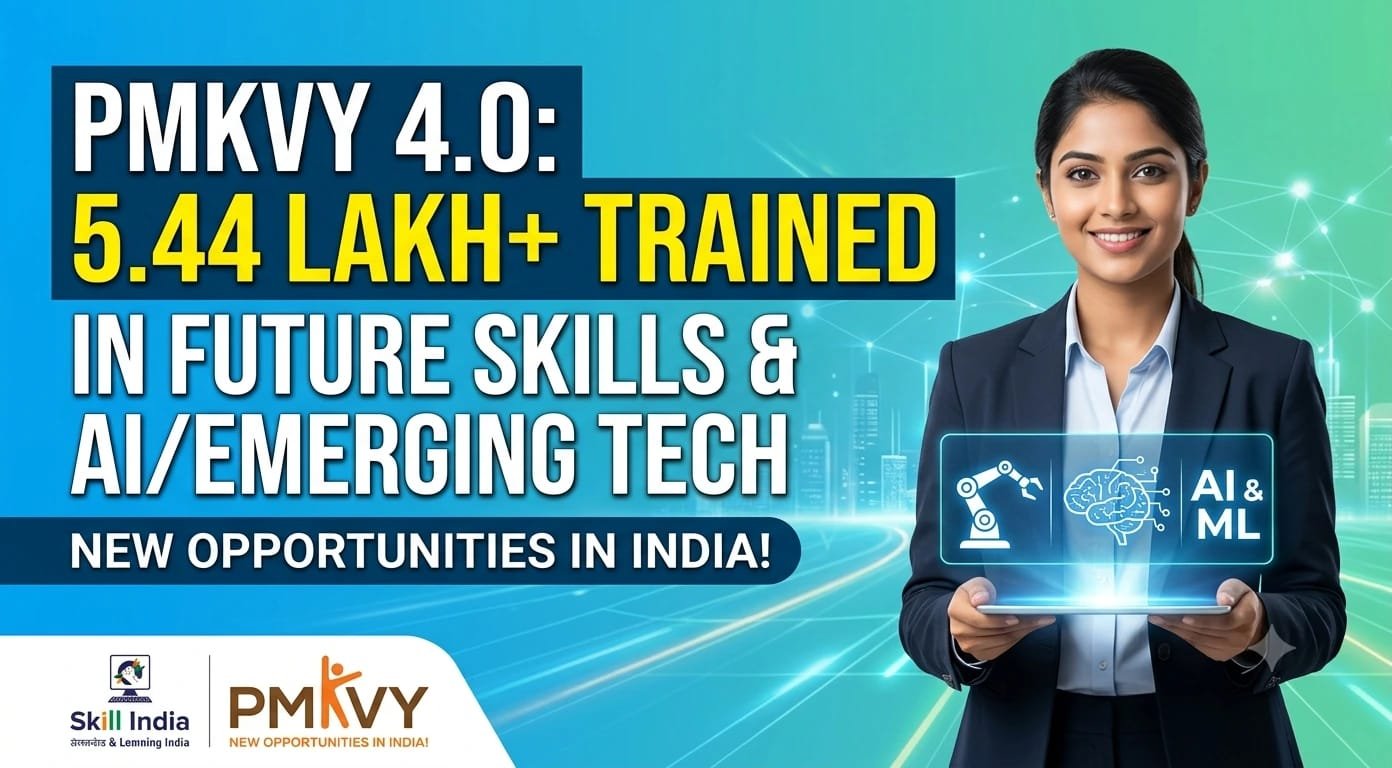
The government’s recent figures show that PMKVY 4.0 has trained 5,44,383 candidates in Artificial Intelligence and other emerging technologies from 2023 through June 30, 2026, a scale that signals both ambition and urgency in building India’s future-ready workforce.
This large absolute number over five lakh people reflects training delivered across multiple states and union territories and includes shorter, industry-aligned courses introduced under the PMKVY 4.0 design, which focuses on future skills such as AI/ML, data analytics, IoT, robotics and other Industry 4.0 roles.
The programme’s stated intent is to create industry-relevant, employable talent by offering standardised courses developed using National Occupational Standards and qualification packs, and by leveraging public–private partnerships and Sector Skill Councils to align content with employer needs.
Complementary initiatives and investments aimed at strengthening the pipeline include centrally promoted efforts like PM-SETU (Pradhan Mantri Skilling and Employability Transformation through Upgraded ITIs), which the government has described alongside PMKVY as a mechanism to upgrade institutional capacity and create better linkages with industry for placements and practical exposure.
On the positive side, PMKVY 4.0 introduces new job roles (including AI/ML-related roles and green-skills roles like solar installers and EV technicians). Customised short-duration courses. 77 new customised courses and over 100 future-skill roles have been referenced in government materials, thereby widening the menu of career paths for young learners and linking training to emerging employer demand.
Several partners from industry have been roped in for capacity building: For example, earlier collaborations, such as between IndiaAI and private tech firms aimed to create AI productivity labs, train educators and certify foundational courses for students in ITIs and NSTIs, framing a multi-stakeholder approach to scaling AI skills.
Financially, PMKVY 4.0 and related schemes report dedicated outlays for trainer pools, digital skilling and institutional upgrades. Figures published for earlier and adjacent programme components cite crores of rupees allocated for capacity building and delivery, which illustrates that the initiative combines programmatic scale with targeted spending to operationalise courses.
India’s AI skilling drive has clearly expanded at a large scale, with 5,44,383 trainees reported under PMKVY 4.0. However, the real test lies in transparent outcome data on jobs, income gains, certification performance, and geographic reach, since these indicators reveal whether the programme is delivering genuine employability.
One clear next step for stakeholders is to demand and publish time-bound outcome metrics from implementing agencies and to map training delivery against local industry demand by district and sector so that future rounds of PMKVY and allied schemes can be optimised for both scale and tangible employment impact.

