
India’s export story is changing. Goods linked to advanced technology now account for a larger share of manufactured exports than they did two decades ago. An analysis by Tirumala Kaggundi, published in Indian Westerlies, puts this share at 20.2% in the financial year 2025–26, compared with around 6% in 2006–07.
Their export value rose from roughly $5 billion to $62.8 billion. These figures cover exported goods, not everything produced in India or services sold overseas.
The change becomes clearer through everyday products. Phones, medicines, computers and medical equipment form part of this category. The analysis uses an OECD product classification followed by the World Bank, based on industries’ research intensity.
However, the classification is old. Cars and most generic medicines remain outside it, while certain chemicals qualify. The figures therefore reflect a specific statistical definition, rather than a complete measure of modern manufacturing.
Growth accelerated after 2017–18. High-tech goods represented 10.5% of manufactured exports in FY22, rising to 20.2% in FY26. Electronics and telecom equipment contributed $34.6 billion in FY26, making them the largest group.
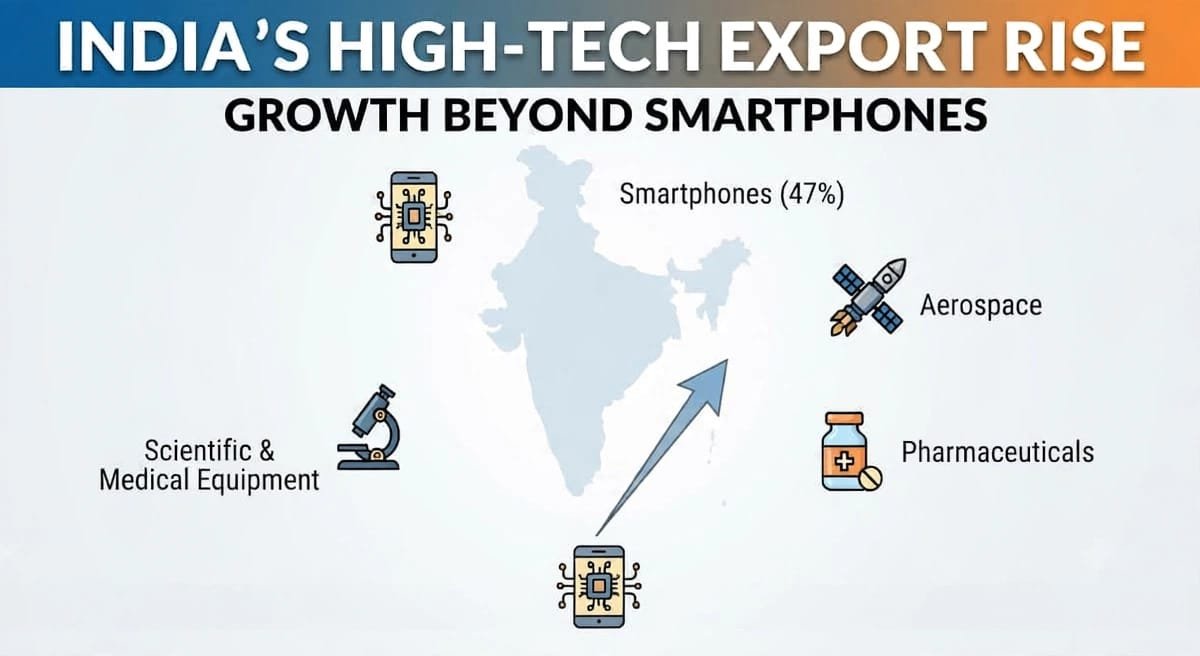
Smartphones and other mobile phones alone brought in $29.4 billion, or 47% of high-tech exports. Their share was just 16% in FY22, showing how strongly phone manufacturing has changed the export mix.
Still, the progress extends beyond phones. Excluding phones and their parts, high-tech exports increased from $16.3 billion in FY18 to $30.8 billion in FY26. That represents annual growth of around 8%, against less than 4% for the remaining manufactured exports.
Over this period, high-tech pharmaceutical exports rose from $3.6 billion to $6.5 billion. Scientific and medical instruments increased from $1.7 billion to $3.6 billion, while aerospace exports more than doubled to $5.7 billion.
Other categories also expanded. Electronics excluding phones, including telecom network equipment and solar modules, approached $5.2 billion. Computer exports reached $1.8 billion. Specialty chemicals were an exception: exports fell to $6.8 billion after peaking at $9.2 billion in FY22.
This uneven performance matters because lasting progress depends on several industries growing, rather than one successful product carrying the total.
The export base remains geographically narrow. Tamil Nadu recorded $19.2 billion in high-tech exports and Karnataka $10.6 billion, together accounting for almost half the national total. Maharashtra, Gujarat, Delhi and Uttar Pradesh supplied much of the remainder. Individual manufacturing centres dominate too: Kanchipuram contributed $16.3 billion, while Gautam Buddha Nagar, which includes Noida, generated about $5 billion of Uttar Pradesh’s $5.3 billion total.
There is another important distinction. A product can qualify as high-tech even when India mainly assembles imported components. Its full export value does not reveal how much technology, research or production originated domestically. Stronger local component manufacturing would therefore make the export gains more meaningful.
The broader trend is encouraging, but comparisons need care. India’s FY26 share approaches the OECD’s 22.3% average for calendar 2024, although the periods differ. Manufactured goods also reached 70.5% of India’s merchandise exports in FY26, suggesting high-tech growth was not simply caused by other manufacturing shrinking. The next test is whether more industries, domestic suppliers and regions can participate in this expanding trade.

